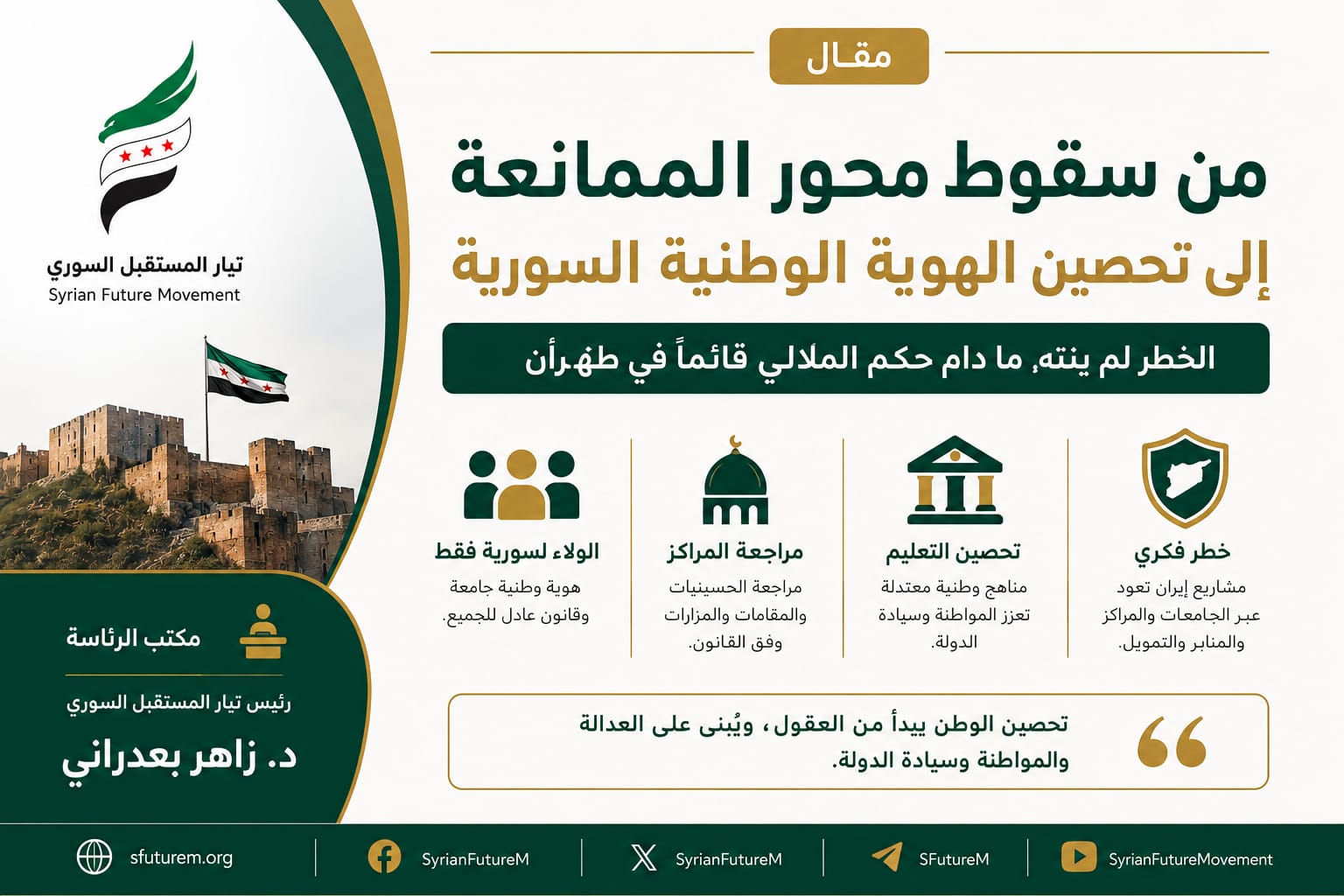
The collapse of Iranian influence in Syria, and the subsequent clear decline of what had been known for decades as the “axis of resistance,” was not merely a military or political shift. Rather, it was a historic moment that exposed the true nature of a project that raised the banners of liberating Jerusalem and confronting Israel, while in practice it was preoccupied with building networks of influence, establishing militias, interfering in the affairs of Arab states, and reshaping the maps of allegiance to serve the interests of the Iranian regime.
With the spectacle of the burial of Iranian Supreme Leader Ali Khamenei, and all its political and symbolic implications, some might think that the Iranian project has ended. However, the reality is far more complex. Ideological projects are not buried with the death of their leaders, nor do they end with the fall of some of their military instruments, as long as the mullahs’ regime remains in power in Tehran, and as long as the intellectual and organizational structure that created this project remains intact and capable of reproducing itself in new forms.
The Syrian experience has proven beyond any doubt that the Iranian project was not a resistance project, but rather a project of political, military, and ideological influence. It used religion as a tool to expand control and transformed sectarian affiliation into a means of building loyalties that transcend national borders. The Syrian people paid the price for this with their blood, the destruction of their cities, the tearing apart of their social fabric, and the weakening of their state institutions.
Today, after this project has been defeated in its most crucial arenas, the most dangerous mistake Syria could make is believing that the threat has passed. Influence is not always regained through tanks and militias; it can also be regained through universities, religious institutions, cultural centers, associations, scholarships, foreign funding, and the creation of elites whose intellectual and political allegiances are tied to projects that extend beyond national borders.
Therefore, Syria’s next battle is not a military one, but rather a battle to build a modern nation-state, solidify a unified Syrian identity, and cultivate citizens whose loyalty is to Syria alone, not to any transnational project or any project linked to any foreign capital, whatever it may be.
Therefore, safeguarding Islamic universities, religious institutes, faculties of Sharia, and centers for religious studies must become an integral part of the Syrian national security project, given the profound influence these institutions have on shaping the consciousness of future generations. This cannot be achieved through exclusion or incitement, but rather through curriculum reform, promoting moderate thought, instilling the values of citizenship, and linking religious education to the fundamental principles of the Syrian state, its sovereignty, and its national unity.
Furthermore, building the new state necessitates launching a comprehensive national review of all Husseiniyas, cultural and religious centers, shrines, and mausoleums that were established or reactivated during the years of Iranian influence. This review should be conducted by independent scientific, legal, historical, and religious committees tasked with examining the legal foundations of their establishment, the historical contexts upon which they were based, the validity of the religious narratives related to them, their sources of funding, the roles they played during the years of war, and their compatibility with Syrian state sovereignty and national interests.
This applies to sites that have been linked to the Iranian project in recent years, including some shrines and religious centers that have been exploited for political, security, or propaganda purposes, such as the shrine of Sayyida Sakina and the shrine of Uways al-Qarni, among others. These sites require a reassessment of their legal, historical, and religious status, conducted objectively and in accordance with the standards of the state and the law.
Those sites whose legal legitimacy is established, whose historical origins are sound, and whose religious foundations are intact, and which have not been used as tools for foreign interference or the spread of sectarian division, remain protected and respected. However, those sites proven to have been established or used as instruments of a political or sectarian project linked to foreign powers, or as tools for sectarian mobilization and the undermining of national sovereignty, must be addressed according to the provisions of the law, in a manner that preserves the unity of Syrian society and the prestige of the state.
States do not demolish places of worship, but neither do they allow them to be transformed into centers of political, security, or intelligence influence, nor into instruments for altering national identity or creating transnational loyalties.
The Syrian experience has proven that the greatest threat to nations is not sectarian differences, but rather the transformation of sectarianism into a political project managed by a foreign state.
Therefore, fortifying Syria is not about targeting Shiites as a religious component of society, but rather about targeting political Shiism. Simultaneously, it is about opposing any Sunni, nationalist, or ideological project that prioritizes loyalty to entities other than Syria or that places foreign interests above national interests.
From this perspective, the Syrian Future Movement believes that the next phase necessitates working on a number of national priorities, most notably:
- Establishing a unified Syrian national identity as the supreme reference point for all citizens.
- Revising educational and religious curricula to reinforce the values of citizenship, the state, and the rule of law.
- Subjecting religious and cultural institutions, universities, and institutes to standards of transparency and legal oversight.
- Regulating foreign funding for religious and cultural institutions and preventing any support aimed at building foreign political loyalties.
- Reviewing the legal, historical, and religious status of shrines, mausoleums, and Husseiniyas that were established or expanded during the years of Iranian influence.
- Protecting Syrian universities from any sectarian or ideological polarization that serves regional agendas.
- Strengthening scientific research and national studies that document the experience of foreign interventions and their impact on the Syrian state.
The collapse of the resistance axis presents a historic opportunity to learn lessons, close the gaps that allowed the Syrian state to be infiltrated for decades, and build a national system capable of protecting the independence of Syrian decision-making and preventing a recurrence of this experience under any guise or slogan.
Today, after Khamenei’s demise and the continued rule of the mullahs in Tehran, the most important message is not that the Iranian project has ended, but rather that the responsibility of the Syrian people has begun.
The future is not built on slogans, nor are homelands protected by knee-jerk reactions, but rather by building a state of law and institutions, consolidating national identity, and cultivating an awareness that prioritizes loyalty to Syria alone and closes the door to any foreign project, regardless of its nature. Its name, its slogan, or its religious or political affiliation.
The coming battle is not about overthrowing a regime, but about protecting a homeland; and protecting homelands begins with fortifying minds before fortifying borders, with building people before building structures, and with establishing the sovereignty of the state before any other consideration.