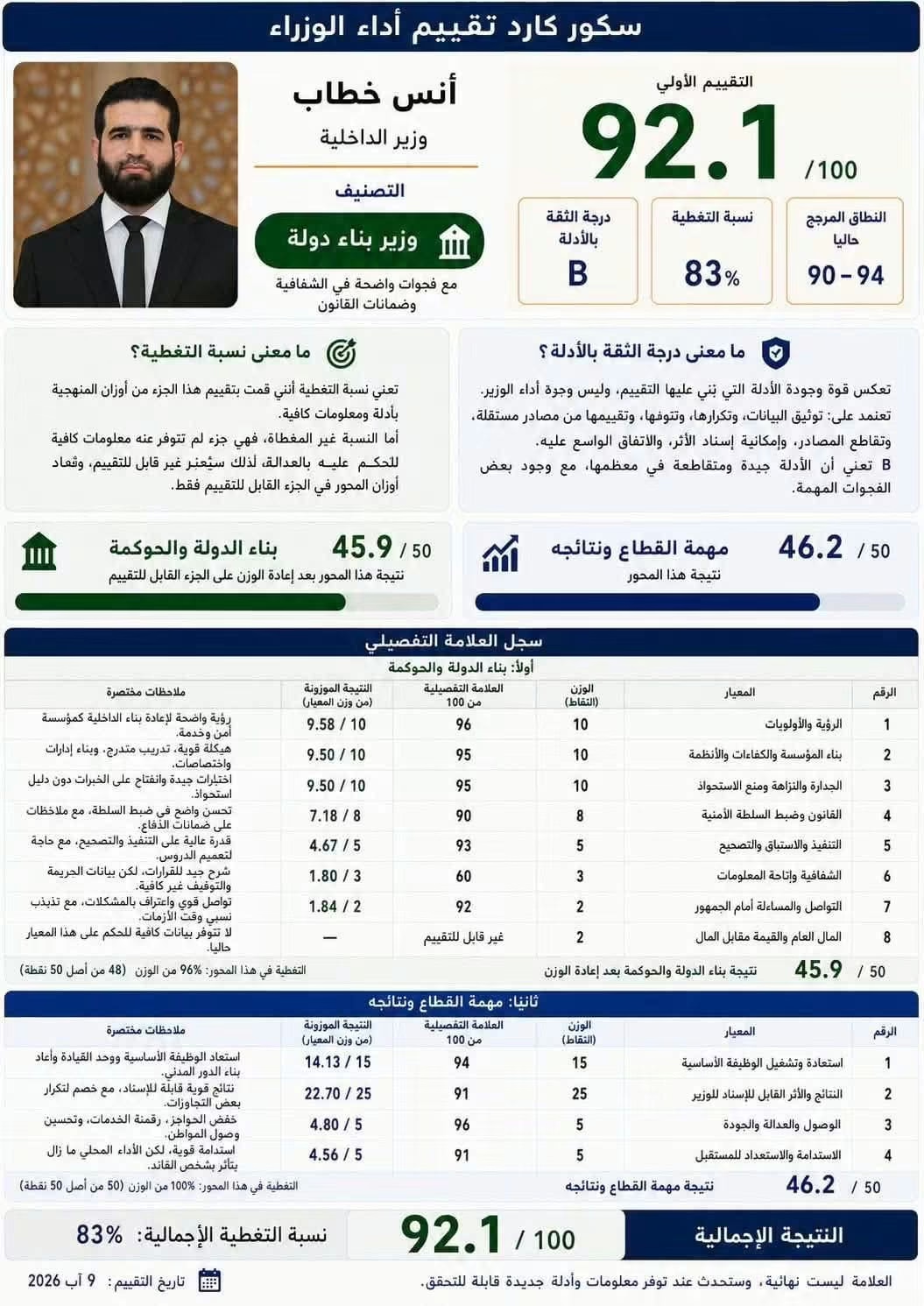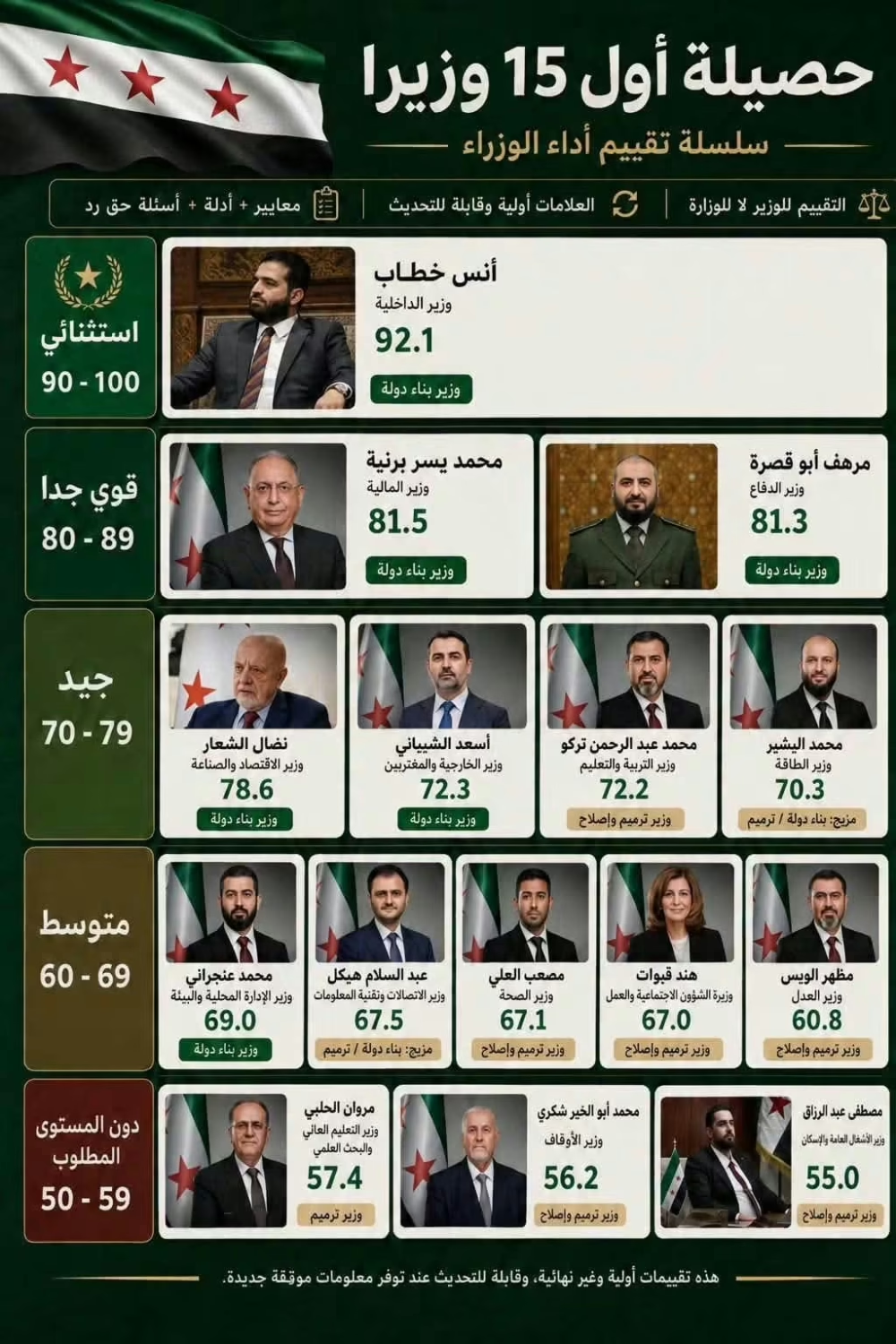
The Syrian Future Movement has been following with interest the initiative launched by Mr. Feras A. Atassi to evaluate the performance of ministers in the Syrian government. This initiative involves publishing detailed assessments based on a set of criteria, weights, coverage ratios, and levels of confidence in the evidence. Mr. Atassi has emphasized that the evaluation pertains to the individual minister’s performance, not the ministry itself, and that the results are preliminary and subject to update as new information and evidence emerge. The continued publication of the evaluation series and some details of its methodology have been confirmed through the initiative’s public page.
While we in the Syrian Future Movement declare our support for this pioneering idea and its initiator, our support does not necessarily stem from agreement with every score, ranking, or conclusion reached by the project. Rather, it stems from our belief in the importance of the idea itself: that the performance of public officials should become a legitimate subject of measurement, critique, and evaluation, and that the relationship between citizens and the authorities should shift from a culture of applause or hostility to one of inquiry, information, results, and accountability.
Syria, emerging from decades in which officials were shielded from criticism, now needs to enshrine the exact opposite principle: public office is not a personal privilege, responsibility is not immunity, and the performance of those entrusted with managing the affairs of Syrians is a public right subject to criticism, evaluation, and review.
The Syrian Future Movement believes that the importance of the initiative by our friend Firas Al-Atassi also lies in its being an independent, grassroots attempt to develop tools for measuring government performance, and in presenting a model that can be built upon and developed institutionally and methodologically, far removed from personalization, defamation, and preconceived political impressions.
In this context, the Syrian Future Movement emphasizes a number of principles and recommendations:
- We call for supporting this initiative and encouraging its continuation and development. We believe that Syrian society needs similar independent projects that monitor the performance of institutions and officials and measure results based on verifiable information.
- We call on civil society organizations, research centers, universities, and Syrian researchers and experts to engage scientifically with the project, discuss its methodology, and develop its indicators and criteria, which will contribute in the future to building a professional Syrian system for measuring government performance.
- We emphasize the necessity of maintaining the complete independence of the project and its author, and ensuring that support from political or civil forces does not transform into control over it, attempts to manipulate its outcomes, or its exploitation in political disputes. The fundamental value of any oversight project lies in its independence.
- We call upon the government and relevant ministers to engage positively with the initiative, not as a final judgment upon them, but as an opportunity to review performance and identify areas of success and shortcomings. We believe that the right to respond, clarify, and provide data should be an integral part of any sound evaluation process.
- We propose the gradual development of the project into an independent national indicator of government performance, with a transparent methodology, measurable criteria, documented sources, and periodic mechanisms for updating, correcting, and addressing objections.
- We recommend a clear separation between evaluating individuals and evaluating institutions, between political opinion and measuring executive performance, and between individual responsibility and the objective circumstances under which each ministry operates. This will enhance the fairness and credibility of the results.
- We encourage expanding this experiment in the future to include, using different methodologies suited to the nature of each institution, the performance of governors, public institutions, agencies, directorates, and local services, so that a national culture gradually develops that considers evaluation and accountability an integral part of public administration.
At the same time, the Syrian Future Movement emphasizes a point we consider fundamental: our support for the project does not mean adopting its results in detail, and our future disagreement with a result or criterion does not diminish our support for the right of its creator to independence, evaluation, and publication.
Independent projects are not supported because they say what we want to hear, but rather because they open the door for Syrians to know, question, discuss, and hold accountable.
We want the new Syria to move from the question, “Who is with the official and who is against him?” to a more mature and state-oriented question: “What has the official accomplished? At what cost? With what efficiency? And what impact has his work had on the lives of Syrians?”
Therefore, the Syrian Future Movement declares its readiness to support this initiative morally, scientifically, and through the media, as requested by its initiator and without compromising its independence in any way. It calls for protecting the initiative from attempts at discrediting it, personalizing it, or polarizing it, while simultaneously subjecting its methodology to rigorous scientific critique and continuous development.
We believe that the best thing the state can offer this type of initiative is not to co-opt it, but rather to provide public data and information that will make the evaluation more accurate, fair, and transparent.
The Syria we aspire to is not a state where ministers fear evaluation, nor citizens fear evaluating ministers; rather, it is a state where transparency is a right, accountability is the rule, information belongs to society, and responsible criticism is a partner in building institutions.
The experience of Mr. Firas al-Atassi, regardless of whether Syrians agree or disagree with the details of its outcomes, deserves to be studied as the seed of a new political and civic culture; a culture that monitors power without destroying the state, supports success without creating idols, and criticizes shortcomings without resorting to personal animosity.