Executive Summary:
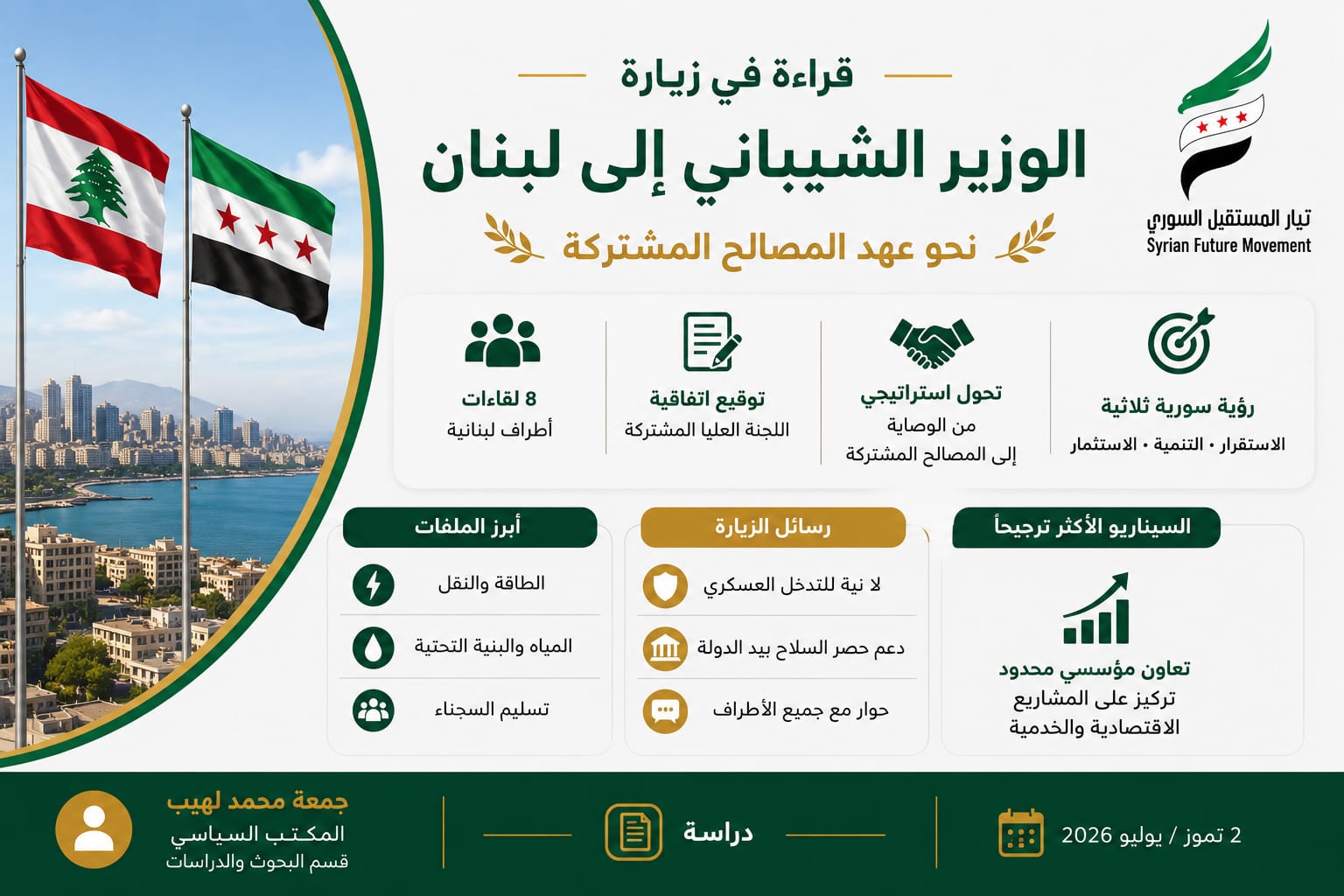
Syrian Foreign Minister Asaad al-Shaibani concluded a diplomatic visit to Beirut on July 2, 2026, marking a turning point in bilateral relations. The visit was characterized by eight high-level meetings with various Lebanese political figures and culminated in the signing of an agreement to establish the “Joint Higher Committee for Cooperation and Partnership,” which replaced the “Lebanese-Syrian Higher Council.” This paper analyzes the visit within the framework of a strategic shift from an era of “tutelage” to an era of “shared interests,” based on President Ahmad al-Sharaa’s three-pronged vision: stability, development, and investment. It concludes that the success of this path hinges on the ability of both sides to translate understandings into concrete projects, while taking into account the complexities of the regional landscape, particularly the Iranian position, the Turkish role, and American pressure. The paper offers practical recommendations for both governments and civil society and outlines three possible scenarios for the future development of the relationship.
First, the Theoretical Framework – Reading the Transformation in Light of International Relations Concepts:
The transformation in Syrian-Lebanese relations can be understood through two interconnected theoretical frameworks:
The theory of interdependence, as formulated by Robert Keohane and Joseph Nye, which suggests that relations between states in the modern era are no longer based solely on military power, but rather on complex networks of economic and social interests. In this context, Syria’s shift from the language of “security influence” to that of “shared interests” represents an acknowledgment that Lebanon’s stability is no longer viewed as a security threat, but rather as an opportunity to enhance mutual economic and trade interests. This was evident in President al-Sharaa’s statement during his visit to Chatham House in London, where he declared: “We paid the price for Hezbollah’s intervention in Syria, and we were keen to prevent the conflict from spilling over into Lebanon.” In the same session, in response to a question concerning borders and weapons, he affirmed: “It is the duty of the Syrian state to protect its borders,” emphasizing the enforcement of the rule of law and the state’s monopoly on the use of force.
The concept of soft power, as developed by Joseph Nye, refers to a state’s ability to achieve its objectives through attraction and persuasion rather than coercion. Here, Shibani’s visit, with its focus on dialogue with all parties and its emphasis on economic and developmental cooperation, represents a shift in Syrian diplomatic tools from hard power (military and security) to soft power (diplomacy, economics, and culture). President Aoun affirmed that the visit “removes the concerns of some Lebanese through constitutional institutions” and confirms the falsity of rumors regarding a Syrian intention to interfere in Lebanese affairs.
These two frameworks explain why Syria chose this particular timing and approach: given its urgent need for reconstruction and attracting investment, shared economic interests with Lebanon have become more pressing than any narrow security or political considerations.
Secondly, an analysis of the features of this phase – from the era of tutelage to the era of shared interests:
Breaking the patterns of historical relations:
What distinguishes Shibani’s visit is its clear break with the legacy of intervention and tutelage that characterized the relationship between the two countries for decades. Instead of the traditional security-focused rhetoric, the visit adopted the language of institutional diplomacy, manifested in public meetings with President Joseph Aoun, Speaker of Parliament Nabih Berri, Prime Minister Nawaf Salam, Grand Mufti Abdul Latif Derian, Cardinal Mar Bechara Boutros al-Rahi, and leaders of major Christian parties such as Walid Jumblatt, Sami Gemayel, and Samir Geagea. The Lebanese president affirmed that the Syrian delegation emphasized the importance of conducting bilateral cooperation through constitutional institutions, “that is, between two states,” and not through any internal party or faction.
The Joint Higher Committee: A New Institutional Framework
The most significant achievement of the visit was the signing of the agreement to establish the “Joint Higher Committee for Cooperation and Partnership,” which replaced the “Lebanese-Syrian Higher Council” established in 1991 under the “Treaty of Brotherhood, Cooperation, and Coordination.” Lebanese Prime Minister Nawaf Salam explained that the committee would serve as “a coordinating platform comprising the relevant ministries, with the aim of developing economic, investment, and trade partnerships, and strengthening security understandings between the two sides.” Areas of cooperation include: political and diplomatic affairs; economic, financial, and trade affairs; transportation, energy, water, and infrastructure; education, culture, and scientific research; health and social affairs; and communications and digital transformation.
Political Messages:
The visit carried three main political messages:
First: Syria’s reaffirmation that it has no intention of intervening militarily in Lebanon, in response to statements by US President Trump hinting at the possibility of Syria “dealing with Hezbollah.” President al-Sharaa quickly denied any intention of military intervention, reframing Trump’s statements within the context of “Syria’s role in seeking a peaceful and secure solution for Lebanon.”
Second: A Syrian political initiative to support the Lebanese state’s efforts to monopolize weapons through a consensual political process, reflecting a shift in the Syrian approach from dealing with sectarian groups to dealing with state institutions.
Third: Syria’s openness to meeting with Hezbollah if deemed necessary, reflecting a political pragmatism that prioritizes national interests over ideological considerations.
Third, the Iranian Position – The Absent Yet Present Player:
No development in Lebanon can be analyzed without considering the Iranian position. Iran is Hezbollah’s primary backer, and any shift in the relationship between Syria and Lebanon will have repercussions for Iranian influence. An analysis by the Carnegie Middle East Center indicated that any American attempt to “engage Sunni Syria against Shiite Hezbollah (and consequently Iran) will almost certainly exacerbate sectarianism among both Lebanese and Syrians, and ultimately transform a geopolitical conflict into a sectarian one.”
Here, the likely Iranian position falls within three scenarios:
The first scenario: Conditional acceptance. Iran might see
Tehran sees Syria’s rapprochement with Lebanon as an opportunity to alleviate its own regional isolation, especially if it is accompanied by understandings that preserve Hezbollah’s role in the Lebanese equation. A report by the European Council on Foreign Relations indicates that Iran has linked the strength and development of its fragile memorandum of understanding with the United States to an Israeli withdrawal from Lebanon, suggesting that Tehran may be open to broader understandings.
The second scenario: apprehension and monitoring. Iran may view any Syrian-Lebanese rapprochement as a threat to its influence, particularly if it coincides with a Syrian-Saudi or Syrian-American rapprochement. A Carnegie analysis warned that any Syrian role in Lebanon “will transform the geopolitical conflict between the United States and Iran on one side, and Israel on the other, into a sectarian conflict.”
The third scenario: indirect confrontation. Iran may seek to obstruct any progress in Syrian-Lebanese relations through its allies in Lebanon if it feels its strategic interests are threatened. The problem isn’t just Hezbollah’s weapons, but also Tehran’s insistence on including Lebanon in the negotiations and its linking of the memorandum of understanding with Washington to a halt in Israeli attacks on Lebanon.
As for the Turkish role and its additional regional dimension, its contribution to the equation cannot be overlooked. Turkish President Recep Tayyip Erdoğan affirmed on June 10, 2026, that “Turkey’s security doesn’t begin in Hatay province, but in Aleppo, Damascus, and Beirut,” warning that “Israeli attacks on Syria and Lebanon now threaten Turkey.” Furthermore, Turkish Vice President Cevdet Yılmaz emphasized on June 17, 2026, that joint efforts contributing to the stability of Syria and the development of cooperation with Lebanon are in line with Turkish interests. This Turkish stance adds an important dimension, as Ankara might view any Syrian-Lebanese rapprochement favorably if it strengthens stability, or with suspicion if it perceives it as a threat to its influence in northern Syria.
Fourth, Possible Future Scenarios:
Scenario One: Limited Institutional Cooperation (Most Likely in the Near Term):
In this scenario, Syria and Lebanon continue to activate institutional cooperation mechanisms through the Joint Higher Committee, focusing on economic and service projects (energy, water, transportation, and prisoner exchange). During his visit, Minister Shibani indicated that the issue of Syrian prisoners in Lebanon “may be resolved in the near future,” within the framework of the agreed-upon process. Security matters remain sensitive but are managed through bilateral coordination. However, this scenario faces significant obstacles, including the ongoing Lebanese economic crisis, internal political divisions, and international pressure, particularly from the United States, which could hinder any cooperation with Syria while sanctions remain in place.
Scenario Two: Expanded Strategic Cooperation (Depending on Political Will):
In this scenario, the Higher Committee expands to include advanced security and intelligence coordination, leading to understandings on managing border crises and addressing shared threats. The Syrian Foreign Minister indicated that the committee would serve as “a platform for all ministries to develop partnerships and security understandings.” This scenario requires greater political stability in Lebanon, national consensus on the priority of cooperation with Syria, and positive regional developments (such as the complete lifting of sanctions on Syria or US-Iranian understandings). A Chatham House analysis indicated that “the economic landscape in Lebanon and Syria is intertwined, and the collapse of the Lebanese banking sector and the devaluation of the Lebanese pound have had a direct impact on the economic situation in Syria and the Syrian pound,” thus reinforcing the incentives for strategic cooperation.
The third scenario: Stalling and a return to stagnation (the cautionary scenario):
In this scenario, the High Committee faces implementation obstacles, economic projects falter due to a lack of funding or internal political challenges in Lebanon, and security concerns once again dominate the relationship. A Carnegie analysis warned that “the new regime in Damascus, which is expected to help stabilize Lebanon, has not yet demonstrated its ability to stabilize Syria itself.” The analysis also warned that “the US proposal to involve Syria in confronting Hezbollah would have disastrous consequences.” This scenario could be triggered by several factors: an Israeli escalation in southern Lebanon, a crippling economic crisis in Lebanon, or Iranian pressure on the Lebanese government to halt cooperation with Syria.
Fifth, recommendations from the Syrian Future Movement:
To the Syrian government:
- Activate the Joint Higher Committee with a clear timetable, defining short-term executive priorities (6-12 months) in the energy and electricity interconnection sectors, and submitting periodic progress reports, while expediting the implementation of the prisoner transfer agreement.
- Continue dialogue with all Lebanese parties, maintaining the fundamental principle of dealing with Lebanese state institutions as the primary framework for relations, while keeping communication channels open with all political factions, as Minister Shibani announced.
- Manage the Iranian position wisely by informing Tehran of the nature of the understandings with Lebanon and providing assurances that any cooperation with Lebanon will not come at the expense of Iranian interests, but rather within the framework of broader regional cooperation.
- Consider the Turkish dimension in the equation and coordinate with Ankara regarding developments in Lebanon, in light of Erdogan’s statements linking Türkiye’s security to the stability of Syria and Lebanon.
For the Lebanese government:
- Activate the state’s role in managing the relationship, build upon the Syrian initiative to support the state’s monopoly on weapons, and benefit from Syrian support in this regard.
- Expedite the signing of sectoral memoranda of understanding, particularly in the energy, water, and transportation sectors, and translate the provisions of the High Committee agreement into actionable projects.
- Strengthen media coordination, work to correct the stereotypical image of the relationship between the two countries, and highlight the positive achievements of cooperation.
For civil society and the private sector:
- Support joint economic projects and encourage business leaders.
- The committee encourages financial and investment opportunities, particularly in the energy, agriculture, and industry sectors.
- It also aims to monitor the implementation of agreements by establishing civil society committees to oversee their execution, ensuring transparency and combating corruption.
- Furthermore, it seeks to strengthen cultural and academic ties and support cultural and educational exchange programs between the two countries.
Conclusion:
Al-Shaibani’s visit to Beirut represents a serious attempt to establish a new approach to Syria’s role in Lebanon, one based on politics, diplomacy, and institutional work, rather than security or military influence. However, the success of this approach hinges on several factors, most notably:
- The ability of both sides to translate understandings into tangible projects.
- Managing the Iranian position wisely.
- Considering the Turkish dimension.
- Overcoming internal economic and political obstacles in Lebanon.
As the Carnegie Middle East Center noted, “The new regime in Damascus, which is expected to help stabilize Lebanon, has not yet demonstrated its ability to stabilize Syria itself.” This means that the success of the Syrian-Lebanese track is closely linked to Syria’s ability to first consolidate its internal stability. Conversely, the Chatham House analysis, as previously mentioned, indicates that “the economic landscapes of Lebanon and Syria are interconnected,” meaning that economic cooperation can be a tool for enhancing stability in both countries.
However, the new Syria, as interim President Ahmed al-Sharaa stated at the United Nations, “has transformed from a country that exports crises into a historic opportunity for stability, peace, and prosperity.” This stability and prosperity cannot be achieved without a strong and stable neighbor. The challenge today lies in the ability of both sides to translate this aspiration into tangible reality.
References and Sources:
- Keohane, R. O., & Nye, J. S. (1977). Power and Interdependence: World Politics in Transition. Little, Brown.
- Nye, J. S. (2004). Soft Power: The Means to Success in World Politics. PublicAffairs.
- Statements by President Ahmed al-Sharaa at the United Nations, September 2025.
- Interview with President Ahmed al-Sharaa at Chatham House, London, April 2026.
- “New Syria, Old Lebanon: Absence of the State,” Carnegie Middle East Center, June 29, 2026.
- “The Interconnectivity of Syria’s and Lebanon’s Economic Landscapes,” Chatham House, June 1, 2026.
- “Beyond Informality: A Formal Roadmap for Syrian Refugees in Lebanon,” Chatham House, April 22, 2026.
- “Israel’s Encroachment on Lebanon and Syria,” Carnegie Middle East Center, June 4, 2026.
- “Syria Skirts the Conflict With Iran,” Carnegie Middle East Center, March 16, 2026.
- Statements by Turkish President Recep Tayyip Erdoğan, June 10, 2026.
- Statements by the Turkish Vice President. Cevdet Yılmaz, June 17, 2026.
- Statement from the Syrian Ministry of Foreign Affairs regarding the Foreign Minister’s visit to Lebanon, July 2, 2026.
- Reports from the Syrian Arab News Agency (SANA) and the Lebanese National News Agency (NNA) regarding the Foreign Minister’s meetings in Beirut, July 2, 2026.
- Al Jazeera Net’s coverage of the Syrian Foreign Minister’s visit to Beirut, July 2, 2026.
- DW Arabic’s coverage of the Syrian Foreign Minister’s statements regarding openness to meeting with Hezbollah, July 2, 2026.
- Al-Ghad’s report on the formation of the Joint Higher Committee, July 2, 2026.
- The Agreement on the Transfer of Convicted Persons between Syria and Lebanon, February 6, 2026.