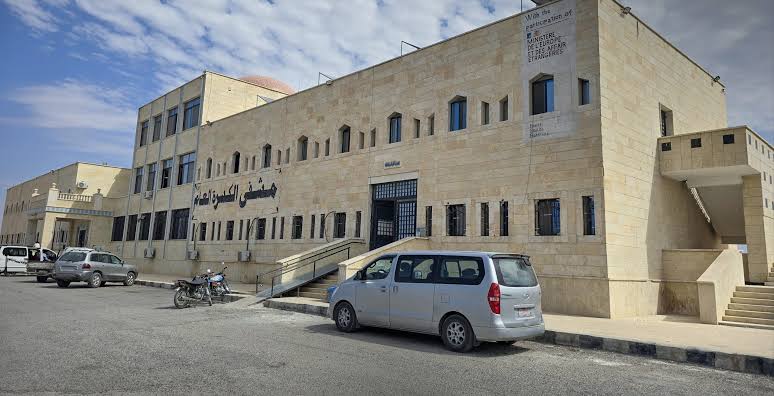
The Syrian Future Movement is following with great concern the unfolding developments regarding the issue of expired medicines and anesthetic drugs at the Al-Kasra General Hospital in the western countryside of Deir ez-Zor. This matter came to light through video footage, released on October 22, 2026, which revealed the presence of spoiled medical supplies and expired anesthetic agents within the hospital.
Previously, on October 27, 2026, the Syrian Future Movement issued a statement titled “The Incident Involving Expired Medicines and Anesthetic Drugs at Al-Kasra General Hospital in the Western Countryside of Deir ez-Zor.” In it, the Movement called for an independent and transparent investigation, a comprehensive audit of the pharmaceutical inventory, the protection of the legal rights of staff, and the strengthening of independent pharmaceutical oversight.
The Syrian Future Movement notes that some of its demands have indeed been met—a preliminary response that demonstrates the Movement’s input was not merely an observation, but a set of actionable recommendations.
Nevertheless, the Syrian Future Movement maintains that this response remains partial and incomplete; it is not commensurate with the gravity of the offense, nor does it address the root cause of the systemic failure that has been uncovered. The Syrian Future Movement notes that the Deir ez-Zor Health Directorate announced, on October 26, 2026, that it is addressing the matter. The Directorate confirmed that expired medications were present in the Al-Kasra Hospital warehouses but had not been used. It stated that responsibility lies with the staff overseeing the department, that measures have been taken against those who failed in their duties, and that it intends to terminate the appointments of all individuals involved in the case. Furthermore, the Directorate indicated that its doors remain open to receive complaints.
We also clarify that the Internal Security Directorate has launched a comprehensive investigation into the case, following a request and directive from the competent judicial authorities. The medications will undergo examination, and the investigation—which will involve gathering statements and testimonies—will not be limited to any single individual or entity; rather, it will encompass warehouse keepers and other relevant officials.
The Syrian Future Movement considers these measures to align with certain demands made in its previous statement—specifically, the call for a thorough inspection of pharmaceutical stock and the demand to hold those responsible for warehouse management accountable.
The Syrian Future Movement acknowledges the Health Director’s admission that responsibility rests with the supervisory staff—a step that goes beyond merely denying the use of the expired medications—as acknowledging responsibility is the first step toward genuine accountability.
However, the Syrian Future Movement observes that this official response, while significant, contains a fundamental flaw: the continued detention of the individual who recorded the footage, who has been accused of “undermining the prestige of the state” and “communicating with hostile entities.” The Syrian Future Movement considers this action to be in contradiction with the principle of protecting whistleblowers who report health-related violations—a point the Movement emphasized in its previous statement. At that time, it stressed that “any engagement with medical personnel who have documented these violations must be conducted within the framework of the law and transparency, avoiding any measures that could be perceived as a deterrent against reporting such violations.”
The Syrian Future Movement points out that detaining a whistleblower does not facilitate the uncovering of the truth; rather, it hinders it. Such actions discourage others from reporting future violations and shift the nature of the case from a health-related matter to a security issue.
The Syrian Future Movement calls for the immediate release of the individual who recorded the video, or for his referral to a competent judicial authority based on a specific and clearly defined charge—not vague accusations such as “undermining the prestige of the state.” The prestige of the state is not upheld by detaining those who expose corruption, but rather by holding accountable those who store expired or spoiled medicines in a government hospital.
The Syrian Future Movement notes that while the investigation initiated by the Internal Security Directorate is significant, it remains a security-focused inquiry. Given that the offense is health-related, administrative, and judicial in nature, it requires an independent investigative committee—comprising pharmaceutical experts, judges, and financial auditors—rather than relying solely on a security entity.
The Syrian Future Movement reiterates that its previous statement called for an “independent, transparent, technical, and administrative” investigation, rather than a purely security-led one. A security agency might view the case through the lens of “state prestige” rather than through the lens of “patient safety.” The Syrian Future Movement emphasizes that the administrative measures taken by the Health Directorate—such as terminating an assignment or issuing a formal warning—are insufficient. This is not merely an administrative infraction; it involves the presence of toxic and spoiled substances in close proximity to operating rooms—substances that could have been used for anesthesia, thereby putting patients’ lives at risk of death.
In this regard, the Syrian Future Movement cites Legislative Decree No. 12 of 1970, which regulates the practice of medical and health professions. This decree explicitly prohibits the possession, sale, or use of spoiled or expired medications and holds health administrations responsible for ensuring the safety of pharmaceutical stocks. Furthermore, the Syrian Penal Code mandates penalties for actions that endanger the lives and safety of citizens.
Acting upon its national responsibility, the Syrian Future Movement recommends the following:
First: The formation of an independent investigative committee—comprising judges, pharmacists, financial auditors, and experts in pharmaceutical quality—tasked with identifying the source of the spoiled medications, how they entered the hospital’s storage facilities, who was aware of their presence, and who failed to ensure their proper disposal. The full findings of this investigation must be made public.
Second: The immediate release of the individual who recorded the video, and the implementation of protections for whistleblowers. This should include clear provisions that shield anyone who reports health or pharmaceutical violations from legal or administrative repercussions, thereby encouraging staff to come forward without fear. Protecting whistleblowers is an essential prerequisite for uncovering corruption within the healthcare sector. Third: Extend inspections to all hospitals and health centers in Deir ez-Zor—not just Al-Kasra Hospital—ensure the destruction of any expired materials in accordance with legal procedures, and publish periodic reports on inspection findings to prevent similar surprises in other facilities.
Fourth: Strengthen independent pharmaceutical oversight within the Ministry of Health by establishing an autonomous drug inspection unit. This unit should conduct unannounced visits to warehouses and hospitals, operate within a clear accountability framework, and hold any party found negligent in the management of pharmaceutical stocks responsible.
The Syrian Future Movement acknowledges the response from the Deir ez-Zor Health Directorate and the Internal Security Directorate to the demands made in its previous statement. It views this as a first step, demonstrating that advocating for one’s rights yields results when met with a genuine willingness to respond.
However, the [Syrian Future] Movement The Syrian Future Movement points out that an inadequate response can be more dangerous than no response at all; it creates the impression that the problem is being addressed while the root causes remain, and those who speak out end up facing punishment rather than receiving protection.
The Syrian Future Movement asserts that building a reliable healthcare system begins with upholding basic pharmaceutical safety standards, prioritizing patients’ lives above all else, and protecting—rather than penalizing—those who expose flaws. A hospital that conceals the presence of substandard or expired medicines and punishes those who bring them to light is a hospital that does not deserve the trust of its patients.