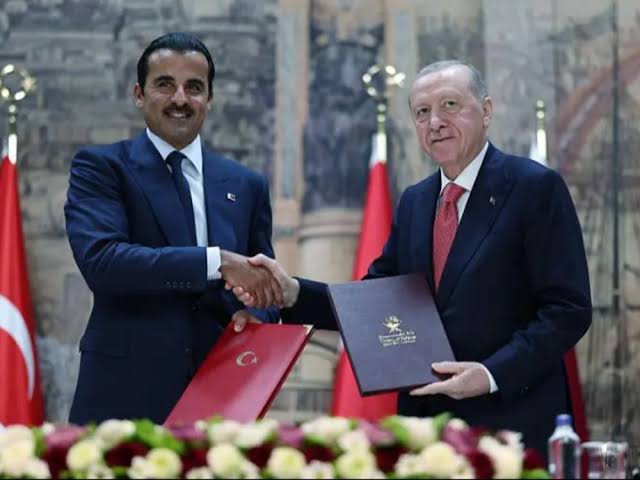
The Syrian Future Movement commends the joint statement issued by the State of Qatar and the Republic of Turkey on Friday, November 13, 2026, at the conclusion of the 12th session of the High Strategic Committee between the two countries, held in Istanbul under the chairmanship of the Emir of Qatar, Sheikh Tamim bin Hamad Al Thani, and Turkish President Recep Tayyip Erdoğan. The statement affirmed the two countries’ support for the Syrian government’s efforts to restore stability and strengthen state institutions, and called upon the international community to take a firm stance to halt Israeli violations of Syrian sovereignty. It also stressed the necessity of respecting the 1974 Disengagement Agreement and ensuring the withdrawal of Israeli forces from the occupied Syrian territories.
The Syrian Future Movement considers this statement to embody significant regional support for Syria at a critical juncture. It reveals the emergence of a joint Arab-Turkish position that not only condemns the violations but also demands concrete implementation mechanisms. This represents a qualitative shift in the regional discourse regarding the Syrian issue, and deserves recognition.
However, the Syrian Future Movement believes that this support, despite its value, will not change the equation on the ground unless it translates into effective international pressure that compels Israel to respect international law, and not merely statements added to the growing list of condemnations.
The Syrian Future Movement notes that the joint statement included three essential elements that warrant attention:
First: The affirmation of Syria’s unity and sovereignty. The statement stressed “respect for Syria’s sovereignty, unity, and territorial integrity,” and support for “a comprehensive political process led and owned by Syria.” This is an important affirmation at a time when external projects are being proposed that do not serve the country’s unity.
Second: The statement did not separate “support for stability” from “stopping Israeli violations,” but rather placed them in the same context, emphasizing that stability in Syria cannot be achieved while the occupation and incursions continue.
The Syrian Future Movement considers this connection to reflect a correct understanding of the essence of the crisis, because any talk of reconstruction and development remains incomplete as long as the attacks targeting the land and its people do not cease.
Third: We appreciate the Doha and Ankara declaration of support for the Syrian government’s efforts through projects in the infrastructure, housing, technical training, energy, industry, and basic public services sectors, as well as the expansion of security cooperation in law enforcement and training.
We believe that this support, if implemented, can make a tangible difference in the lives of Syrian citizens, particularly in the chronically crisis-ridden energy and housing sectors.
The Syrian Future Movement reiterates its firm position, published on its official website in the article titled “Beyond the 1974 Agreement: A New Syrian Doctrine,” dated August 16, 2026, where it emphasized that “the 1974 Agreement is not a Syrian right in itself, such that preserving it should become a national objective. Rather, it is a legal and political instrument that should be evaluated to the extent that it serves the restoration of Syrian rights and sovereignty.”
The Syrian Future Movement considers the demand for respect for the agreement, as stated in the Qatari-Turkish declaration, necessary as a minimum legal basis, but it should not become the ceiling of the Syrian position, especially after Israel has practically violated it and encroached on new areas.
The Syrian Future Movement recalls that it presented a clear national equation in the same article: “No futile war, no normalization without concessions, no Israeli security at the expense of Syrian sovereignty, and no security agreement that transforms the occupation into a permanent reality.”
The Syrian Future Movement believes that this equation remains valid today and should form the framework within which Syrian diplomacy operates with allies and friends, ensuring that Syria’s right to its land is not traded for promises of temporary stability.
However, the Syrian Future Movement believes that the statement, despite its importance, raises fundamental questions about its feasibility:
First: The absence of binding mechanisms. The statement “called on the international community to take a firm stance” and “reaffirmed its commitment to supporting diplomatic initiatives,” but it did not specify a clear mechanism for translating these demands into binding resolutions or practical steps that would compel Israel to withdraw.
We ask, what is new in this statement compared to the dozens of previous Arab and international statements that condemned Israeli violations without actually stopping them?
Second: We note that Qatari and Turkish support for Syria, while important, remains limited in its impact unless it expands to include pressure on Western capitals to lift the remaining sanctions and support reconstruction with substantial funding, not just limited projects.
Third: We emphasize that this cooperation must be under full Syrian leadership and aim to empower Syrian institutions to assume their responsibilities independently, not to entrench permanent external security arrangements.
Based on its national responsibility, the Syrian Future Movement recommends the following:
First: Building on the statement to transform it into effective international pressure – The Syrian Future Movement calls on the Syrian government to work with Doha and Ankara to convey this joint position to the Security Council and demand the issuance of a binding resolution obligating Israel to respect the 1974 agreement and immediately withdraw from the areas it has invaded, with clear monitoring and implementation mechanisms.
Second: Strengthening Coordination with Allies to Lift Remaining Sanctions – The Syrian Future Movement calls on Qatar and Turkey to use their diplomatic and economic influence to pressure Western capitals to lift the remaining sanctions on Syria, considering this a prerequisite for the success of recovery and reconstruction efforts, similar to what the Movement has called for in its previous statements regarding lifting the financial and digital isolation.
Third: Translating Economic Support into Tangible and Scheduled Projects – The Syrian Future Movement demands that Qatar and Turkey announce a timetable for implementing the projects mentioned in the statement (infrastructure, housing, energy, industry, and technical training), with transparent monitoring mechanisms to ensure they reach their intended beneficiaries, rather than remaining mere promises.
Fourth: Strengthening Security Cooperation within the Framework of Syrian Sovereignty – The Syrian Future Movement calls for security cooperation with Ankara and Doha to be translated into training programs and Building the capabilities of Syrian institutions, while ensuring that security decisions remain entirely Syrian and that national capacity building is not replaced by permanent external security arrangements.
Fifth: Continued adherence to the equation of “no senseless war and no normalization without concessions.” The Syrian Future Movement emphasizes that any future negotiation process must be based on this equation, and that Syria’s right to its land should not be traded for promises of temporary stability. The issue of the Golan Heights and all occupied territories must remain at the heart of any negotiation.
The Syrian Future Movement appreciates the joint Qatari-Turkish statement, viewing it as important regional support for Syria in confronting Israeli violations and as support for recovery and stability efforts.
However, the Syrian Future Movement reiterates that regional support, however sincere, does not negate the need for effective international pressure, and that demanding respect for the 1974 agreement remains a necessary legal basis but not the limit of national aspirations.
The Syrian Future Movement affirms that Syria deserves more from its allies and friends than joint statements. Practical stances that translate into binding international resolutions, pressure that forces Israel to withdraw, and economic support that rebuilds what the war destroyed are all that are needed.