
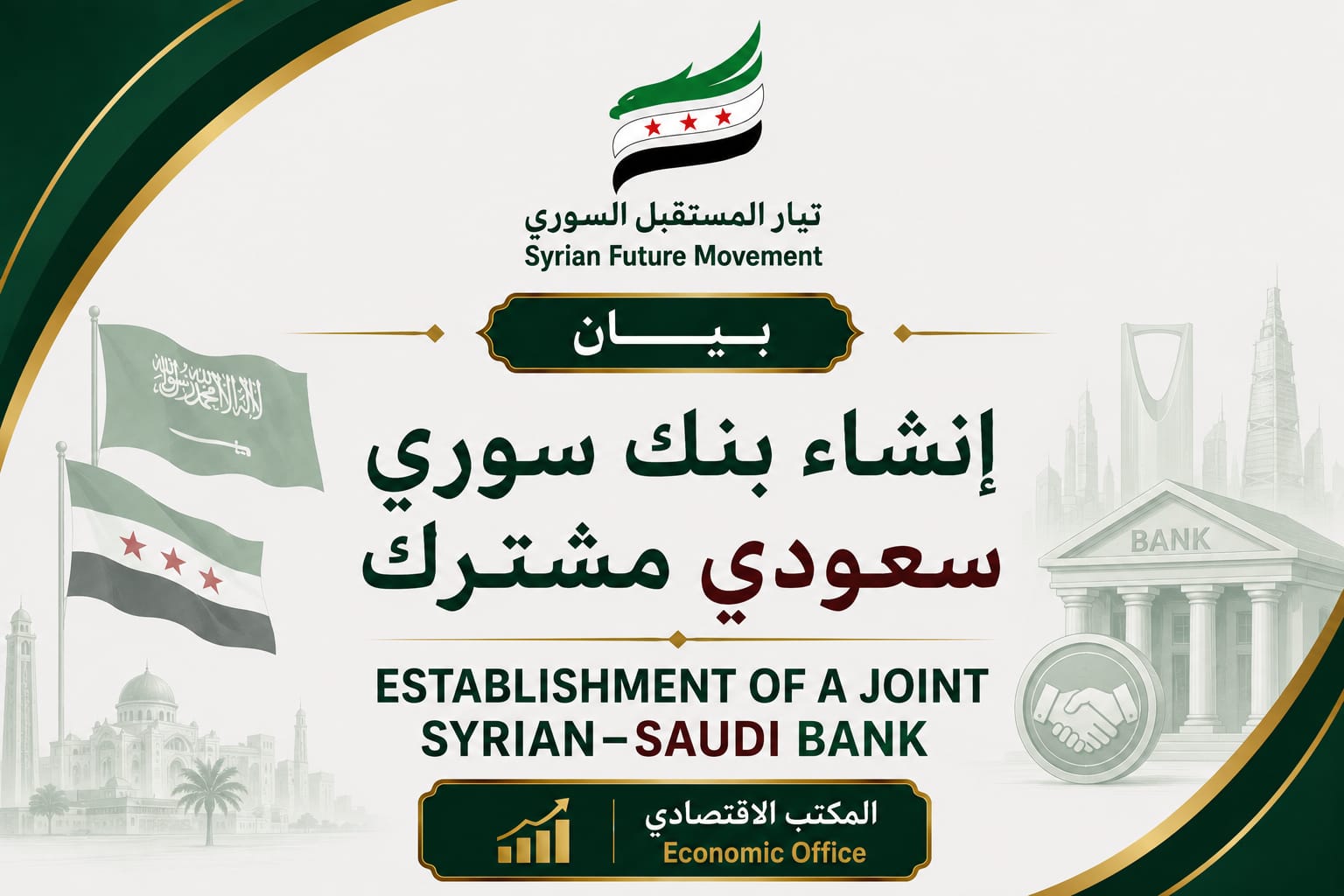
The Syrian Future Movement is following with great interest the announcement issued by the Central Bank of Syria on Thursday, August 27, 2026, regarding the agreement with the Saudi-Syrian Business Council to establish a joint Syrian-Saudi bank and open direct and organized banking channels between the two countries. This will facilitate the flow of funds related to investment projects.
This agreement was reached during a meeting between the Governor of the Central Bank of Syria, Safwat Raslan, and a delegation from the Saudi-Syrian Business Council, headed by Mohammed Abu Nayan, with the participation of the Syrian-Saudi Business Council, headed by Haitham Joud. The meeting focused on supporting investment and facilitating banking transactions between the two countries. This coincided with advanced discussions between the Head of the General Authority of Customs, Qutaiba Badawi, and the Saudi delegation, which addressed ways to develop cooperation in the ports, free zones, and logistics sectors.
The Syrian Future Movement commends this historic step, which represents a qualitative leap in financial and banking relations between the two countries and removes one of the major obstacles that hindered Saudi investments in Syria: the absence of direct and organized banking channels. This agreement, which comes weeks after the signing of 47 agreements and memoranda of understanding totaling approximately $6.4 billion, is seen as a practical manifestation of the exceptional momentum in Syrian-Saudi relations, where announced investments have exceeded $20 billion.
However, the Syrian Future Movement emphasizes that the establishment of the joint bank, despite its significant importance, is a tool, not an end in itself. The real challenge lies in translating this banking facility into tangible investment projects on the ground that benefit the national economy and the Syrian citizen, and contribute to supporting reconstruction efforts and sustainable development.
The Syrian Future Movement notes that the agreement to establish the joint bank carries four key economic and strategic implications:
First: A radical solution to the obstacle of banking transfers. The absence of direct and organized banking channels was one of the most prominent challenges facing Saudi investors wishing to enter the Syrian market, as they were forced to rely on indirect channels or cash transfers, which increased costs and risks. The Movement believes that opening these channels removes a major barrier that hindered the flow of Saudi capital into Syria.
Second: Strengthening confidence in the Syrian banking sector. Establishing a joint Saudi-Syrian bank, with the participation of businesspeople and investors from both countries, will bolster international investors’ confidence in the Syrian banking sector and establish new standards of governance and transparency in managing financial operations. This will contribute to improving Syria’s credit rating and attracting more foreign investment.
Third: Supporting major investment projects. We appreciate the statement by the Chairman of the Saudi-Syrian Business Council, Mohammed Abu Nayan, that the targeted projects “are long-term investment projects stemming from the needs of the Syrian economy and priority sectors.”
We believe that providing clear and organized banking mechanisms that allow investors to manage their operations and access their investments easily and securely is a fundamental requirement for the success of these projects in the tourism, real estate, infrastructure, and energy sectors.
Fourth: Strengthening regional economic and logistical integration. Discussions focused on developing ports, free zones, and logistics services, as well as the Saudi vision for enhancing economic and logistical integration between the two countries. Leveraging Syria’s geographical location to serve as a logistics hub on the Mediterranean Sea, positions Syria at the heart of an ambitious regional project to link ports, dry docks, free zones, railways, and industrial cities.
In this context, the Syrian Future Movement reiterates its consistent positions, published on its official website, which emphasize the priority of economic and investment cooperation as a fundamental pillar for building the new state. These positions include the statement on “Adopting an Electronic Payment System in Syria” (dated August 20, 2026), which stressed the importance of modernizing the financial sector and promoting financial inclusion. This complements efforts to establish a joint bank and facilitate remittances.
The Syrian Future Movement believes that the establishment of the joint bank, despite its importance, faces challenges and opens up opportunities that require follow-up:
- The challenge of rapid implementation: The agreement to establish the bank is a first step, and the real challenge lies in expediting the necessary licensing and regulatory procedures and commencing actual banking operations as soon as possible, lest the agreement become merely unfulfilled promises.
- The challenge of governance and transparency: The success of the joint bank requires adopting the highest standards of corporate governance, transparency in management, and combating money laundering and the financing of terrorism, thereby enhancing the confidence of investors and international financial institutions.
- An opportunity to promote digital transformation in the banking sector: We see the establishment of the joint bank as an opportunity to transfer Saudi expertise in the field of digital banking services and to develop the financial infrastructure in Syria, which will contribute to accelerating the pace of comprehensive digital transformation.
- An opportunity to attract broader regional and international investments: We also see the success of this joint banking model as a model to be emulated by other countries, enhancing the confidence of regional and international investors in the Syrian market, thus opening the door to more investment partnerships.
Based on its economic and national responsibility, the Syrian Future Movement recommends the following:
- Expediting the completion of legal and regulatory procedures for establishing the bank and commencing its operations as soon as possible, with a clear timeline for implementation phases and measurable performance indicators to ensure the agreement is translated into tangible reality.
- Adopting the highest standards of governance and transparency in managing the joint bank to guarantee the fight against corruption and money laundering, enhance the confidence of investors and international financial institutions, and establish a leading banking model in the region.
- Linking the bank to priority investment projects in the energy, infrastructure, and other sectors. The telecommunications, real estate, and tourism sectors, along with providing flexible and accessible financing mechanisms for investors, will contribute to achieving sustainable economic development.
- The Syrian Future Movement will leverage Saudi expertise in digital banking transformation to transfer technology and develop digital banking services in Syria, thereby enhancing financial inclusion and facilitating transactions for both citizens and investors.
The Movement emphasizes that the joint bank is not an end in itself, but rather a tool for achieving economic development and improving citizens’ lives. Its success hinges on serious implementation, transparent management, and adherence to the highest banking standards.
The Movement affirms that this step, along with a package of agreements and memoranda exceeding $6.4 billion, constitutes a solid foundation for a long-term strategic economic partnership that will contribute to Syria’s reconstruction and economic revival.
The Syrian Future Movement will remain a supporter of all that strengthens economic and investment cooperation, a critic of all that hinders development, and a monitor of all that is accomplished on the ground, striving for a new, strong, and prosperous Syria.