
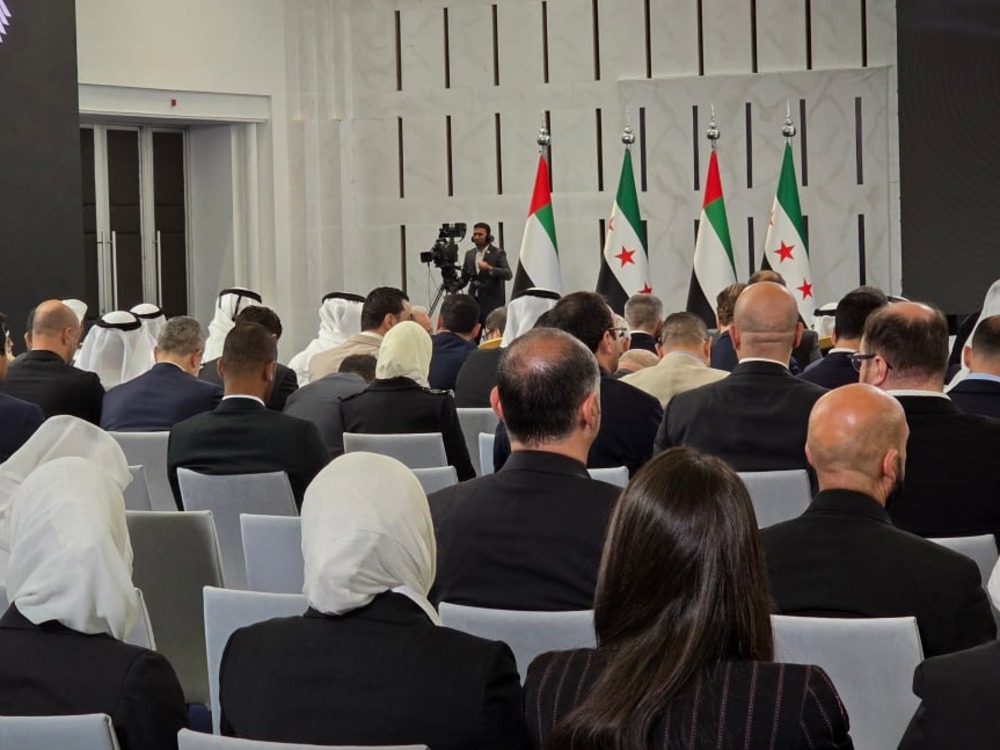
This forum was the culmination of a series of escalating understandings that reached their peak with the launch of a comprehensive “investment forum” for the first time in over 15 years.
The scale of the event, its atmosphere, and the president’s personal attendance reflect a shared Syrian-Emirati ambition to move beyond the stage of anticipation and into actual implementation. Damascus is banking on this step to send a political message that its return to its Arab economic sphere is now a “reality.”
Dimensions of the Forum:
First, the Economic Dimension:
The forum revealed significant investments, including:
- A tangible trade momentum, with the volume of trade exchange between the two countries exceeding $1.3 billion in 2025 (of which $1.4 billion according to other figures, representing a 132% increase over the previous year), and the registration of approximately 40,000 Syrian companies operating in the UAE.
- Projects worth billions of dollars are under consideration. For example, the Emirati company Emaar is studying real estate projects in Damascus worth $12 billion and projects on the Syrian coast worth $7 billion.
- Clear investment priorities exist, such as the telecommunications sector (Emirati companies have applied for a new license), energy, agriculture and food security, tourism and real estate development, and logistics and airports.
Secondly, the political dimension:
What happened in Damascus transcended the economic sphere, becoming a practical normalization under the banner of “opportunities,” manifested in:
- A dual message: The UAE has always been among the most complex countries in its stance toward the transitional government due to its concerns about its Islamist background and its history as a country of counter-revolutions. However, its participation at this high level breaks through this implicit complex and acknowledges the end of the de facto boycott, opening a new chapter in the region, not just between the two countries.
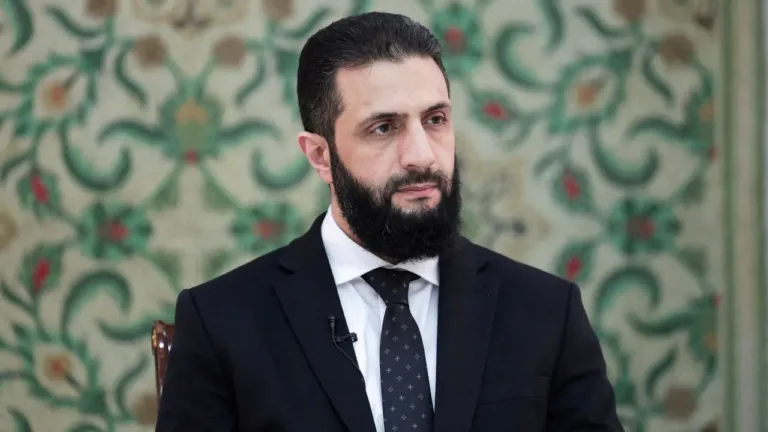
- The timing of the presidential presence: President Ahmed al-Sharaa’s personal attendance on the second day and his reception of the delegation provide the forum with a political guarantee and the utmost governmental confidence. It is interpreted as a public message to the world that Syria is open to partnership under this political system.
- Beyond the economic dimension: As Syrian Economy Minister Nidal al-Shaar stated, “The visit of the Emirati businessmen transcends the economic dimension, embodying trust, brotherhood, and a sincere desire to build a genuine partnership.”
Third, the declared developmental dimension:
The forum focused on a “training and capacity-building model,” not just on injecting funds, through:
- Transferring the Emirati experience in streamlining procedures, expediting processes, and developing the business environment by activating the joint Syrian-Emirati Business Council to facilitate direct communication between businesspeople and investors.
Cooperation in microfinance to support small businesses and empower youth, families, and entrepreneurs, as well as cooperation in vocational training and technical qualification. - Developing modern industrial zones and projects in technology, digital transformation, governance, and digital payments.
Now, the question arises: Are we witnessing a qualitative leap or “electioneering”?
Strengths: What distinguishes this forum from others:
- An unprecedented consensus on “implementation” rather than “promises,” where all speeches focused on translating opportunities into tangible projects (the Emirati Minister of Trade stated: “We are working on transforming ideas into joint projects”), a rare occurrence in Arab conference culture.
- Establishing a “cumulative path,” the forum’s true significance lies in reopening a direct channel between Syrian decision-makers and Emirati investors, establishing a clear list of priority sectors, and testing the seriousness of Syrian promises to implement the investment law and expand the “one-stop shop.”
- High organizational rigor, as noted by Dr. Khaled Al-Hamdi, an investment and economic planning expert, who observed in his analysis “a specialized, genuine, and realistic academic effort.”
Weaknesses:
Absence of “a number of executed deals”: The initial analysis by Syrian Business Gateway indicates that, by the end of the first day, “no numbered deals or final list of signed memoranda of understanding had been announced,” and the forum was “primarily a platform for showcasing opportunities and dialogue sessions.”
A real gap in the absence of a “transparency guarantee charter”: Neither official coverage nor expert analysis addressed the existence of an independent oversight body or a binding timeline for implementing what was agreed upon. This leaves a fundamental question: How will the average Syrian know whether the investment promises have translated into funds entering the treasury, or whether they remain confined to “preliminary deals”? Analysis of reactions:
Official reactions (very optimistic): Economy Minister Nidal al-Shaar affirmed that the UAE “has succeeded in building a development model based on efficiency” and that the forum reflects “Syria’s return to the heart of the Arab and global economic movement.”
As for the UAE Minister of Trade, Thani bin Ahmed Al Zeyoudi, he was keen to convey the image of the UAE as a country that wants to build partnerships, not exploit a vacuum, noting that his country believes that economic partnerships are built on mutual cooperation, mutual benefit, and a long-term commitment.
Regarding the reactions of experts and analysts, investment expert Dr. Khaled al-Hamdi pointed out the connection between discussions of Emirati investments and a stable global economy, and described the forum as “distinguished” in its approach. Most experts believe that the true results will only become apparent after several months, by monitoring the reduction in licensing costs and the speed of issuance through the “one-stop shop,” as well as the actual increase in infrastructure projects in upcoming budgets. The biggest bet, however, hinges on Syria’s openness to financial transparency and the independence of the Anti-Corruption Commission in receiving complaints about delayed fulfillment of promises (based on an analysis of the fragile investment climate).
Based on my observations of the positions of activists and observers, I have divided them into three categories:
- The optimists (who saw this as a step towards a breakthrough): They welcomed the size of the delegation and the nature of the sectors involved, and viewed the $19 billion reconstruction pledge as a glimmer of hope in a struggling economy.
- The pessimists, driven by the logic of “Israeli exploitation of the state’s weakness”: They believe that massive Emirati deposits mean increased economic dependence. There are also concerns that Gulf capital will be directed towards luxury projects (coastal real estate, shopping malls) rather than the devastated infrastructure, which…
This only reflects positively on elite investors. - The neutral (the “wait-and-see” approach): They represent the largest group in the field analyses I’ve observed. They don’t reject the forum, but they are waiting to see the results on the ground.
Conclusion:
What the Presidential Palace and the Investment Authority did was an unprecedentedly professional effort to remove the usual obstacles. The forum’s value lies in its redefinition of the investment landscape in Syria on more realistic foundations.
However, the true indicator remains the extent to which Emirati businessmen actually translate their letters of intent into contracts, bank agreements, and actual operational commitments. This needs to be monitored after 3 to 6 months.
The real analysis, as I see it, is that the biggest problem isn’t the “format of the event” but rather the “implementing body.” There must be immediate directives to activate a “high-level follow-up committee” with the participation of the private sector and representatives of investors. Its meetings should be regular and partially public, with quarterly reports published.
Investments must also be linked to explicit commitments to creating job opportunities for Syrians in the poorest regions, and not be concentrated solely in Damascus. Furthermore, it is imperative—and I use every possible word of caution—that this path, initiated at the Presidential Palace, must not be lost in the labyrinth of bureaucracy.
If Damascus succeeds in translating this momentum into even 20% implementation within a year, Syria could become a rare economic success story in emerging from war. However, if it fails, the conference will simply be another episode in the long-running saga of “investment galas” in the Arab world.
We remain hopeful that Damascus will succeed 100%. Who knows? Perhaps if God wills something, He will make it happen!