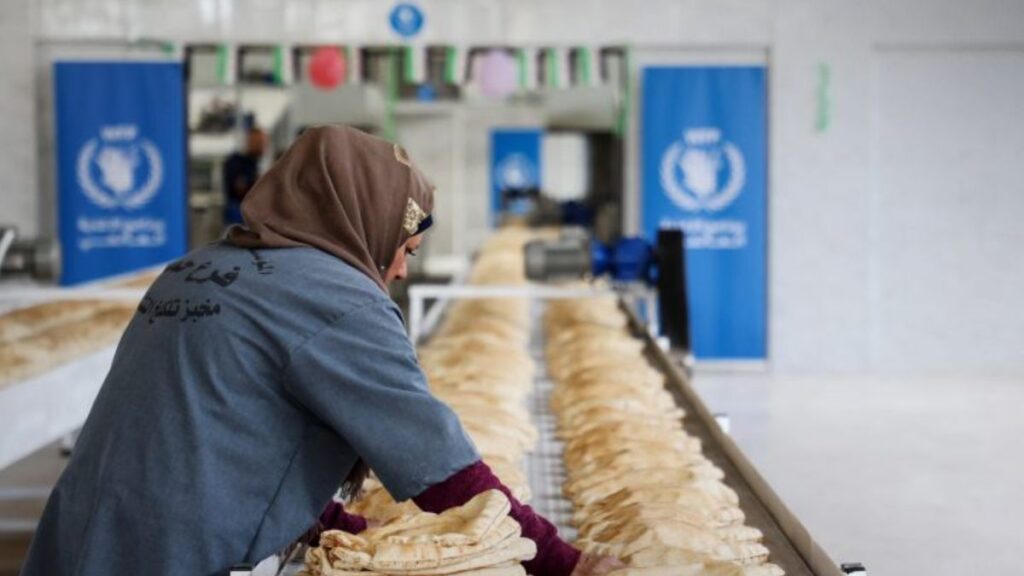
The Syrian Future Movement follows with grave concern and condemnation the announcement issued by the United Nations World Food Programme (WFP) on Wednesday, May 13, 2026, to immediately reduce emergency food aid in Syria by 50%.
This tragic measure is a direct result of the severe funding shortage plaguing the international organization, which has forced it to make harsh humanitarian decisions. This is a direct reflection of the decline in international support and the international community’s failure to fulfill its moral and legal responsibilities during this critical transitional phase.
The Syrian Future Movement rejects this decision and holds the international community and donor countries responsible for failing to support stability in Syria. We believe that this reduction reflects not only a funding crisis but also a profound humanitarian crisis for which broad segments of the Syrian population will pay a heavy price. The Syrian Future Movement reiterates that this reduction is not a result of diminishing needs or gains on the ground, but rather comes despite alarming humanitarian indicators. As the World Food Programme’s Country Director in Syria, Marianne Ward, confirmed, the cut is “due exclusively to funding constraints, not a decrease in needs.”
The Syrian Future Movement recalls the magnitude of the disaster this decision will cause. The number of beneficiaries of food aid has been reduced from 1.3 million to only 650,000 this May, a disastrous figure by any measure.
Even worse is the suspension of the bread subsidy program, which provided daily support to approximately 4 million people in the most vulnerable areas. These decisions come at a time when 7.2 million people in Syria are still suffering from acute food insecurity, including 1.6 million facing extreme levels of hunger.
We believe this decision threatens to accelerate hunger and push more families toward negative coping mechanisms, negatively impacting social cohesion and fragile stability.
The Syrian Future Movement points out that the program’s funding crisis has also negatively impacted Syrian refugees in neighboring countries. Cash and food assistance has been suspended for 135,000 Syrian refugees in Jordan, and support has been reduced for others, in addition to cuts in aid in Lebanon and Egypt. This cross-border problem reflects a decline in international attention to the Syrian refugee crisis.
The Syrian Future Movement calls on donors and the international community to intervene urgently to provide the required $189 million for the next six months (June to November 2026), an amount the program has declared it desperately needs to sustain and restore its vital assistance.
We also warn that the continued funding shortfall, as stated by the program’s Regional Director, Samer Abdel Jaber, “threatens to undermine the gains achieved over the years and push millions of people into greater food insecurity,” jeopardizing the prospects for stability and recovery in Syria.
The Syrian Future Movement views this tragic crisis, coinciding with a sensitive transitional phase, as a true test of the world’s commitment to a new Syria. We call on the Syrian government to fully cooperate with UN organizations to facilitate their work and to develop national social protection programs. We also call for the development of national emergency plans to address a potential collapse in international aid and to seek alternative funding sources.
From this perspective, the Syrian Future Movement puts forward a set of urgent practical recommendations:
- Formation of a National Crisis Cell: We urge the Syrian government to form an emergency and specialized crisis cell, comprising the Ministries of Social Affairs, Economy, and Planning, along with economic experts and representatives of civil society, to develop an emergency plan to address the repercussions of this sudden cut in aid.
- Activation of National Funds: We call for the establishment of an emergency funding mechanism and a national fund to support food security, targeting the poorest segments of society, and for the immediate mobilization of local resources to form the nucleus of a more sustainable social protection system in the future.
- Local Bread Subsidy Initiative: We call on the Federation of Agricultural Chambers and professional syndicates to form a committee to explore the possibility of temporarily producing and distributing subsidized bread using local resources and at reduced prices, in consultation with the government.
- Transparency and Oversight: The government is urged to ensure full transparency in the distribution of any available aid or food alternatives, prevent any monopolistic practices or corruption in the distribution of bread and basic commodities, and involve civil society organizations as independent monitors.
In conclusion: The Syrian Future Movement calls on the international community to review its funding policies and recognize that austerity measures imposed at the expense of Syria’s starving population will not result in savings, but rather in a much higher price of instability and a return to conflict and fragility.