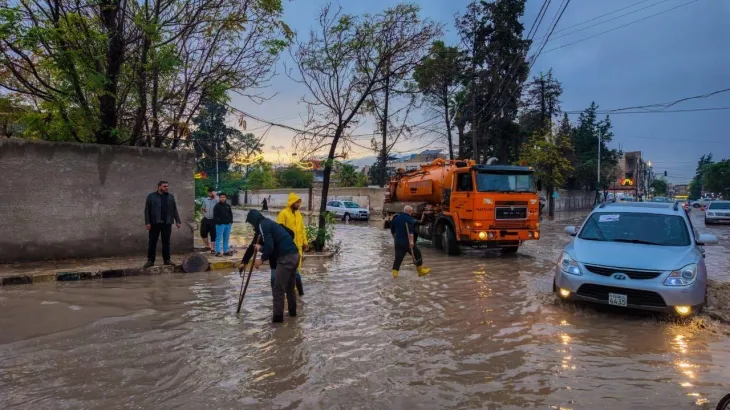
The Syrian Future Movement follows with deep concern and condemnation the flash floods and torrents that struck several Syrian governorates on the evening of Wednesday, October 28, 2026—specifically Raqqa, Deir ez-Zor, Al-Hasakah, Aleppo, Hama, Homs, and Latakia.
In a statement issued on Thursday, October 29, 2026, the Ministry of Emergency and Disaster Management reported that five people—including four children (three in Raqqa and two in Deir ez-Zor)—have died, while five others remain missing in the rural areas of Raqqa, Deir ez-Zor, and Aleppo. Meanwhile, Civil Defense teams successfully rescued 25 individuals who had been trapped by the floodwaters or whose vehicles had become stranded.
Furthermore, these teams evacuated approximately 375 families from affected camps in the countryside of Raqqa. More than 150 homes and public facilities—including two hospitals, schools, and bakeries—sustained damage. Seven bridges, culverts, and unpaved roads were rendered unusable; entire neighborhoods were left without electricity, and school classes were suspended across three governorates.
The Syrian Future Movement asserts that this disaster, while triggered by exceptionally heavy and unprecedented rainfall, is not merely a “natural event.” Rather, it serves as a stark indictment of failed urban planning and inadequate infrastructure, as well as the absence of a national strategy for disaster risk reduction. This follows years of neglect regarding drainage networks, the filling in of natural watercourses (valleys), and a lack of routine maintenance for bridges and culverts. The Syrian Future Movement emphasizes that floods can occur even in stable nations. However, the distinction between a country where streets become submerged and one where risks are effectively managed lies in the presence of robust institutions, proactive preparedness, and investment in prevention—rather than relying solely on a response after a disaster has already struck.
The Syrian Future Movement highly commends the rapid response of the Ministry of Emergency Situations, disaster management teams, and the Civil Defense. These units carried out 165 field interventions across six governorates, addressed over 350 distress calls, rescued dozens of civilians, evacuated hundreds of families from affected camps, and pumped floodwater out of hospitals, schools, and bakeries.
The Syrian Future Movement believes that these efforts—undertaken despite limited resources—demonstrate a genuine dedication worthy of recognition. They further prove that national personnel are capable of working with great efficiency when provided with the necessary equipment and support.
The Syrian Future Movement also acknowledges the awareness shown by citizens who followed emergency guidelines and heeded the Ministry’s warnings to stay away from watercourses and flooded bridges; such public awareness serves as the first line of defense in any disaster.
Nevertheless, the Syrian Future Movement maintains that field responses, however heroic, cannot substitute for addressing the root causes that allow flash floods to escalate into full-scale disasters. The Syrian Future Movement notes that World Bank reports have estimated direct physical damage in Syria at approximately $108 billion between 2011 and 2024. Infrastructure sustained the heaviest impact, accounting for 48% of the total damage—valued at $52 billion—which implies that drainage networks, bridges, and roads are suffering from chronic, unaddressed deterioration.
The Syrian Future Movement points out that this is not the first time floods have struck Syrian provinces in 2026. Last February, floods hit several displacement sites in Idlib and Latakia, and in May, they destroyed vast areas of wheat crops that were nearing harvest. The Syrian Future Movement asks: How many more disasters must occur before the lessons learned are translated into concrete policies?
The Syrian Future Movement highlights that countries facing similar flood risks have gone beyond mere emergency response by investing in prevention—an approach from which Syria could benefit:
The Netherlands’ experience—the Dutch government launched the “Room for the River” program, which is now being further developed through “Room for the River 2.0.” The government has allocated approximately €2.5 billion for its implementation, with additional long-term provisions for maintenance spanning decades. The initiative aims to halt the erosion of riverbeds and restore hydrological balance. It serves as a model demonstrating that protecting rivers is not achieved by building higher dams, but by providing the river with the space it needs to “breathe.” The Japanese experience—which relies on a combination of green infrastructure (such as retention basins and rain gardens) and traditional infrastructure (such as canals and dams)—demonstrates that the benefit-cost ratio for flood protection projects consistently exceeds one across all scenarios. This means that every monetary unit invested in prevention yields savings greater than the cost, by averting potential losses.
The Syrian Future Movement maintains that such experiences prove prevention is a profitable investment rather than an additional cost. Had Syria—which currently spends billions on disaster response—invested a portion of those funds into preventive infrastructure, it could have saved many lives and significant financial resources.
The Syrian Future Movement notes that the transitional government has begun strengthening early warning systems through a European-supported project launched on October 18, 2026. This initiative aims to improve early warning mechanisms and enhance the country’s capacity to anticipate and respond to disasters. It is built upon three pillars: flexible and inclusive governance; conflict-sensitive implementation at the local level; and evidence-based, proactive action supported by a drought and flood forecasting system.
While the Syrian Future Movement welcomes this step, it emphasizes that early warning systems alone are insufficient. They must be accompanied by investments in infrastructure, urban planning that respects natural watercourses (wadis), and regular maintenance of bridges and utility networks.
Guided by its national responsibility, the Syrian Future Movement recommends the following:
First: Launching a national disaster risk reduction strategy that mandates all governorates to upgrade drainage networks, maintain bridges and culverts, raise road levels in low-lying areas, and designate safe evacuation zones—supported by a dedicated annual budget for prevention, rather than focusing solely on emergency response.
Second: Adopting a “green infrastructure” approach in cities—modeled after the Japanese experience—by creating water retention basins, rain-absorbing gardens, and permeable surfaces in new neighborhoods; cities that can “breathe” water are less susceptible to flooding.
Third: Providing urgent and fair compensation to those affected. Through a national disaster fund, families who have lost their homes, crops, or livelihoods should be compensated, and damaged camps should be rehabilitated. It must be ensured that no family is left to face its fate alone; for the true disaster lies not in the rain itself, but in leaving people without shelter or compensation.
Fourth: Strengthen and expand early-warning systems, integrating them with mobile applications, local media outlets, mosques, and churches to ensure that warnings reach every citizen—not just those who follow news broadcasts.
Fifth: Engage local communities in disaster planning by training neighborhood and village committees in evacuation procedures and initial response, and by distributing hazard maps to residents. The swiftest response almost always comes from a neighbor, rather than from a distant central authority.
The Syrian Future Movement reaffirms its full solidarity with the families of the victims and those affected in Raqqa, Deir ez-Zor, Al-Hasakah, Aleppo, Hama, Homs, and Latakia. It also commends the efforts of emergency teams working under extremely difficult conditions.
The Syrian Future Movement further emphasizes that the floods that struck Syria this week are not merely an “act of fate” to which we attribute the calamity; rather, they are the result of accumulated neglect, a lack of proactive planning, and fragile infrastructure. Nations that respect their citizens do not wait for a disaster to strike before taking action; instead, they invest in prevention long before the streets are submerged. The Syrian Future Movement asserts that building a new Syria begins with protecting people’s lives from the rain—long before it begins with the construction of high-rises and bridges—for a nation that fails to protect its children from floods does not deserve to be built upon the ruins of its own victims.