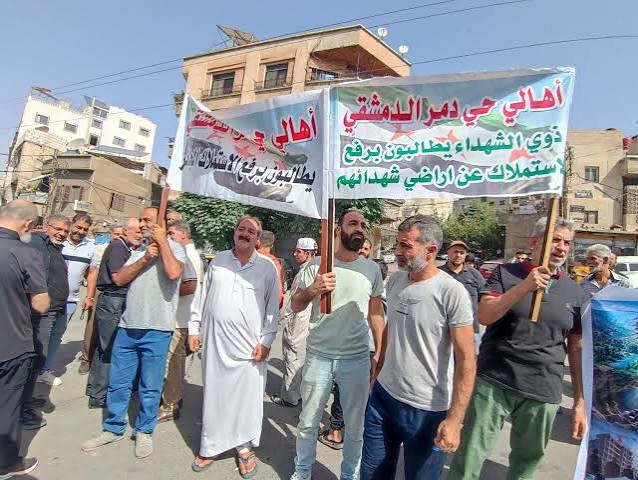
The Syrian Future Movement is closely monitoring the escalating protests that took place in the Dummar neighborhood of Rural Damascus on Friday, October 9, 2026. Dozens of residents staged a protest rejecting the continued enforcement of land expropriation and seizure orders regarding land and real estate, demanding the cancellation of these decisions and the return of the land to its owners—or fair compensation for those affected.
The Syrian Future Movement views these protests as a legitimate expression of the genuine suffering endured by thousands of Syrians for decades. It further considers the continued application of expropriation decrees—inherited from the defunct regime—a true test of the new state’s commitment to the principles of justice and fairness.
The Syrian Future Movement views with grave concern the extent of land seized over decades through expropriation and urban planning decrees, based on documented data:
The total area seized is estimated at approximately 1.5 million hectares (equivalent to 15,000 square kilometers), representing nearly 8% of Syria’s total land area.
In Moadamiyat al-Sham alone, the Damascus Governorate expropriated approximately 12,500 dunams (28% of the city’s area), while the General Housing Establishment expropriated about 9,000 dunams (22% of the city’s area). Decree No. 66 of 2012 converted local residents’ property rights in the Basatin al-Razi area—spanning 214 hectares—into what are known as “undivided regulatory shares.” Meanwhile, 15% of the displaced residents failed to qualify for alternative housing, and 5% filed complaints after being denied eligibility.
The Syrian Future Movement views these figures as a humanitarian tragedy experienced by millions of Syrians who lost their lands and homes, and were forced to either flee or sell their shares at rock-bottom prices in the absence of fair compensation.
The Syrian Future Movement asks: How many Syrian families have paid this same price? And how many rights have been lost under the weight of bureaucracy and unjust laws?
The Syrian Future Movement recalls its statement titled “A Stand to Overturn Expropriation and Old Tenancy Laws” (dated August 29, 2026), in which it commended the protest held by residents of the Al-Bajaj, Al-Saboura, and Qudsaya farms outside the People’s Assembly. It deemed their demands “just and legitimate, reflecting the genuine suffering endured by thousands of Syrians for decades.”
It also reiterates the position stated in its release regarding the “Halt to the Renovation of Al-Zahrawi Palace” (dated October 8, 2026), in which it warned that “using the property for commercial investment purposes strips the expropriation of the legal legitimacy originally intended for the public good.” However, the Syrian Future Movement believes that the transitional government has yet to take serious action to address this tragedy.
On September 28, 2026, the Minister of Public Works and Housing, Mustafa Abdul Razzaq, and the Governor of Rural Damascus, Amer Al-Sheikh, discussed citizens’ demands; however, the ministry’s official statement merely affirmed that projects are being “implemented in accordance with applicable laws and regulations,” without offering concrete solutions.
The Syrian Future Movement views this stance as a failure to grasp the magnitude of the disaster. It holds the transitional government responsible for the continued suffering of those affected and for failing to take radical steps to annul unjust expropriation decrees and compensate rightful owners.
Acting on its national responsibility, the Syrian Future Movement recommends the following:
First: Annul the expropriation decrees issued during the era of the ousted regime and enact urgent legislation to repeal Decree No. 66 of 2012, Law No. 10 of 2018, and all expropriation decrees issued after 2011, while returning lands to their original owners or providing them with fair compensation.
Second: Establish an independent national committee—comprising legal experts, representatives of those affected, and human rights organizations—tasked with cataloging all properties seized through expropriation decrees, determining their legal status, and establishing a fair compensation mechanism. Third: Approving fair compensation for those affected—taking into account the true value of the land at the time of expropriation as well as the material and moral losses incurred—consistent with the stance taken regarding “transitional justice,” which emphasizes that “redressing victims and restoring their rights is an indispensable condition for building a new Syria.”
Fourth: Involving the residents of Dummar, Qudsaya, Al-Baja’, and Al-Mu’adamiyah in the planning of any future urban development projects and ensuring their consent before implementation begins, in line with international practices that rely on the participatory management of resources and land.
The Syrian Future Movement values the right of the residents of Dummar and others to express their legitimate demands and affirms that peaceful protest is a constitutional and legal right.
The Syrian Future Movement holds the transitional government fully responsible for addressing this issue, redressing those affected, and putting an end to the burdensome legacy of expropriation that hinders reconstruction efforts and undermines trust between the state and the citizen.
The Syrian Future Movement asserts that protecting property rights and citizens’ dignity is a fundamental pillar of building a new Syria, and that any failure to address this matter constitutes a failure regarding the Syrian people as a whole.