
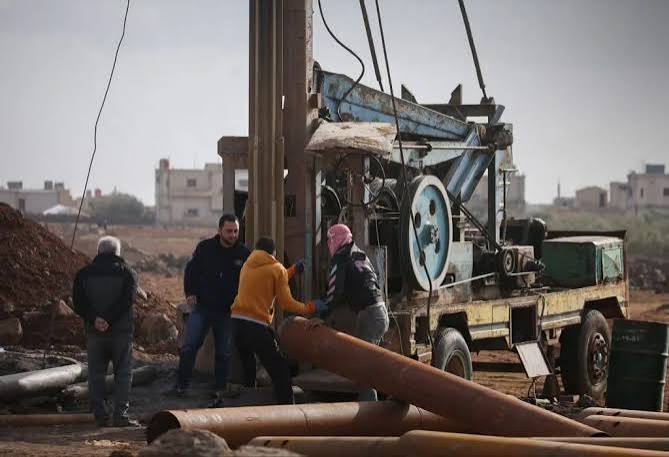
The Syrian Future Movement is closely monitoring the protest held by the residents of Daraa Governorate on Thursday, October 8, 2026, in front of the governorate building. The protest was staged to oppose measures involving the sealing of several water wells and the reduction of their pumping capacity; demonstrators expressed their rejection of what they described as corruption and cronyism in the management of the region’s water well sector.
The Syrian Future Movement views this protest as a legitimate expression of genuine concern. It maintains that addressing this issue requires a balanced approach that reconciles the protection of water resources from depletion with the guarantee of local communities’ right to drinking water and the safeguarding of the livelihoods of farmers who rely on these wells to irrigate their crops.
The Syrian Future Movement reiterates the position it previously stated in an article titled “The Water Crisis in Syria” (dated February 10, 2024): that the water issue in Syria has evolved into a matter of critical national security and sovereignty. It emphasizes that resolving this issue “requires a comprehensive approach that combines the protection of water resources, the guarantee of the right to water, and the inclusion of local communities in resource management.”
The Syrian Future Movement views the scale of the water crisis in Daraa with grave concern, based on official data:
According to figures from the Directorate of Water Resources, the flow rate of springs in Daraa Governorate has plummeted from 6,786 cubic meters per hour to 960 cubic meters per hour. The Directorate estimates that there are between 10,000 and 15,000 illegal wells in the governorate, while other estimates suggest the figure could reach 20,000—compared to only about 4,500 licensed wells—resulting in an annual water depletion exceeding 200 million cubic meters.
At the national level, Syria’s annual water deficit is estimated at approximately 2.3 billion cubic meters, while around 34% of Syrians lack access to safe water.
The Syrian Future Movement views these figures as an existential crisis threatening the lives of millions of Syrians; the situation places immense pressure on dwindling water resources and exacerbates the risks of drought and the degradation of agricultural land.
The Syrian Future Movement notes that the management of shared water resources is one of the most complex issues in public policy, a subject for which political science and economics have developed theoretical frameworks to facilitate understanding and address the challenges involved.
The “Common Pool Resources” theory, developed by Elinor Ostrom—winner of the 2009 Nobel Prize in Economics—is considered one of the most significant theoretical frameworks for analyzing this issue. The Syrian Future Movement notes that Ostrom demonstrated—through her field studies of groundwater basins in Southern California and irrigation systems in Nepal—that local communities are capable of sustainably managing common-pool resources without the need for privatization or nationalization, provided specific conditions are met: clearly defined boundaries (determining who has the right to use the resource), rules tailored to local conditions, genuine user participation in rule-making, self-monitoring, graduated sanctions, rapid conflict resolution mechanisms, and recognition of the right to self-organization.
The Syrian Future Movement believes these conditions are almost entirely absent from the management of water resources in Daraa. Current policies lack clarity and transparency; local communities are excluded from rule-making, and there are no effective conflict resolution mechanisms. This has exacerbated the crisis and fueled escalating protests.
The Syrian Future Movement points out that Ostrom’s findings—demonstrating that local communities can manage their own resources when the right conditions exist—offer a practical framework applicable to Daraa, as an alternative to imposing policies from the top down without meaningful participation.
The Syrian Future Movement notes that the crisis of groundwater management is not unique to Syria; many other nations have faced similar challenges and successfully addressed them through innovative approaches.
For instance, in Germany, the Federal Ministry of Education and Research launched the “Sustainable Groundwater Management” (LURCH) program. This initiative funds ten joint research projects aimed at developing practical solutions for groundwater management and ensuring its availability for future generations. The “WaterFarmers” project in the Uelzen region relies on cooperation between farmers and official authorities to develop a collaborative groundwater management system; preliminary results indicate that approximately 140 of the region’s 1,370 irrigation wells may require reduced extraction or relocation.
The Syrian Future Movement believes that this cooperative model—based on a partnership between farmers and official authorities—could inspire a similar approach in Daraa.
The Syrian Future Movement notes that Jordan faced similar challenges in managing the Disi groundwater basin, which it shares with Saudi Arabia; the two nations reached an agreement—the first of its kind between sovereign states—aimed at resolving disputes over shared groundwater resources.
The Syrian Future Movement views this model as evidence that cooperative solutions are possible even in the most complex contexts, and that managing shared resources requires political will and clear legal frameworks.
The Syrian Future Movement also points out that California faced a similar crisis in the 1990s regarding the management of the Raymond groundwater basin. The state managed to overcome the issue through a participatory management model involving both users and official authorities, which contributed to restoring the region’s water balance.
Driven by its national responsibility and guided by theoretical frameworks and international best practices, the Syrian Future Movement recommends the following:
First: Adopting a participatory approach to water resource management by establishing local groundwater management committees in each region. These committees—comprising representatives from farmers, local communities, water authorities, and official bodies—would be responsible for setting water usage rules, monitoring wells, and resolving disputes, following the German “WaterFarmers” model and aligning with Ostrom’s principles for managing common-pool resources.
The Syrian Future Movement emphasizes that involving local communities in decision-making is a fundamental prerequisite… …is fundamental to the success of any water policy; it is neither a luxury nor a secondary option.
Second: Establishing a clear and comprehensive legal framework for groundwater management. In this regard, the Syrian Future Movement calls for the redrafting and modernization of Water Legislation Law No. (31) of 2005—which dates back to the era of the ousted regime—to align with current challenges. This framework should include clear definitions of water rights, well-licensing mechanisms, graduated penalties for violators, expedited dispute resolution mechanisms, and the right of local communities to participate in rule-making, drawing on successful international models.
Third: Launching a national program to transition to modern irrigation methods (sprinkler and drip systems) targeting farmers who rely on wells for irrigation, while providing them with financial and technical incentives. This aligns with the Movement’s statement regarding “World Water Week” activities (August 24, 2026), which emphasized that “transitioning to modern irrigation methods (drip and sprinkler) in the agricultural sector” is the only way to halt the massive waste of groundwater.
Fourth: Providing fair compensation to owners of wells that are sealed or closed, and offering housing and agricultural alternatives to families relying on these wells as their primary source of livelihood. This reflects the position stated by the Movement regarding the “decision to close Al-Hol Camp” (February 24, 2026), which emphasized that “addressing this issue requires a fundamental approach—free from security or political exploitation—that guarantees the dignity of the Syrian people.”
Fifth: Enhancing transparency and combating corruption in the management of the water sector by launching transparent investigations into all instances of cronyism and corruption regarding well management in Daraa, holding those responsible accountable, and disclosing the findings to the public—consistent with the call made by the Movement in its statement regarding the “poor-quality gasoline crisis” (October 7, 2026).
The Syrian Future Movement values the right of the people of Daraa to express their legitimate demands and calls upon the transitional government to address these protests with seriousness and responsibility. It further urges the adoption of a participatory approach to water resource management that involves local communities in decision-making and ensures the preservation of resources for future generations.
The Syrian Future Movement reiterates that the water crisis is an existential issue linked to the lives and dignity of citizens, requiring fundamental and innovative solutions grounded in science, knowledge, and successful international experiences.
The Syrian Future Movement affirms that protecting water resources is both a national and moral responsibility, and that any failure in this regard constitutes a failure to uphold the rights of the entire Syrian people.