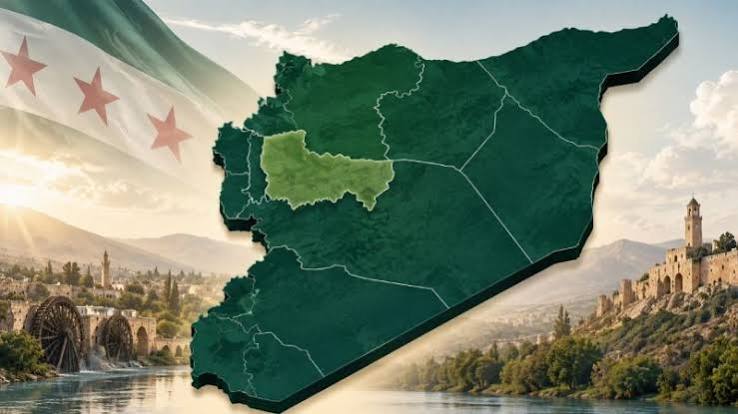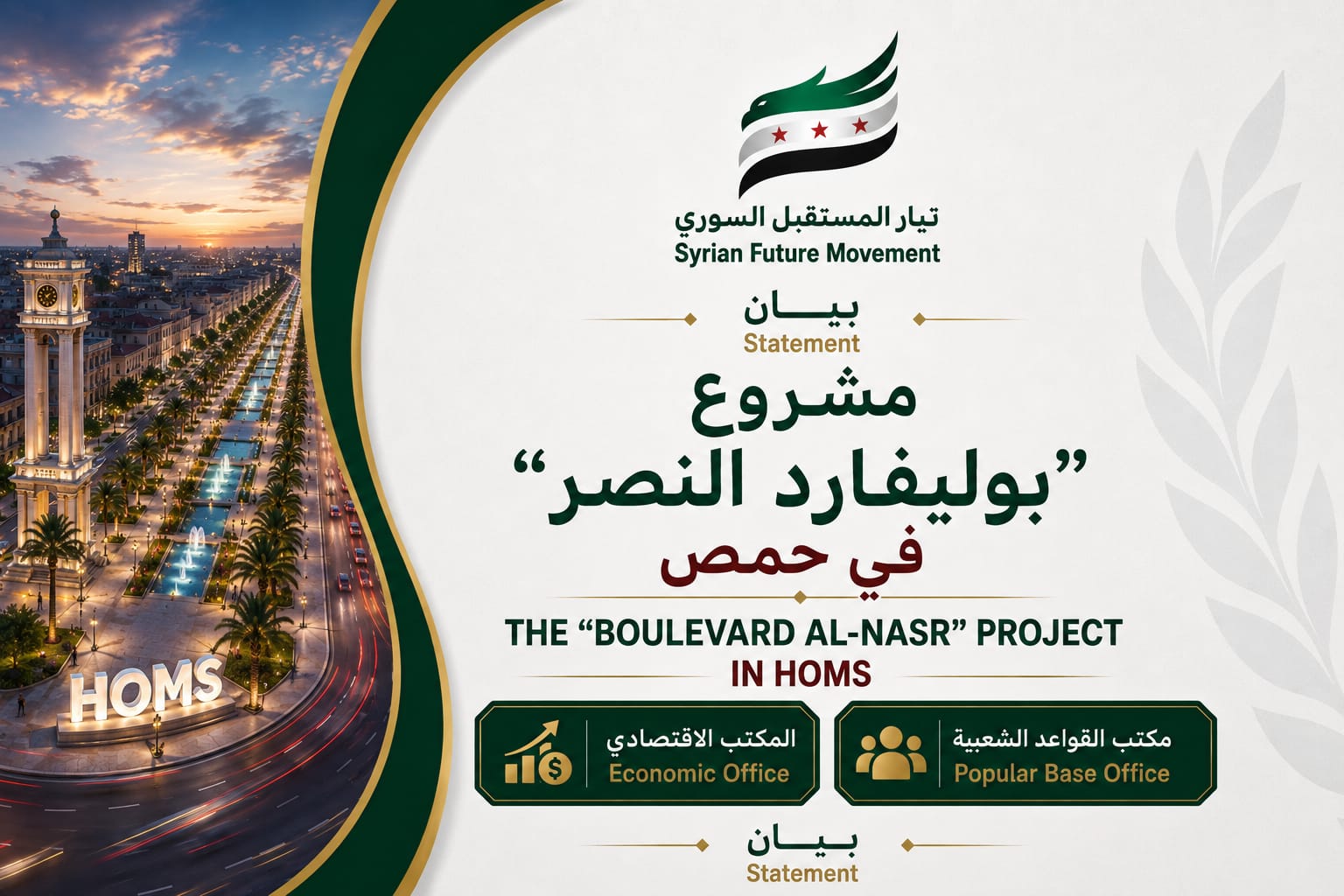
The Syrian Future Movement is following with great interest the launch of the “Victory Boulevard” project in Homs on Thursday, August 20, 2026. This project is considered one of the largest urban development and investment projects in the reconstruction phase, with promising development aspirations that include 2,500 residential apartments and approximately 10,000 direct job opportunities.
The Syrian Future Movement also appreciates any effort made to rebuild Syria and sees the Victory Boulevard project as an indicator of the economic and urban activity the country is witnessing, and the private sector’s ability to contribute to recovery efforts.
However, the Movement emphasizes that the success of any reconstruction project is measured by its ability to achieve sustainable development that benefits citizens, strengthens their trust in their state institutions, and contributes to building a new Syria on the foundations of justice, participation, and transparency.
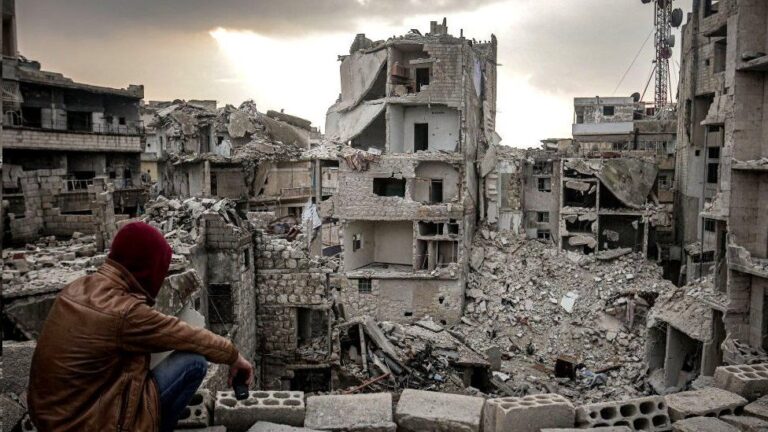
The Syrian Future Movement believes that the Victory Boulevard project is being launched at a time when there is a dire need for development projects that revitalize Syrian cities devastated by the war and provide job opportunities and decent housing for citizens. As we can see from the project’s details, from its vast green spaces to its integrated facilities, there are positive indicators of an urban vision aimed at improving the quality of life in Homs.
However, the Syrian Future Movement notes that the project faced objections from residents of the Qurbas neighborhood, who expressed their fears of a repeat of the forced displacement experiences that Syria witnessed in previous decades, and of the lack of sufficient consultation with them before the project’s announcement. For our part, we support the response of the relevant authorities, which, under pressure from the protests, led to the removal of the Qurbas neighborhood from the project’s plan. We consider this response a positive indicator of flexibility and adaptability. However, it also raises questions about the necessity of involving local communities in planning development projects from the outset, rather than after protests have erupted.
The Syrian Future Movement believes that the Al-Nasr Boulevard experience offers important lessons that should be built upon in future reconstruction projects:
- The importance of community dialogue and transparency. The lack of consultation with the residents of the Qurbas neighborhood before the project’s announcement led to tension and a loss of trust, despite the project’s developmental benefits.
- We emphasize that any reconstruction project must begin with dialogue with local communities, listening to their concerns and needs, and ensuring complete transparency in the compensation mechanism and property rights.
- Addressing the wounds of the past is crucial. Several reports we have reviewed indicate that the objections of Qurbas residents stem in part from the memory of the “Homs Dream” project under the ousted regime, which was associated with forced displacement. We reiterate that reconstruction cannot succeed without addressing the legacy of the past and building trust between citizens and the new state institutions.
- Turning challenges into opportunities for reform is essential. We see the response of the relevant authorities to the residents’ protests as an opportunity to solidify the principle of community participation as the foundation of any development project and to transform this experience into a model to be emulated in reconstruction projects across all governorates.
Based on its national responsibility, the Syrian Future Movement recommends the following:
- Establishing the principle of community participation as the foundation of any reconstruction project by creating institutional mechanisms for dialogue with local communities and ensuring their participation in planning and implementation. This will strengthen project ownership and prevent protests and delays.
- Ensuring transparency in compensation and property rights by establishing clear and fair compensation mechanisms and fully informing those affected of their rights in advance, thereby building trust and preventing disputes.
- Leveraging international expertise in participatory reconstruction, which indicates that the success of reconstruction projects depends on involving local communities in decision-making and considering the specific characteristics and needs of each region.
- Assessing the impact of development projects on local communities through thorough socio-economic impact studies, and ensuring that the benefits of these projects reach all segments of society, not just limited groups.
- Documenting the Al-Nasr Boulevard experience as a lesson learned and working to generalize these lessons to all reconstruction projects in Syria, thus contributing to building a successful national model for sustainable development.
The Syrian Future Movement appreciates the ambitious development goals of the Al-Nasr Boulevard project and calls for its completion in a spirit of participation and transparency, ensuring it becomes a successful model for reconstruction in Syria.
It is worth noting that building a new Syria is not limited to constructing buildings and infrastructure, but extends to rebuilding trust between citizens and the state, and establishing the principles of justice and equal citizenship.
The Syrian Future Movement also emphasizes that the success of reconstruction projects depends on their ability to balance development aspirations with the needs of local communities, and that dialogue and transparency are the only way to ensure these projects become a source of stability and prosperity, not tension and conflict.
For its part, the Syrian Future Movement will remain a supporter of everything that promotes sustainable development and community participation, a critic of everything that hinders its achievement, and a monitor of everything accomplished on the ground, striving for a new Syria built by the will of all its people.