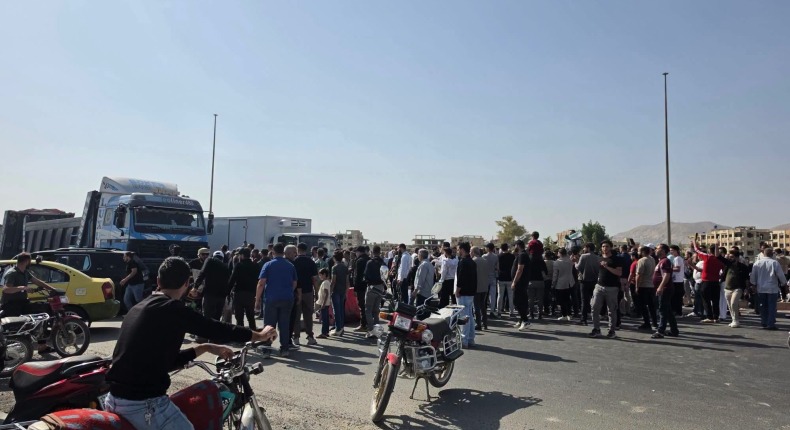
The Syrian Future Movement is following, with great concern and close attention, the escalation of popular protests in the Jobar neighborhood of Damascus. On Friday, October 23, 2026, dozens of local residents blocked the Southern Ring Road (Al-Mutahallaq al-Janubi) to protest the delays in reconstruction, as well as to express their rejection of the urban development plan and the investment proposals put forward by the Damascus Governorate.
During a meeting with residents on Friday evening, community leaders went further, calling for the resignation of the Governor of Damascus, Maher al-Idlibi, asserting that the reconstruction of Jobar “cannot proceed without his resignation.”
The Syrian Future Movement views this public outrage not as a spontaneous, isolated event, but as the culmination of years of waiting, a persistent lack of solutions, the rejection of proposals—which the neighborhood’s Board of Trustees has described as “unfair”—and the continued disregard for the residents’ legitimate demands to return to their homes and reclaim their rights.
The Syrian Future Movement emphasizes that while blocking a public road may be an understandable expression of frustration, it must remain strictly peaceful and temporary. It should not obstruct the daily lives of other citizens or interfere with their interests; a civilized form of protest is what protects a cause, rather than undermining it.
The Syrian Future Movement has noted the specific details of the crisis as documented by various sources:
The Board of Trustees of the Jobar neighborhood has officially rejected the proposed investment plan for the area’s reconstruction in its current form. They have called on the Governorate to present alternative proposals that are “more aligned with the rights of landowners,” reiterating their characterization of the existing offers as “unfair.” A correspondent for Syria TV reported that local residents rejected proposals put forward by the governorate—including an offer from a company backed by Syrian investors—citing concerns over the proposed timelines and the share of residential space allocated to the current inhabitants. The correspondent noted that the residents “did not receive an offer that meets their aspirations.”
The Syrian Future Movement points out that this is not the first time residents have rejected such proposals. On October 14, 2026, the Boards of Trustees for Jobar and Al-Qaboun called for the current proposal to be halted, citing disputes over investment ratios, property owners’ rights, and population density. They urged the authorities to “present alternatives that address the residents’ demands and ensure their participation in shaping the project.”
Furthermore, on September 8, 2026, the Liaison Committee—an offshoot of the Jobar Board of Trustees—rejected the 35% share proposed for property owners, deeming it far from equitable.
The Syrian Future Movement reaffirms its consistent position, as stated on its official website on October 15, 2026, in a piece titled “Residents of Jobar and Al-Qaboun Reject the Reconstruction Project in Its Current Form.” The movement emphasized that “the residents’ rejection is not an objection to the principle of reconstruction itself, but rather to a framework that lacks even a minimum level of transparency and clarity.” It called for “an immediate response to the residents’ demand to halt the current proposal,” the “full disclosure of all plans and studies,” and the “meaningful and direct involvement of local community representatives in all decision-making processes.” The Syrian Future Movement also recalls its statement regarding the “protest to overturn expropriation and old rent laws,” issued on August 29, 2026, in which it affirmed that “the protesters’ demands are just and legitimate, reflecting the genuine suffering endured by thousands of Syrians for decades.” The Syrian Future Movement views the current events in Jobar as a natural continuation of those demands; the state’s months-long disregard for these concerns has driven the residents to escalate their actions—including blocking roads—as prolonged waiting without a response erodes trust and fuels anger.
The Syrian Future Movement holds the Damascus Governorate and the transitional government fully responsible for this escalation. It calls upon them to provide an immediate response to the residents’ demands, rather than merely issuing statements intended to calm the situation or calling for dialogue that yields no tangible results.
The Syrian Future Movement emphasizes that while the residents’ demand for the governor’s resignation stems from accumulated frustration, its core objective is a shift in approach—not merely a change in personnel—and the adoption of a reconstruction policy that is fair to the residents and guarantees their right to return to their homes.
The Syrian Future Movement acknowledges that residents have the right to reject any proposal that fails to meet their aspirations. At the same time, it stresses their duty to maintain the peaceful nature of their protest and to avoid blocking vital roads for extended periods, as doing so disrupts the interests of other, uninvolved citizens and diminishes public sympathy for their cause.
The Syrian Future Movement further notes that the most effective form of protest is one that combines firm, clear demands with disciplined conduct.
Acting out of a sense of national responsibility, the Syrian Future Movement (SFM) makes the following recommendations:
First: Immediately halt the current proposal and begin developing alternatives. This process must involve the active participation of residents’ representatives, as well as experts in urban planning and law. A fair share of the property’s market value must be allocated to the owners, with a range of options provided—such as cash compensation, an alternative housing unit, or a partnership stake in the project.
Second: Publicly disclose all project-related plans, studies, and contracts, making them accessible to the general public and relevant specialists. Establish clear, binding timelines, and ensure that any subsequent amendments are subject to the approval of the residents. A lack of transparency only fuels rumors and deepens a sense of distrust.
Third: Establish a joint committee—with the authority to make binding decisions—comprising representatives of the residents, the Damascus Governorate, the Ministry of Public Works, and independent experts. This committee should be tasked with reviewing the current proposal, developing alternatives, and overseeing implementation; its decisions must be enforceable, not merely advisory.
Fourth: Initiate an immediate dialogue with the prominent figures and the Board of Trustees of Jobar. Their demands should be addressed directly, rather than through an exchange of public statements; direct dialogue is the only path to calming tensions and forging a sustainable solution.
Fifth: Uphold the right to peaceful protest and ensure the protection of demonstrators. At the same time, residents are urged to keep their actions peaceful and to avoid blocking main roads for extended periods, as the protection of one’s own rights should not come at the expense of others’ interests. The Syrian Future Movement values the legitimate stance taken by the residents of Jobar, viewing their protest as an expression of the genuine suffering endured by the neighborhood—which was devastated during the years of war—and by its people, who are still awaiting their return home.
The Syrian Future Movement further emphasizes that the reconstruction of Jobar is not merely a project It is not merely a matter of reconstruction; rather, it serves as a test of the new state’s commitment to the principles of justice, transparency, and popular participation.
The Syrian Future Movement asserts that any reconstruction project lacking societal consensus is inherently flawed—regardless of its purported developmental justifications—and that the construction of a new Syria cannot be achieved at the expense of the rights of its own people.