
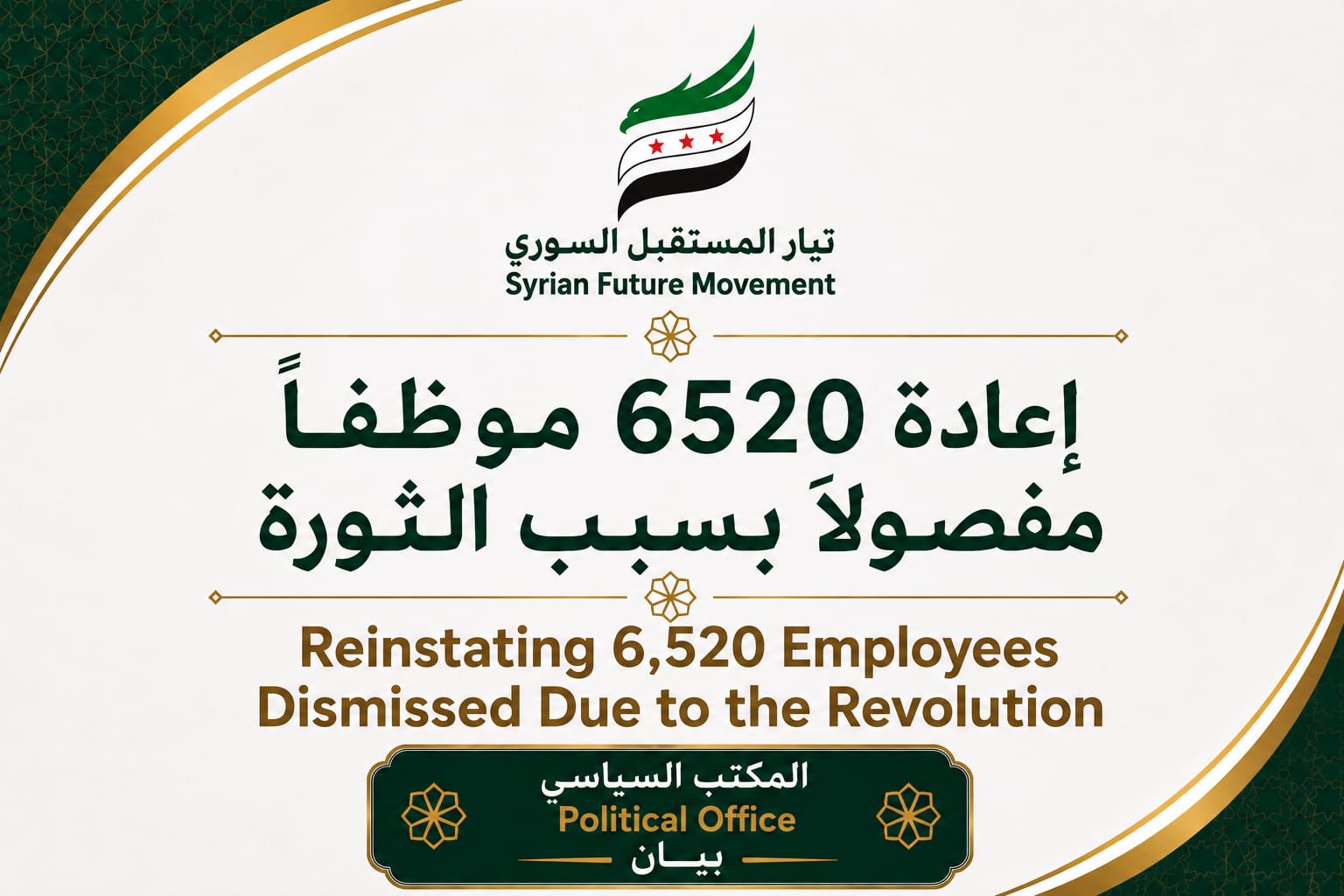
The Syrian Future Movement is following with great interest the announcement issued by the Ministry of Local Administration and Environment on Wednesday, 2026, regarding the reinstatement of 6,520 employees who were dismissed for their participation in the Syrian revolution. These 6,520 employees represent an 81% return rate out of the 8,014 whose cases were included in the file.
The Syrian Future Movement believes that the reinstatement of these employees carries several key implications, including:
First: It embodies an official acknowledgment of the grave injustice inflicted upon thousands of Syrians who lost their jobs and livelihoods simply for participating in the peaceful expression of their demands. This was one of the most prominent manifestations of discrimination and exclusion practiced by the ousted regime for decades. This step represents a correction of a historical course and the beginning of restoring dignity to a broad segment of Syrians who paid a heavy price for their affiliation with the revolution.
Second: It indicates a shift in the methodology for addressing the transitional justice file, moving from a selective approach to an institutional approach based on clear criteria. The ministry did not simply reinstate all dismissed employees automatically. Instead, it linked the process to a study of actual vacancies and the needs of public entities, and conducted individual interviews to assess the technical and administrative skills of each applicant, according to standardized criteria aimed at achieving fairness and transparency.
The Syrian Future Movement appreciates and supports this approach, viewing it as a model of good governance that balances equity and efficiency.
Thirdly, it highlights the commitment to applying the principle of “non-discrimination” in rebuilding state institutions. We endorse the ministry’s assertion that the anticipated civil service legislation will reorganize the status of public sector employees, ensuring equal rights for reinstated employees and those currently employed. We see this approach as a step towards establishing the principle of equal citizenship and ending decades of discrimination practiced by the state against its citizens.
In this context, the Syrian Future Movement reiterates its consistent positions, published on its official website, which emphasize the priority of transitional justice as a fundamental condition for building the new state:
- Statement on “Reinstating Those Arbitrarily Dismissed to Their Positions in the Ministry of Local Administration and Environment” (dated February 18, 2026): This statement welcomed the decision issued by the Minister of Local Administration and Environment, Muhammad Anjarani, on Tuesday, February 17, 2026, to reinstate 1,200 employees who had been arbitrarily dismissed from their positions under the former regime due to their support for the Syrian revolution and their commitment to the values of freedom and dignity.
- Statement on “Transitional Justice in Syria” (dated June 19, 2026): In this statement, the Movement presented a comprehensive vision for the transitional justice process, emphasizing that redressing the grievances of the victims of the former regime and restoring their rights is an indispensable condition for building a new Syria based on the principles of accountability, reconciliation, and reparation.
The Syrian Future Movement believes that this step, despite its importance, faces major challenges that require fundamental solutions:
- The continued absence of 1,494 employees from reinstatement. These employees, who did not meet the conditions for return or did not submit the required documents, need clear mechanisms to address their situations and ensure they are not left behind.
- The gap between temporary contracts and permanent legislation, which is evident in the reinstatement of employees on temporary contracts, despite their necessity as an interim solution, leaves their situations in limbo until the new Civil Service Law is issued.
We call for the swift enactment of this legislation to provide job security for those returning. - Ensuring that appointments align with competence: Despite the professional procedures adopted by the Ministry, the greatest challenge remains ensuring that reinstatement is based on merit and competence, not just fairness, thus preventing a recurrence of administrative inefficiencies.
- The lack of training programs for those returning, as many of those dismissed have spent years away from government work, necessitates training and development programs to enhance their skills and align them with the requirements of the current phase.
- The need to extend this experience to all ministries is paramount. The Ministry of Agriculture and the Ministry of Local Administration have already taken similar steps, and the remaining ministries and public institutions should follow suit to ensure fairness for all those dismissed across all sectors of the state.
Based on its national responsibility to monitor the progress of state-building and the strengthening of its institutions, the Syrian Future Movement recommends the following:
- Expediting the enactment of the new Civil Service Law to serve as the permanent legal framework regulating the status of returning employees, guaranteeing their job security, and ensuring equal rights for all employees.
- Addressing the situation of the 1,494 employees who did not meet the requirements by extending the deadline for submitting the necessary documents or providing alternative mechanisms to rectify their situations and ensure they are not deprived of their right to return.
- Implementing training and rehabilitation programs for returning employees to enhance their skills and align them with the demands of government work in the current phase, ensuring their ability to perform efficiently.
- Extending this experience to all ministries and public institutions, following the example of the Ministries of Agriculture and Local Administration, to guarantee fairness for all those dismissed across all sectors of the state, without exception.
- Establishing oversight and monitoring mechanisms to ensure that rehiring is based on competence and merit, and to prevent any attempts to circumvent established professional standards.
- Launching an awareness campaign within institutions to inform both new and existing employees about the importance of this step, and to instill a culture of acceptance and reject the culture of exclusion and discrimination that prevailed for decades.
The Syrian Future Movement appreciates this step, which restores dignity to thousands of Syrians who lost their jobs due to their patriotic stances, and sees it as an embodiment of the principle of transitional justice, which it has long advocated.
We emphasize that providing justice for the victims of the former regime is a fundamental condition for building trust between the state and its citizens, and for the success of any national reconciliation process.
The Syrian Future Movement affirms that this step, despite its importance, is the beginning of a path, not its end. Transitional justice is not limited to reinstating employees, but extends to holding perpetrators accountable, restoring usurped rights, and ensuring that practices of discrimination and exclusion are not repeated.
In turn Yes, he will remain a supporter of everything that promotes justice and reconciliation, a critic of everything that hinders its achievement, and a monitor of everything that is accomplished on the ground, striving for a new Syria in which the rule of law prevails, and the dignity of all citizens is preserved without discrimination.