
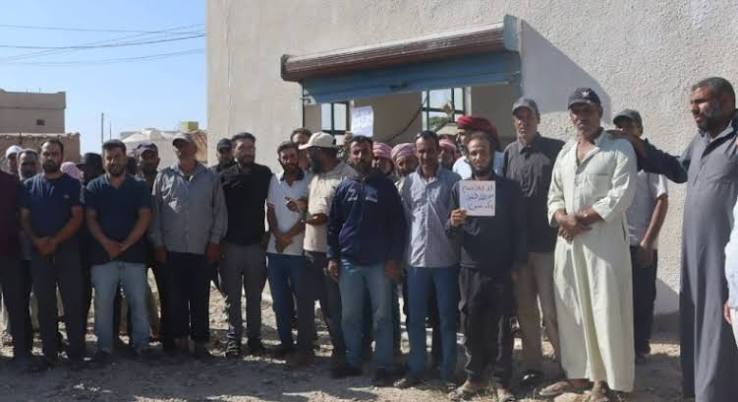
The Syrian Future Movement is monitoring the protest staged by workers from the Water Corporation and its facilities in the city of Al-Shaddadi and its countryside—south of Al-Hasakah—on Sunday, October 4, 2026. The protest, held in front of the corporation’s headquarters, is a response to delays in integrating them into Syrian government institutions and the failure to pay their salaries and financial dues, which have been outstanding for approximately ten months.
The Syrian Future Movement views these workers—who continue to operate and maintain a vital service facility for the population despite the suspension of their salaries—as a stark example of the institutional neglect affecting the most vulnerable segments of Syrian society. They bear a profound humanitarian responsibility to ensure water supplies for hundreds of thousands of civilians, yet they and their families are left to cope with the high cost of living without any source of income.
The Syrian Future Movement emphasizes that the delay in salary payments has evolved into a humanitarian crisis directly impacting the lives of hundreds of families. Households are struggling to meet daily needs, patients face difficulties accessing medication, and the workers’ children have been deprived of necessary school supplies, all while a large number of employees have accumulated significant debt.
The Syrian Future Movement considers the persistence of this situation—more than a year after the January 29, 2026 agreement intended to end institutional duplication—to be a failure to demonstrate the transitional government’s seriousness in fulfilling its obligations toward employees in the areas covered by the integration process. Furthermore, it deepens the sense of marginalization felt by the residents of the southern Al-Hasakah countryside. The Syrian Future Movement reiterates that the water issue in Syria has evolved into a matter of national security and sovereignty—a point emphasized in its statement titled “World Water Week Activities” (dated August 24, 2026). That statement stressed that “water is the greatest human common good, which must not be monopolized or withheld from people under any pretext,” and that “protecting regional water resources and reaching international consensus on shared waterways” are essential prerequisites for safeguarding the rights of future generations.
The Syrian Future Movement regards workers in the water sector as the guardians of this national security; leaving them unpaid directly undermines the country’s water security and unfairly burdens them with the consequences of administrative disputes for which they bear no responsibility.
Furthermore, the Syrian Future Movement points out that the government’s failure to pay these workers’ salaries stands in stark contradiction to the achievements it claims to have made in the water sector.
According to Minister of Energy Mohammed Al-Bashir, the water sector achieved significant results during the first half of 2026, including the production of 558 million cubic meters of drinking water, the provision of services to over 15 million beneficiaries, and the implementation of rehabilitation projects across various governorates.
The Syrian Future Movement asks: How can there be talk of national achievements in the water sector when the very people operating facilities—such as those in Al-Shaddadi—have gone ten months without pay? And how can a state based on strong institutions be built when vital services are held hostage by administrative delays? The Syrian Future Movement reiterates its steadfast position—published on its official website on July 7, 2026, under the title “Completion of the Workers’ Union Merger in Al-Hasakah”—in which it welcomed the finalization of merger procedures for the governorate’s workers’ union. While viewing this as a “practical step toward institutional unification and state-building,” the Movement simultaneously emphasized that the merger serves as a “true test of the state’s ability to unify institutions, guarantee workers’ rights across all governorates, and strengthen the role of unions in defending their professional and social rights.”
The Syrian Future Movement believes that the current crisis facing water utility workers in Al-Shaddadi reveals that this test has not yet been passed; a merger that is merely nominal—lacking guarantees for workers’ rights—remains incomplete and fails to achieve the true objective of institutional unification.
Furthermore, the Syrian Future Movement recalls its statement dated August 14, 2026, titled “UN Report Warns of Growing ISIS Threat in Syria,” in which it asserted that “addressing the economic and social drivers of radicalization” is a fundamental prerequisite for combating terrorism, noting that “poverty, unemployment, and despair” create fertile ground for recruitment by extremist groups.
The Syrian Future Movement considers the situation of hundreds of workers in the Al-Hasakah countryside—left without salaries for ten months—to be precisely the kind of circumstance that fuels despair and frustration, thereby threatening stability in a highly sensitive region that has long been, and remains, a theater of multiple conflicts. Acting out of a sense of national responsibility,
the Syrian Future Movement makes the following recommendations:
First: Immediate payment of salaries and dues – The Syrian Future Movement calls upon the transitional government to issue an immediate decree to pay the salaries of water sector employees in Al-Shaddadi and the southern countryside of Al-Hasakah—retroactively covering the ten-month period during which payments were halted—without waiting for the completion of formal merger procedures.
The Syrian Future Movement asserts that a salary is a legal right, not a grant or a gift—as the workers themselves emphasized in their statement—and that delaying payment constitutes a violation affecting hundreds of families.
Second: Expediting merger procedures and establishing a binding timeline – The Syrian Future Movement calls for the formation of a joint committee comprising the Ministry of Energy, the Al-Hasakah Governorate, the General Federation of Trade Unions, and worker representatives. This committee should be tasked with resolving outstanding merger issues within a maximum of one month, announcing the names of those included, and ensuring that no worker who continued to perform their duties is excluded.
The Syrian Future Movement views the administrative uncertainty facing these workers—and their lack of knowledge regarding their employment status—as a form of exclusion that must be brought to an end.
Third: Holding negligent parties accountable – The Syrian Future Movement demands accountability for any party found negligent in delaying merger procedures or salary payments—whether within the Ministry of Energy, the Al-Hasakah Governorate, or any other administrative body—and insists that the findings of investigations be made public.
The Syrian Future Movement emphasizes that allowing this crisis to persist without accountability amounts to a tacit admission of incompetence and fosters a culture of impunity. Fourth: Ensuring the crisis does not recur in other sectors – The Syrian Future Movement calls upon the transitional government to conduct a comprehensive review of the personnel files of all employees in the service institutions subject to the merger in Al-Hasakah (electricity, transport, telecommunications,…[Health]), and the establishment of a unified, transparent mechanism for salary disbursement that prevents a recurrence of the situation experienced by water sector employees in other areas.
The Syrian Future Movement commends the steadfastness of the water workers in Al-Shaddadi, who continue to ensure water supplies for citizens despite having gone ten months without pay, and expresses its full solidarity with them regarding their legitimate demands.
We hold the Transitional Government fully responsible for this failure and for prolonging the suffering of these workers and their families.
We affirm that building a new Syria cannot be achieved at the expense of its working people; those who shoulder the vital responsibility of providing water to the public deserve, above all others, to have their rights upheld.
For its part, the Syrian Future Movement will continue to support measures that strengthen the rights of workers and employees, critique shortcomings, and monitor developments on the ground, all in pursuit of a new Syria where every worker is honored and every right is safeguarded.