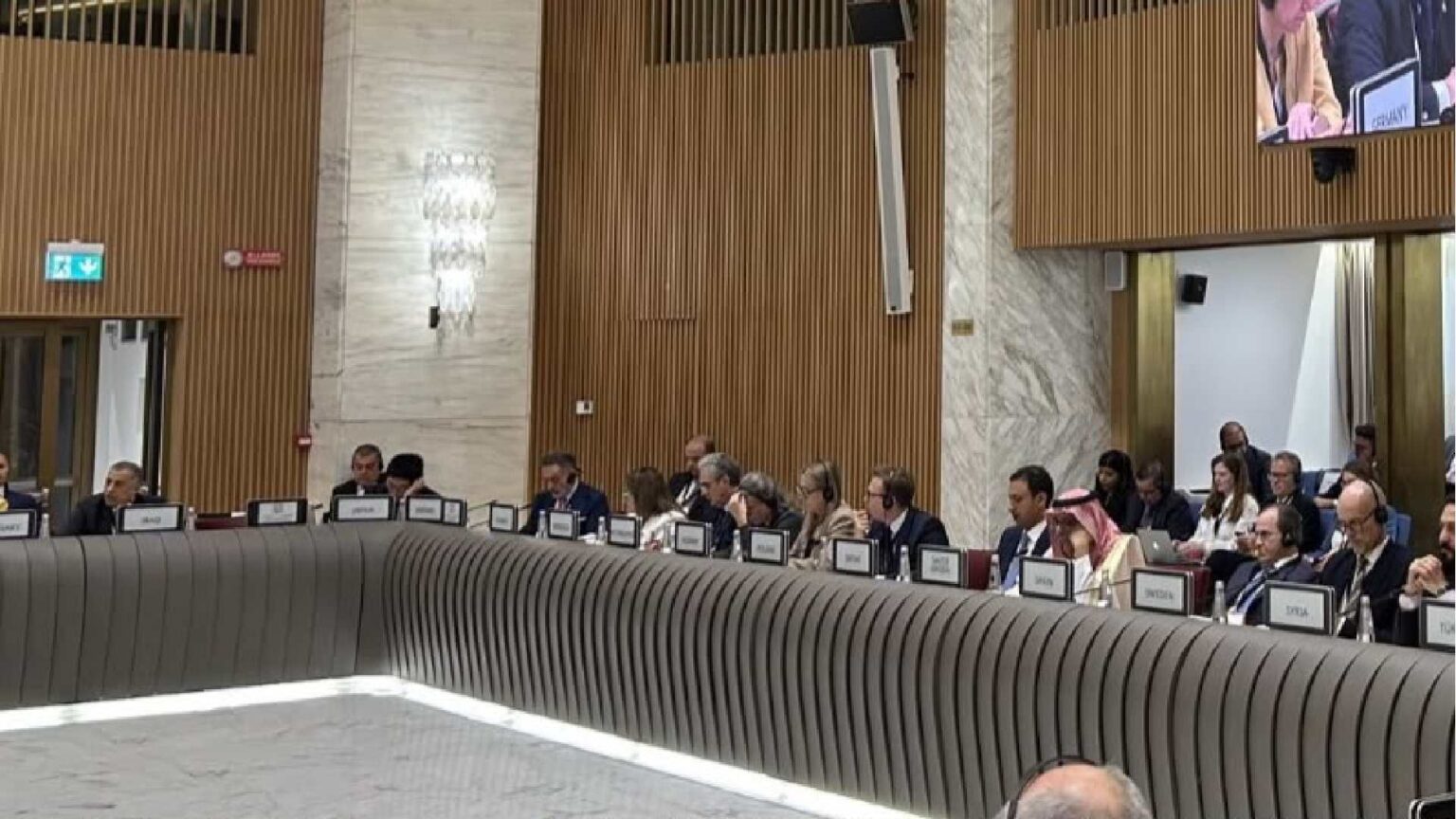
The Syrian Future Movement is following with great interest the statement issued by the U.S. Department of State on Friday, October 2, 2026, regarding the meeting of the Global Coalition to Defeat ISIS held in Rome, Italy, on October 1, 2026. The meeting was attended by 32 nations, the European Union, and several international organizations.
The statement explicitly commended the “presence of a Coalition partner in Damascus that recognizes the threat posed by the organization and is determined to work with the Coalition to curb it.” It also included financial pledges exceeding $75 million to support Syria’s counter-terrorism efforts, enhance detention capabilities, maintain health and sanitation services, and assist displaced persons and detainees.
The Syrian Future Movement values this international recognition, which reflects a shift in the U.S. and Western stance toward Syria—moving from isolation to partnership.
It views this development as the fruit of a process that began when Syria officially joined the Global Coalition as its 90th member in November 2025, following President Ahmed Al-Sharaa’s visit to Washington. This process was further strengthened by Syria’s participation in Coalition meetings, including the Riyadh meeting in February 2026 and the recent Rome meeting.
The Syrian Future Movement considers this recognition a significant step toward Syria regaining its rightful place in the international community and reinforces its position as an active partner in confronting shared threats. The Syrian Future Movement reiterates its steadfast position—published on its official website on August 14, 2026, under the headline “UN Report Warns of Growing ISIS Threat in Syria”—affirming that “Syria’s battle against terrorism is a battle for its very existence and civilization. Ultimate victory can only be achieved by building a strong, just state capable of protecting its citizens and ensuring them a dignified life, while eradicating the sources of extremism at their intellectual, economic, and social roots.”
However, the Syrian Future Movement believes that this diplomatic achievement, despite its importance, should not be viewed in isolation from the fundamental contradictions surrounding it.
There is a clear gap between the rhetoric of “partnership” championed by the International Coalition and actual practices on the ground.
While the Coalition praises cooperation with Damascus to combat ISIS, Israel continues its strikes on Syrian territory—most recently targeting the Abu al-Duhur military airport in the Idlib countryside on August 18, 2026. Regarding this incident, the Syrian Future Movement issued a statement on August 19, 2026, titled “Israeli Raids on Abu al-Duhur Airport,” condemning the Israeli aggression and asserting that the continuation of such attacks constitutes a flagrant violation of international law.
The Syrian Future Movement asks: How can Syria be a “partner” in the fight against terrorism while its sovereignty is violated by another power belonging to the same international system? This contradiction demands clarification from international partners. The Syrian Future Movement notes that the announced financial support, while significant, remains limited relative to the scale of the challenges.
According to a World Food Programme report issued in August 2026, 13.3 million people in Syria suffer from food insecurity—with 7.1 million facing acute levels—and approximately 15.6 million require some form of humanitarian assistance.
The Syrian Future Movement maintains that addressing these deteriorating economic and social conditions is a prerequisite for preventing terrorist groups from exploiting public grievances. This cannot be achieved with a mere $75 million; rather, it requires a comprehensive development strategy and the complete lifting of sanctions.
The Syrian Future Movement views counter-terrorism as a fundamentally sovereign responsibility that must remain under full Syrian leadership. Any international cooperation should not evolve into permanent security arrangements that infringe upon national sovereignty. Furthermore, we emphasize that agreements must be substantive rather than merely symbolic, and that international cooperation must translate into tangible projects that foster development and stability.
The Syrian Future Movement notes that the issue of ISIS detainees remains a major challenge. International reports estimate that there are between 9,000 and 12,000 ISIS detainees in northeastern Syria, distributed across prisons in Al-Hasakah, with a single facility holding between 4,000 and 5,000 of them. The Syrian government permanently closed the Al-Hol camp on February 22, 2026, following its complete evacuation. The Syrian Future Movement welcomed this decision in a statement titled “Decision to Permanently Close Al-Hol Camp in Al-Hasakah After Evacuation,” issued on February 24, 2026, describing it as a “strategic step.” However, the Movement emphasized that “addressing this issue requires a fundamental approach—free from exploitation for security or political agendas—that upholds the dignity of the Syrian people.”
The Syrian Future Movement maintains that such an approach requires a comprehensive national strategy integrating institutional reform, community development, and the promotion of moderate Islamic values—measures it had previously advocated for in its statement regarding “Syrian-Iraqi Judicial Cooperation” on August 14, 2026.
The Syrian Future Movement stresses that any support for “detention capacities” must be accompanied by clear guarantees regarding the rights of detainees, the prevention of torture, and the assurance of fair trials in accordance with international standards.
We reiterate the position stated in our release titled “Arbitrary Detention and the Necessity of Criminalizing It in Syria” (November 3, 2025): “Arbitrary detention—regardless of the perpetrator or the pretext—constitutes a national and humanitarian crime that must be explicitly and categorically criminalized in all future Syrian laws.” Driven by its national responsibility,
the Syrian Future Movement recommends the following:
First: Linking international support to addressing the root causes of extremism, and ensuring that financial aid extends beyond the narrow scope of “counter-terrorism” to encompass economic and social development programs, job creation, and the improvement of basic services in areas exploited by the organization to recruit members—most notably the Syrian Desert and newly liberated areas.
The Syrian Future Movement maintains that any security-related support not accompanied by genuine development……remains a temporary measure that does not prevent the organization from resurging.
Second: Demanding clarification of the international stance regarding Israeli attacks. We call upon the coalition’s partner nations—foremost among them the United States—to clarify their position on the ongoing Israeli strikes against Syrian territory and to condition the continuation of the counter-terrorism partnership on respect for Syria’s sovereignty and the cessation of these attacks. The Syrian Future Movement asserts that any partnership failing to respect state sovereignty or protect its territory is incomplete and cannot achieve the desired security and stability.
Third: Leveraging support to build independent national capabilities. We believe that cooperation with the coalition should serve as an opportunity to develop Syrian national capabilities in counter-terrorism, intelligence sharing, cybersecurity, and border protection. The Syrian Future Movement emphasizes that any such cooperation must operate under full Syrian leadership and aim to empower Syrian institutions to independently assume their responsibilities.
Fourth: Launching a comprehensive national strategy to combat extremism that integrates security operations, institutional reform, community development, and the promotion of moderate Islamic values. The Syrian Future Movement maintains that counter-terrorism efforts cannot succeed in isolation from addressing the economic and social conditions that fuel extremism, nor without building strong, equitable institutions that protect all citizens without discrimination.
The Syrian Future Movement values the international recognition of Damascus as a partner in the fight against terrorism, viewing it as a significant step toward restoring Syria’s international standing and opening new avenues for cooperation and partnership. However, the Syrian Future Movement points out that this recognition—despite its importance—should not be viewed in isolation from fundamental contradictions, nor should it be traded for national sovereignty or the basic rights of citizens.
The Syrian Future Movement asserts that a genuine partnership is one that respects sovereignty, translates into tangible support for development, and contributes to building a strong, just, and independent Syria—rather than entrenching temporary arrangements that serve the interests of external parties at the expense of the Syrian people.