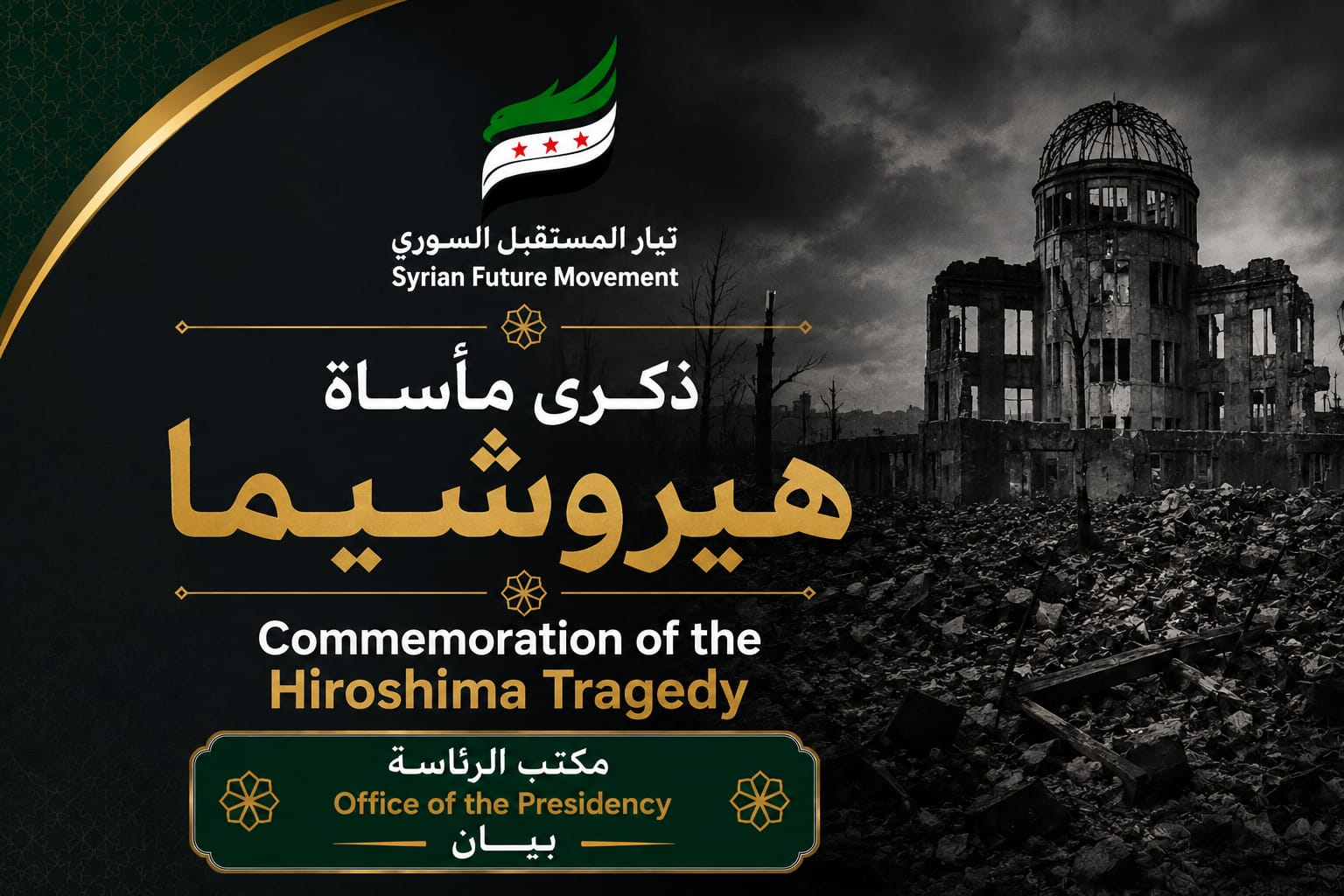
Today, Thursday, August 6th, the world commemorates the 81st anniversary of the great human tragedy of the atomic bombing of the Japanese city of Hiroshima in 1945.
This day, designated by human rights organizations and international peace movements as “Hiroshima International Day of Peace,” is observed annually by millions of free people and international activists to reaffirm the universal humanitarian stance against weapons of mass destruction and to emphasize the right of peoples to live in safety under the umbrella of genuine peace based on justice and accountability, not on deals that grant impunity.
According to documentation by the Stockholm International Peace Research Institute (SIPRI), the atomic bomb in Hiroshima killed approximately 140,000 people instantly by the end of 1945, in addition to generations who suffered from the effects of deadly radiation.
The Syrian Future Movement, while joining the international community in commemorating this painful anniversary, sees in the Hiroshima tragedy a mirror reflecting the Syrian tragedy that has persisted for fifteen years.
The Syrian people were not bombed with atomic weapons, but they endured the same genocidal bitterness through the use of deadly chemical weapons by the defunct Syrian regime and its allies in Ghouta, Khan Sheikhoun, and Saraqeb. These attacks were documented by the Organization for the Prohibition of Chemical Weapons (OPCW) and international commissions of inquiry. This was in addition to the barrel bombs and ballistic missiles that reduced Syrian cities to rubble, reminiscent of the destruction of Hiroshima.
The Syrian Future Movement emphasizes that comparing the Japanese model to the Syrian reality should not be limited to “victimhood sentiment,” but should draw profound political and structural lessons.
Japan’s rise was not the result of a mere miracle, but rather the outcome of reformulating the state’s “security doctrine” and eliminating regional conflicts.
The Syrian Future Movement believes that the features of the transitional phase in Syria require:
- Strict transitional justice as a prerequisite for peace: Japan’s experience of sustainable peace was based on dismantling the structure of genocidal militarism. In Syria, there will be no peace or stability without holding accountable the pillars of the defunct regime and its remnants who ordered the use of chemical and destructive weapons against civilians.
- Formulating a New Security Doctrine: Our vision for the future of Syria necessitates building a professional national military institution, free from partisan or sectarian ideologies, and committed to a complete ban on the possession or development of weapons of mass destruction. Its role should be to protect the borders, not to direct weapons inward against the Syrian people.
- Controlling Weapons and Dismantling Networks of Violence: A successful political transition requires a clear national strategy for disarming militias and foreign forces and collecting uncontrolled weapons, to ensure a secure environment that allows for the commencement of economic and social reconstruction.
Based on this strategic perspective, the Syrian Future Movement presents the following recommendations:
- To the international community and the United Nations: We demand an end to the current state of “inaction and political support” regarding the Syrian issue, and the activation of international criminal accountability mechanisms.
- To contemporary Syrian national forces: We call for the formulation of a “joint security and political charter” based on the principle of the peaceful transfer of power, supporting the success of the current transitional phase, and criminalizing the use of instrumental violence in political action.
- To Syrian human rights and media organizations: We urge civil society organizations to keep the issue of chemical weapons violations alive in international forums and to link it to global networks opposing weapons of mass destruction, to ensure that these crimes are not obscured or forgotten behind regional settlements, so that they are not repeated.
- To the great people of Syria: Living nations are those that build their renaissance from the ashes. Therefore, the Syrian Future Movement calls upon you to adhere to the option of civil peace, reject calls for fragmentation or sectarianism, and rally around a comprehensive national project that will rebuild Syria into a state of law, freedom, and dignity for all its citizens.