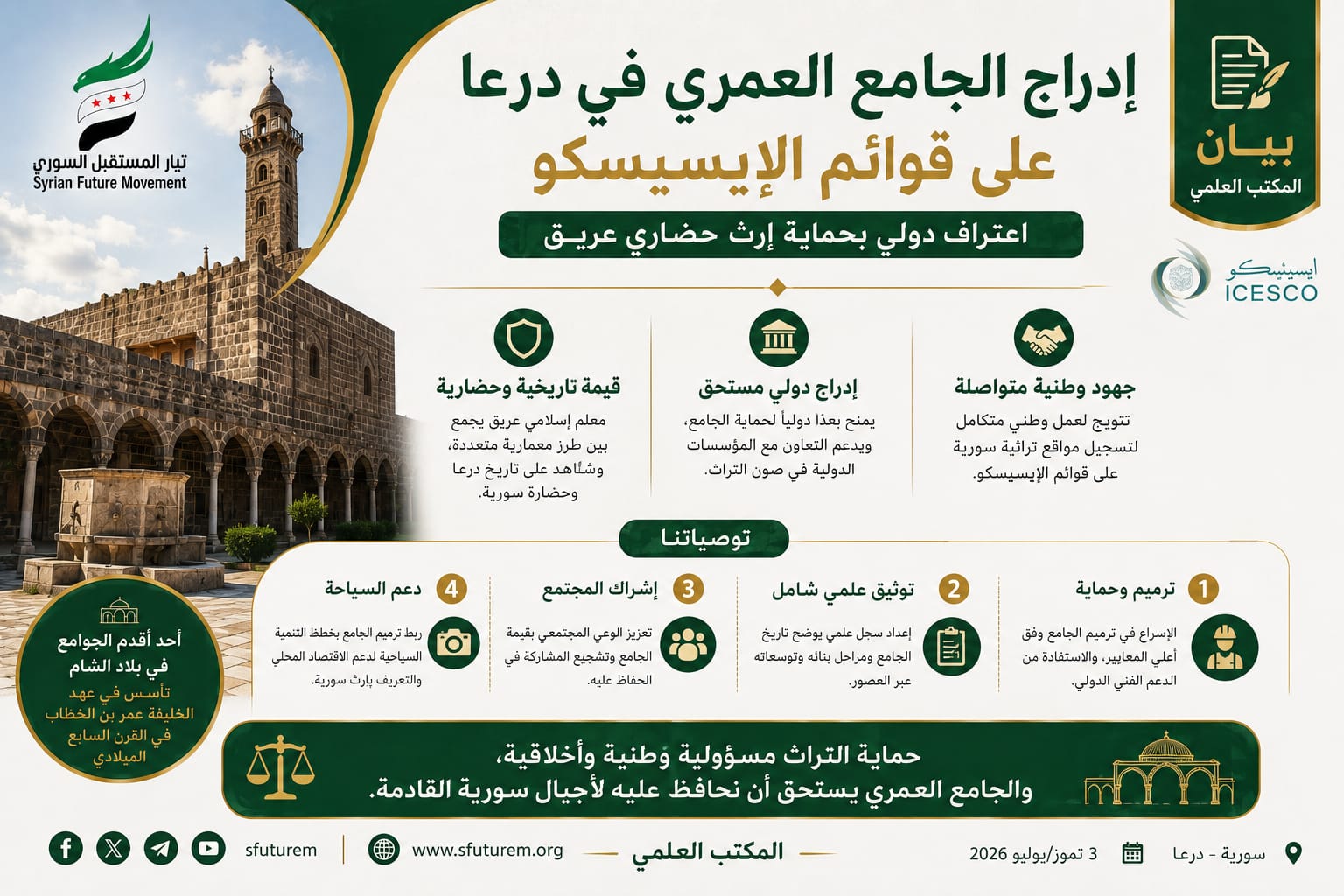
The Syrian Future Movement follows with great interest and appreciation the announcement by the Islamic World Educational, Scientific and Cultural Organization (ICESCO) of the inclusion of the Umari Mosque in Daraa on the Islamic Heritage List. This step strengthens efforts to protect one of the oldest Islamic landmarks in Syria and affirms its historical, religious, and cultural value.
While the Syrian Future Movement values this international recognition, it sees it as the culmination of continuous national efforts and an opportunity to revitalize this landmark, which has witnessed stages of Syria’s history and civilization. It also represents a true test of the state and society’s ability to translate this international momentum into tangible reality on the ground.
First: The Syrian Future Movement commends this step, which sheds light on one of the oldest mosques in the Levant, whose initial construction dates back to the era of the Caliph Umar ibn al-Khattab in the first half of the seventh century CE.
The Syrian Future Movement highly values the statement made by the head of the Daraa Antiquities Department, Muhammad Nasrallah, that the inclusion of the mosque on the ISESCO lists gives preservation efforts a new international dimension, strengthens cooperation with institutions concerned with heritage preservation, and opens the door to technical support, training, and knowledge exchange programs.
We see this achievement as an extension of national efforts that culminated in the registration of nine new Syrian heritage sites on the ISESCO list in May 2026, which confirms the Syrian state’s commitment to protecting and preserving its heritage.
Secondly, the Syrian Future Movement notes that the Omari Mosque is distinguished by its unique architectural style, which combines multiple artistic schools. It features a spacious courtyard, arcades, and a square minaret, in addition to the use of black basalt stone, characteristic of the architecture of the Hauran region.
We also recall that this landmark, located in the heart of Old Daraa, was built upon Roman and Byzantine remains and has been a religious and cultural center for centuries.
The Syrian Future Movement sees in this architectural and historical diversity an embodiment of the richness and multifaceted nature of Syrian civilization, making it a heritage for all humanity, not just Muslims.
Thirdly, while the Syrian Future Movement appreciates this important step, it emphasizes that inclusion on the ISESCO lists is not an end in itself, but rather a means to enhance protection and restoration efforts.
It also notes that the mosque suffered damage during the years of war, and that restoration work is underway to preserve its authenticity.
Based on its national responsibility, the Syrian Future Movement recommends the following:
Expediting the implementation of a comprehensive plan for the restoration of the Umari Mosque, in cooperation with international experts and utilizing the technical support and training programs offered by ISESCO, and ensuring that the restoration work adheres to the highest international standards to preserve its architectural authenticity.
Accurately documenting the history of the mosque and its features, and preparing a comprehensive scholarly record detailing the stages of its construction and expansions throughout different eras, to serve as a reference for researchers and those interested in Islamic heritage.
Engaging the local community in the mosque’s preservation efforts, organizing awareness and cultural programs that highlight its historical and religious significance, and fostering a sense of belonging and responsibility towards this landmark.
Linking the mosque’s restoration efforts to tourism development plans in Daraa Governorate, so that visiting this landmark becomes part of a comprehensive tourism experience that contributes to supporting the local economy and introducing visitors to Syria’s history and civilization. The Syrian Future Movement reiterates its welcome of this important achievement and appreciates the efforts exerted by the Directorate General of Antiquities and Museums and all relevant parties to realize it.
It also emphasizes that protecting cultural heritage is a national and moral responsibility, and that the Omari Mosque, with all its history and symbolism, deserves our collective efforts to preserve it.
The Syrian Future Movement believes that the Syrian government and the international community are called upon today to work together to ensure that this international recognition marks a genuine beginning for a new phase of care for Syria’s heritage and the preservation of its cultural identity for future generations.