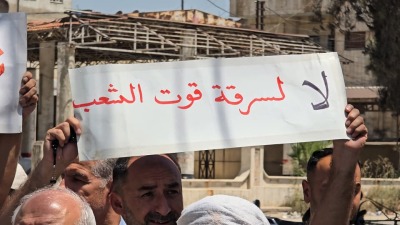
The Syrian Future Movement is following with great concern the escalating popular protests in and around the city of Qamishli, which began on Sunday, June 21, 2026, and continued the following day. These protests are in response to the unprecedented rise in fuel prices, the scarcity of subsidized diesel, and the decline in basic services, all amidst a severe heat wave gripping the region.
We view these protests, which have raised legitimate demands for improved living conditions and services, as an early warning of the dangers of failing to manage these vital issues. They also highlight the fragility of the integration process between state institutions and the Hasakah administration, and raise serious questions about the ability of the relevant parties to overcome the repercussions of this transitional phase.
Firstly, the Syrian Future Movement understands the motivations behind the protests and acknowledges the legitimacy of the popular demands, which reflect the daily suffering of citizens amidst the worsening living crisis.
The Syrian Future Movement recognizes that these protests did not arise in a vacuum, but are the culmination of accumulated economic and living conditions that have intensified in recent weeks.
We will now address the immediate causes of the protests, foremost among them:
- Unprecedented rise in fuel prices: The fuel administration in Hasakah raised the price of a liter of unsubsidized diesel from 55 cents to 75 cents, while the price of diesel from government refineries reached 88 cents, the highest in years. The price of unsubsidized gasoline also jumped to $1.10 per liter.
- Severe shortage of subsidized diesel: The price hikes coincided with the interruption of subsidized diesel supplies to private generators, bakeries, and transportation, leading to the shutdown of most generators and power outages.
- Weak infrastructure and lack of services: The crisis was exacerbated by poor government communication, further compounding the suffering of citizens amidst a severe heat wave.
Therefore, we believe these demands are an expression of the citizens’ legitimate right to a dignified life, and that responding to them is a fundamental responsibility of the state and its institutions. We also note that the protesters’ raising of slogans demanding lower fuel prices, improved living conditions, combating corruption, and the provision of electricity and water reflects a growing societal awareness of the importance of good governance and transparency in resource management.
Secondly, the Syrian Future Movement warns of the repercussions of the continued crisis and holds the relevant parties responsible for addressing its root causes.
- The Syrian Future Movement observes that the Qamishli protests intersect with the historical fault lines in the region and constitute a difficult test for governance during the transitional phase. We warn that the continuation of this crisis without a fundamental solution could lead to:
- An exacerbation of public discontent and the spread of protests to other areas, especially given the deteriorating living conditions in most Syrian governorates.
- A weakening of confidence in the integration process between state institutions and the Autonomous Administration, and a resurgence of instability that external powers exploit to bolster their influence.
The humanitarian crisis is deepening, as fuel and electricity shortages are paralyzing economic activity, halting essential services, and exacerbating the suffering of the most vulnerable groups.
The Syrian Future Movement holds the relevant parties, primarily the Sadcop Company, the Hasakah Governorate, and the Syrian Democratic Forces, responsible for addressing this crisis and demands immediate action to secure citizens’ needs for fuel and basic services.
Third: The Syrian Future Movement reiterates its consistent positions supporting citizens’ rights to basic services, published on its official website, including:
- The statement on “The Worsening Waste Crisis in Aleppo” (dated May 17, 2026), which emphasized that improving public services and strengthening infrastructure are essential for attracting investment and improving the image of Syrian cities. This also applies to the necessity of providing fuel and electricity in Qamishli.
- The statement on “Syria’s Classification Among the World’s Most Dangerous Hunger Hotspots” (dated June 19, 2026), which warned that the continued deterioration of living conditions threatens civil peace and social stability, and called for a comprehensive national strategy to address the crisis.
Fourth: Based on its national responsibility, the Syrian Future Movement recommends the following:
- Forming a high-level emergency committee, comprising representatives from the Syrian government, the Hasakah Governorate, the Syrian Democratic Forces, and the Sadcop Company, to immediately assess the crisis, secure citizens’ needs for fuel, electricity, and water, and develop an urgent plan to address the severe shortage of subsidized diesel.
- Announcing a transparent mechanism for distributing subsidized diesel, ensuring its delivery to those entitled to it, combating smuggling to the black market, and holding accountable those involved in any corruption or monopoly.
- Accelerating the integration of the “Autonomous Administration” institutions into state institutions to ensure the unification of policies and procedures, prevent the recurrence of price discrepancies and supply shortages, and enhance the state’s ability to meet citizens’ needs.
- Initiating a serious dialogue with protesters and representatives of the local community to listen to their demands, work to address them urgently, and build trust between citizens and state institutions, following successful examples in other regions.
In conclusion, the Syrian Future Movement reiterates that providing basic services to citizens is a fundamental responsibility of the state, and that failure in this area threatens social stability and undermines confidence in the state-building process.
We believe that the Syrian government and all relevant parties are called upon today to seriously address the Qamishli protests and work to resolve the root causes of the crisis, not just its symptoms, to ensure that these protests serve as a warning and are not the beginning of wider waves of protest.
For our part, the Syrian Future Movement will remain supportive, critical, and vigilant regarding this issue, striving to build a new Syria on the foundations of social justice, human dignity, and sustainable development.