
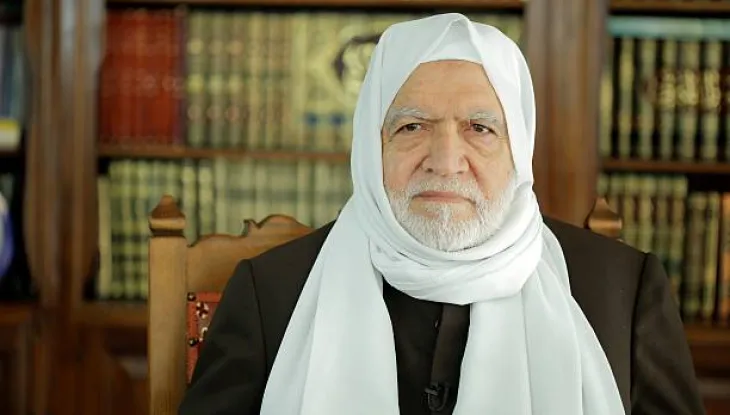
The Syrian Future Movement follows with great interest and appreciation the important address delivered by the Grand Mufti of the Syrian Arab Republic, Sheikh Osama al-Rifai, to the Syrian people on Friday, June 19, 2026. In his address, he called for wisdom and restraint, warning against the dangers of individual revenge and personal retaliation to civil peace, and emphasizing that justice and the rule of law are the only way to address the legacy of the past and build a stable future for the country.
While the Syrian Future Movement values these wise directives, it issues this statement to affirm the alignment of its vision for transitional justice with this noble national and religious call.
First: The Syrian Future Movement commends the moderate approach presented by the Mufti, which balances affirming the victims’ right to justice and accountability with warning against sliding into the chaos of revenge and retaliation that threatens the social fabric.
We see in this address an embodiment of the objectives of Islamic law, which has made justice the ultimate goal and the foundation of governance, prohibited injustice and aggression, and commanded forbearance and forgiveness when one has the power to retaliate.
We believe that the Mufti’s emphasis on “justice and the rule of law as the means to address the consequences of the past and build a more stable future” aligns perfectly with the Syrian Future Movement’s vision that building a modern state can only be achieved on firm foundations of truth and justice.
Secondly, the Syrian Future Movement points out that the Mufti’s warning against individual revenge and personal retaliation is not merely religious preaching, but a national imperative to preserve civil peace and prevent chaos.
The Syrian Future Movement reiterates that demanding justice is a legitimate right, as the Mufti affirmed that “demanding justice and holding those responsible for violations accountable is a legitimate demand and a right that cannot be ignored.”
However, in accordance with the Mufti’s statement, we stress that achieving this right must be done “through state institutions and specialized judicial bodies,” because resorting to individual revenge or illegal actions “threatens stability and undermines state-building efforts.”
The Syrian Future Movement reminds us here that Islamic law has established limits and punishments, placing their implementation in the hands of the Imam and those in authority, to protect society from chaos and ensure the organized and equitable administration of justice.
Third: The Syrian Future Movement reiterates its firm positions supporting transitional justice and accountability within legal frameworks, as published on its official website, including:
- The statement on the “judicial ruling against the symbols of the former regime and their deprivation of civil rights” (dated May 10, 2026), in which it commended the commencement of public trials for the symbols of the ousted regime, considering it a consolidation of the principle of accountability, consistent with the Grand Mufti’s call.
- The statement on the “trial of two Syrian officers in Austria” (dated June 16, 2026), in which it commended international trials based on the principle of universal jurisdiction, emphasizing that “crimes committed against the Syrian people do not have a statute of limitations,” which reinforces the Grand Mufti’s call for justice.
Fourth: The Syrian Future Movement presents a set of recommendations, based on the Grand Mufti’s statement, to ensure the translation of this national call into practical reality.
In this context, we recommend the following:
- Expediting the completion of transitional justice procedures and holding those responsible accountable, in response to the Grand Mufti’s call, because “achieving swift justice is a fundamental factor in calming anxieties and turning the page on the suffering endured by Syrians.”
- Ensuring the transparency and integrity of trials, so that they serve as a model of justice that restores rights to their rightful owners and assures victims that the state is capable of delivering redress. The Grand Mufti emphasized that “achieving fair trials and implementing judgments is what truly brings about a sense of justice.”
- Countering any attempts to exploit public anger to incite strife, warning against “parties that may seek to exploit the public anger to incite strife and destabilize social security,” which requires societal awareness and security vigilance.
- Promoting a culture of dialogue, tolerance, and the rejection of hatred, in accordance with the values of tolerance advocated by the Grand Mufti, and based on our previous statement on the occasion of the International Day for Tolerance (November 16, 2025), in which we emphasized that “tolerance is a structural element in building the modern state, not merely a moral slogan.”
In conclusion, the Syrian Future Movement reiterates its conviction that justice is the only path to fairness, and that a just judicial system is the true guarantee of the stability of the state and the cohesion of society.
We believe that the government, the judiciary, and society are called upon today to work together to translate this wise call into practical steps, and to demonstrate that the new Syria is capable of achieving the justice that the victims have long awaited, and of building a future governed by law and peace, far removed from chaos and revenge.
For our part, the Syrian Future Movement will remain supportive, critical, and vigilant regarding this issue, striving to build the new Syria on the foundations of justice, dignity, and the rule of law.