
A Renewed Purpose-Based Reading of the Verse: “And He established the balance”
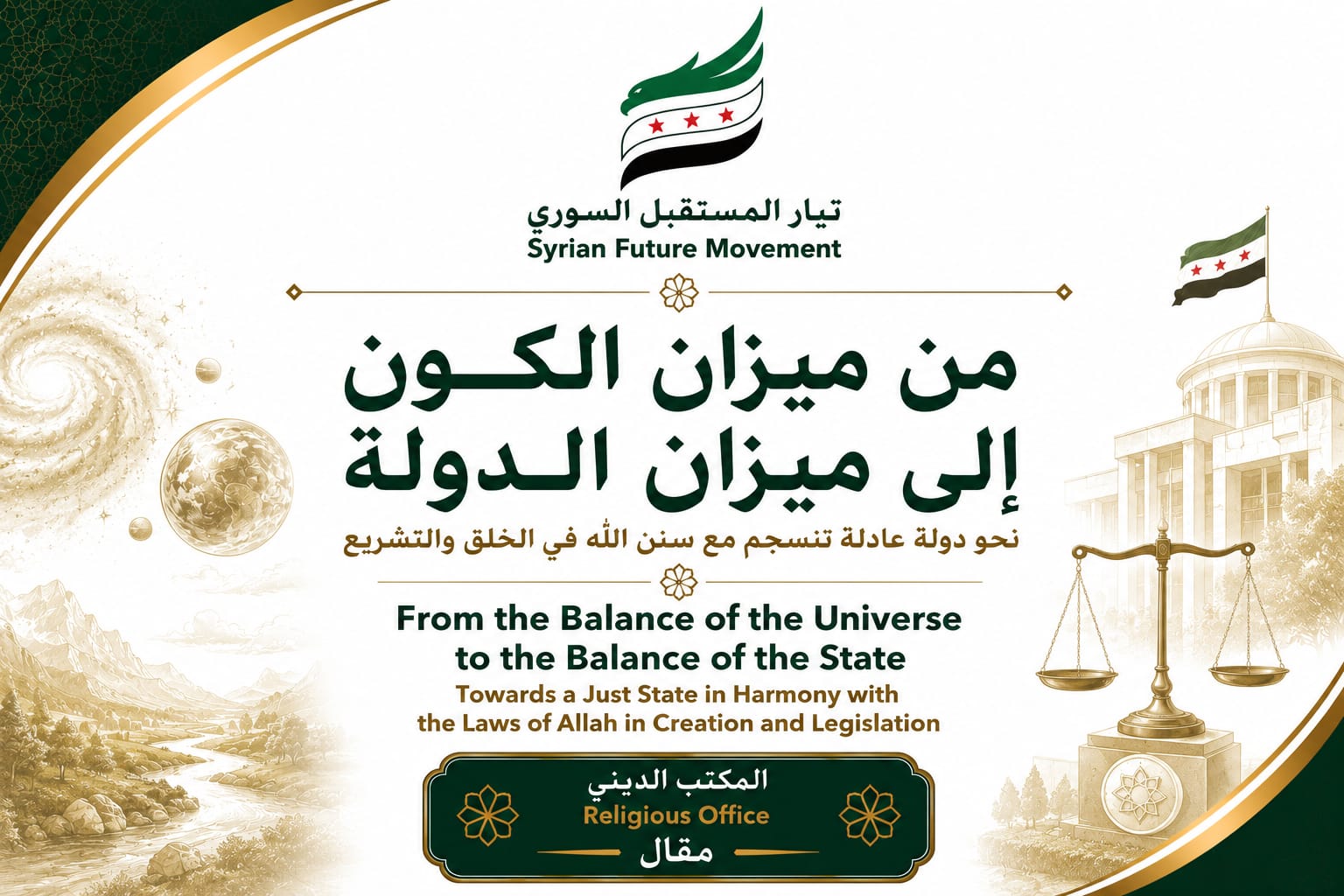
A study published by the Religious Office of the Syrian Future Movement on “The Purposes of Islamic Law and Universal Laws” attempts to build a bridge of knowledge between three levels: existence, value, and legislation.
Among the ideas that deserve deeper analysis is the concept of the balance, because it is not a limited, sermon-based concept, nor a partial legal ruling, but rather it can be viewed as one of the comprehensive Qur’anic concepts that connects the order of the universe, the justice of legislation, and the establishment of the state.
God Almighty says: “And He raised the heaven and established the balance. That you not transgress in the balance. And establish weight with justice and do not fall short in the balance.” [Ar-Rahman: 7-9]
What is striking about these verses is that the Quran moves directly from raising the heavens to establishing the balance, and then from the cosmic balance to enjoining upon humankind not to transgress and to establish weight with justice.
Herein lies a crucial idea:
Humankind is not required to replicate nature, but rather to build its moral and political world upon a principle that corresponds to the order of creation: the avoidance of transgression and the disruption of balance.
This point can serve as an important entry point for renewing Islamic thought on the state and politics.
The balance is not merely a weighing instrument:
Verses about the balance are often read in the context of trade and preventing cheating in weights and measures, which is a valid meaning, but it is part of a broader significance.
In the Quranic discourse, the balance signifies the standard by which things are measured and made upright.
God Almighty says: {We have already sent Our messengers with clear proofs and revealed with them the Scripture and the balance so that mankind may uphold justice} [Al-Hadid: 25].
Here, the Scripture represents guidance, and the balance represents the standard of justice. The aim is not for the ruler alone to uphold justice, but rather the Quranic expression is more precise: {so that mankind may uphold justice}.
This phrase opens a wide door in Islamic political thought; Justice, therefore, becomes a social and institutional responsibility, not a gift bestowed by the ruler upon the ruled.
According to this view, a just state is not merely one with a “righteous ruler,” but rather one where checks and balances prevent even an unrighteous ruler from becoming tyrannical.
Here, political thought shifts from the ethics of individuals to the architecture of institutions.
This shift is among the most crucial needs of contemporary Islamic thought.
From the Righteousness of the Ruler to the Righteousness of the System:
A significant portion of our political heritage, influenced by its historical circumstances, has focused on the qualities of the ruler: justice, piety, knowledge, courage, and ability to govern.
These are undoubtedly important conditions! However, human historical experience has demonstrated that relying solely on the righteousness of individuals is insufficient to build a stable state.
People change, power is tempting, interests become intertwined, and generations succeed one another.
Therefore, the concept of checks and balances allows us to move from the traditional question: How do we find a just ruler?
To a more institutional question: How do we build a system that makes injustice more difficult, facilitates the correction of errors, and prevents the concentration of all power in one hand?
This highlights the importance of the separation of powers, judicial independence, oversight, accountability, freedom of expression, transparency of public finances, and the rotation of responsibilities.
These mechanisms should not be viewed as mere imported modern political products. Rather, their essence can be understood within the framework of a fundamental Quranic principle: preventing tyranny through balance.
Power without oversight is unbalanced; wealth without accountability is unbalanced; a majority that fails to protect minority rights is unbalanced; freedom without responsibility is unbalanced; and security that crushes dignity is unbalanced.
Similarly, a state that fails to protect society in the name of freedom is unbalanced.
A successful state, therefore, is neither one of excess nor deficiency, but rather one of balance. And balance does not mean mere mathematical equality!
Here, it is essential to clarify a crucial concept: balance does not mean giving everyone the same thing, nor making all positions, rights, and duties identical.
Justice is broader than mere mathematical equality. Giving equal treatment to those who are unequal can be unjust, just as discriminating between them can be unjust.
This is why the Quran says: {Indeed, Allah commands justice and good conduct} [An-Nahl: 90].
Justice is giving everyone their due, according to a well-defined general principle, not based on whims or favoritism.
From this, the concept of equitable citizenship can be established: citizens are equal before the law and in their fundamental dignity and political rights. However, the state takes into account, in its policies, the most vulnerable groups, the most affected regions, and those who need additional protection.
Justice does not mean treating a province devastated by war the same as one that has not suffered the same destruction. Rather, justice may require allocating greater resources to the former to restore balance.
This is the transition from formal equality to purposeful justice.
Balance and Freedom:
One of the most dangerous errors committed by some political interpretations of religion is that they have pitted order against freedom, to the point that preserving the state has become a justification for curtailing human rights.
In reality, the Quranic balance does not permit this separation.
For humankind, whom God created with a sense of responsibility, cannot be responsible without the capacity for choice.
However, freedom itself is not synonymous with unleashing chaos or aggression against others.
Here the balance emerges once again:
Freedom without law devolves into chaos, and law without freedom devolves into tyranny.
Therefore, the state based on the objectives of Islamic law is not a state that chooses between freedom and order, but rather a state that builds a system that protects freedom, and a freedom that does not destroy the system.
This is one of the major equations that the new Syria needs.
Balance and Authority:
In the modern state, it is not enough to say that authority is a trust, and that trust requires guarantees.
The Quran itself does not separate power from responsibility: “Indeed, Allah commands you to render trusts to their rightful owners, and when you judge between people, judge with justice” [An-Nisa: 58].
Power is a trust because it is not the property of its holder.
From this, a contemporary political principle can be derived: “Every
As power increases, so too must oversight.
There is no balance if one side can act with impunity.
Therefore, a balanced separation of powers is not a conflict between them, but rather a protection for all.
An independent judiciary does not weaken the executive branch, but rather protects it from injustice.
A supervisory parliament does not undermine the government, but rather helps it identify its mistakes.
A free press does not oppose the state, but rather exposes weaknesses before they escalate into crises.
A national opposition is not an enemy of the state; rather, it can be a weight in the political balance that prevents monopolies.
Consultation as a quest for balance
From this perspective, the Syrian Future Movement’s vision of “consultation” can be understood more deeply.
It is not merely an attempt to combine the linguistic terms “consultation” and “democracy,” but should be understood as a search for an equation that unites value and mechanism.
Consultation gives politics its ethical dimension: the avoidance of tyranny, respect for the community, and the acceptance of responsibility.
Democracy offers a set of modern mechanisms that allow for the transformation of participation into institutions: elections, oversight, separation of powers, rotation of power, and accountability.
But both require a balance.
A democratic majority must not devolve into numerical tyranny.
And the value system must not become a closed authority that monopolizes the interpretation of religion.
Therefore, the state we aspire to is not governed solely by the “voice of the majority” or by the “claim to possess the truth,” but rather by a system of rights, values, and institutions.
This is the political balance.
The balance in economics:
A state that seeks political equilibrium but neglects economic equilibrium will quickly discover that economic imbalance threatens politics itself.
The Quran states: {So that wealth will not circulate only among the rich from among you} [Al-Hashr: 7].
This does not mean fighting wealth or private property, nor does it mean an economy where the state controls every detail. Rather, it means preventing money from becoming a closed force that reproduces itself and monopolizes opportunities.
Here, too, we need balance: we want investment, but we don’t want monopolies.
We want private ownership, but we don’t want the plundering of public funds.
We want a free market, but we don’t want a market without rules.
We want taxes, but we don’t want them to become a penalty for production.
We want to protect workers, but we don’t want laws that make investment impossible.
Sound economic policy is not about choosing one thing and eliminating the other, but rather about building a balance that stimulates production and preserves justice simultaneously.
This balance is even more crucial in Syria’s transitional phase.
Syria is living through an exceptional period, and the danger in exceptional periods is that necessity becomes the permanent rule.
Yes, the state may need additional powers in certain circumstances to confront a security threat or an institutional vacuum, but the principle of balance dictates that these powers be specific, justified, temporary, and subject to review.
Because an exception, if left unchecked, becomes a system of governance.
A successful transitional phase is not one that postpones institutions under the pretext of being transitional, but rather one that uses the transitional phase to build institutions that eliminate the need for exceptions.
Herein lies the difference between the mindset of the state and the mindset of power.
Power asks: How do we maintain our ability to make decisions?
The state, however, asks: How do we build a system that remains just even when decision-makers change?
This is the philosophy of balance in its deepest sense.
From Objectives to State Architecture:
True renewal based on objectives is not achieved merely by talking extensively about grand objectives, but by transforming them into measurable institutional principles.
If we say that justice is an objective, we must ask: How do we measure the independence of the judiciary?
If we say that consultation is an objective, we must ask: How do citizens participate in decision-making?
If we say that preserving public funds is an objective, we must ask: How is public spending monitored?
If we say that human dignity is an objective, we must ask: What guarantees prevent torture and arbitrary detention? If we say that the unity of society is an objective, we ask: How do we protect the rights of its constituent groups without transforming diversity into a system of power-sharing?
Thus, the objectives shift from the realm of exhortation to the realm of the state.
This, in our view, is one of the most important avenues for renewing Islamic political jurisprudence in the 21st century.
In conclusion:
The verse, “And He has set up the balance so that you will not transgress in the balance” (Quran 7:157), is not merely a discussion of nature, nor solely of the balance of the market, but rather embodies a profoundly insightful civilizational vision.
God created the universe according to a system, granted humanity freedom, and then entrusted them with the responsibility of not allowing their freedom to become tyranny.
Therefore, the state closest to the legitimate objectives is not necessarily the one that most frequently employs religious terminology, but rather the one most capable of establishing a balance between power and right, freedom and responsibility, the individual and society, authority and oversight, the majority and the minority, the market and justice, and the constancy of principles amidst the evolution of means.
The Syria we aspire to does not need a weak state in the name of freedom, nor a tyrannical state in the name of stability.
It needs a state of balance, strong in the rule of law, not above it; just among its citizens; accountable; a protector of rights; and capable of transforming core values into living institutions, not mere slogans.
Here, drawing inspiration from universal principles within the framework of Maqasid-based thought becomes more than just intellectual contemplation; it becomes a project for rebuilding the very concept of the state.