Executive Summary:
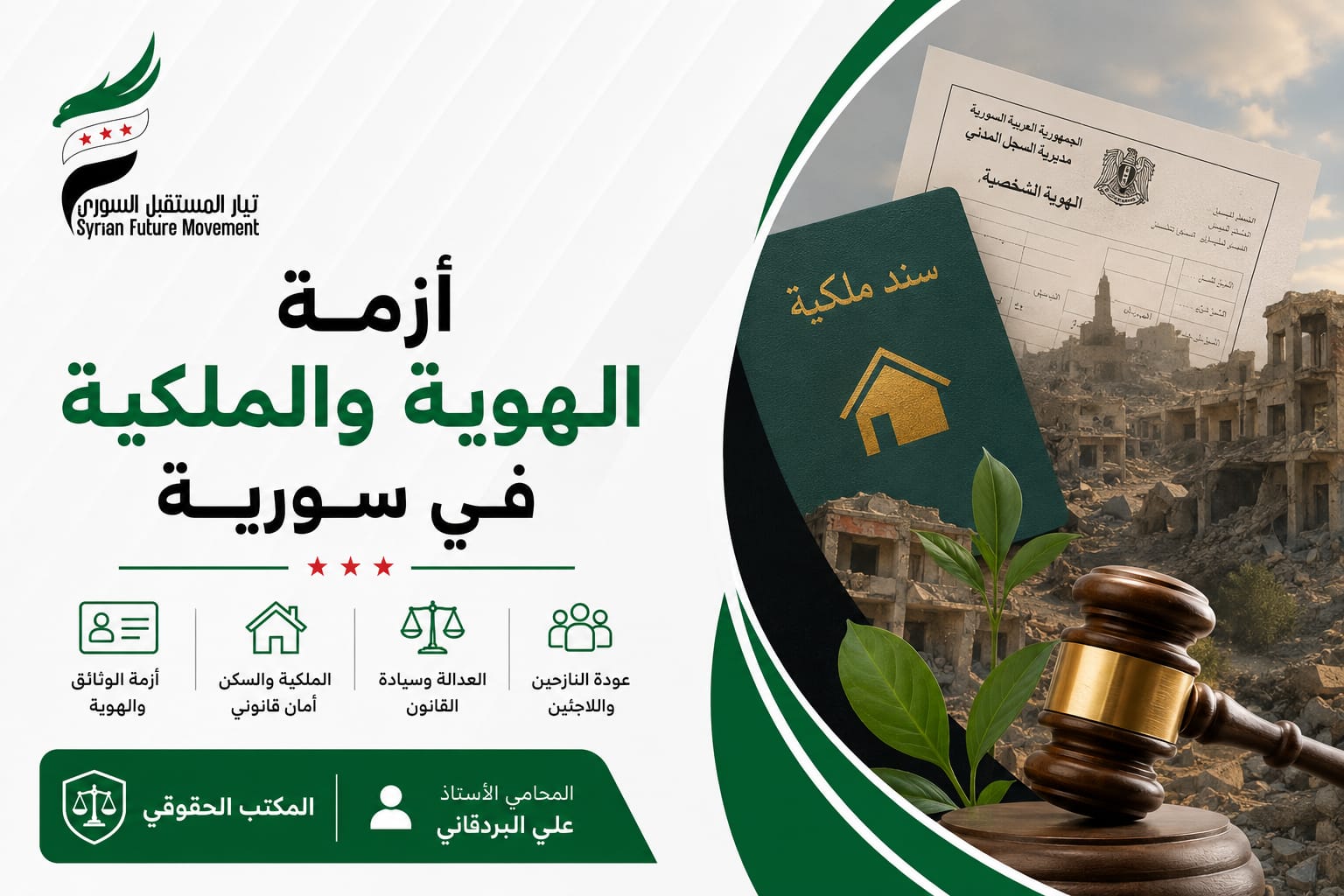
No country can build stable institutions or achieve sustainable economic and social recovery while millions of its citizens are unable to prove their legal identity or ownership of their homes and land. Civil identity and property deeds are not merely administrative documents; they represent the foundation of citizenship, the rule of law, and trust between the individual and the state.
In the Syrian context, the crisis of civil documentation and housing, land, and property rights (HLP) is one of the most complex challenges facing the transition and reconstruction phase, given its direct impact on the return of refugees and internally displaced persons, social stability, investment, and economic development.
This article is based on a field assessment conducted by the Norwegian Refugee Council (NRC), completed in December 2025, which included 1,200 families in nine Syrian governorates, as well as 28 focus group discussions and 36 interviews with experts and specialists. Its findings show that 62% of families lack civil identification documents, while 61% lack official property ownership documents. This percentage rises to 80% among those who have returned since December 2024.
This article discusses the political and legal roots of the crisis, reviews key international comparative experiences, analyzes the current Syrian reality, and presents three possible scenarios for the future of this issue. It concludes with a set of practical recommendations based on international best practices, focusing on judicial independence, property dispute resolution, digital transformation, gender equality, and sustainable financing.
Theoretical Framework:
The literature on peacebuilding and post-conflict economics agrees that legal security is a fundamental prerequisite for the success of any political transition or economic recovery. Attracting investment, reconstruction, and encouraging the return of refugees are impossible without a legal system that guarantees the recognition of the individual, their rights, and their property.
The absence of civil documents or property deeds is not merely an administrative or bureaucratic problem; it strips individuals of their legal identity and deprives them of a wide range of fundamental rights, including education, healthcare, employment, housing, freedom of movement, access to justice, and legal representation.
In this context, Federico Jagetti, the Norwegian Refugee Council’s Country Director in Syria, said:
“During a visit to northern Aleppo, I met countless families whose existence was not recorded because neither their parents nor grandparents possessed any official documents.”
This aligns with the theory of contractual citizenship, which posits that the legitimacy of the modern state rests not on the subjection of individuals to the ruler’s authority, but on a social contract that guarantees equality among citizens and ensures the protection of their legal rights without discrimination.
From this perspective, the crisis of civil and property documents in Syria is not simply an accumulation of administrative failures, but rather reflects the depth of the political crisis that has accompanied decades of authoritarian rule, where official documents have been transformed from a means of proving rights into a tool of control, domination, and exclusion. This issue is also closely linked to several established constitutional principles, most notably:
The rule of law.
Legal security.
Equality before the law.
The right to legal personality.
The right to private property.
The Constitutional Declaration issued on March 13, 2015, affirmed that “private property is inviolable and may only be expropriated for public benefit and in return for fair compensation.” This principle represents an important step in the right direction. However, its practical effectiveness remains contingent upon the establishment of independent and fair legal mechanisms to address the hundreds of thousands of property disputes that accumulated during the years of conflict.
Lessons Learned from International Experiences:
First: Bosnia and Herzegovina (1995-2005)
The Independent Quasi-Judicial Commission Model
Following the end of the war, the Dayton Peace Agreement established the Property Claims Commission (CRPC), an independent body with a quasi-judicial nature, tasked with adjudicating property claims by refugees and internally displaced persons.
Over approximately ten years, the commission processed hundreds of thousands of claims and directly contributed to creating the legal conditions for the return of nearly one million internally displaced persons and refugees.
The Bosnian experience highlights the importance of establishing a body independent of the executive branch, possessing clear legal powers, and issuing binding decisions, while guaranteeing the right of appeal to the judiciary. This strengthens public trust and reduces political interference.
Second: Rwanda (1994-2009)
Digitalization and Comprehensive Legislative Reform
Following the genocide, Rwanda launched a national land tenure regularization program (LTR), which successfully surveyed, numbered, and archived more than ten million plots of land in less than a decade.
The project was not limited to updating records; it was accompanied by comprehensive legislative reform, particularly in inheritance laws and women’s rights. This led to an increase in women’s land ownership, a significant reduction in property disputes, and enhanced legal security.
This experience demonstrates that digital transformation, however advanced, cannot achieve its goals unless it is accompanied by legislative reforms that eliminate the root causes of discrimination and guarantee equal rights.
Third: Iraq and Afghanistan
When Institutions Fail
In contrast, the experiences of Iraq and Afghanistan reveal that the mere existence of advanced laws is insufficient to guarantee justice or protect property rights.
Despite the enactment of modern legislation in both countries, the weakness of judicial independence, the persistence of corruption, and the absence of political will have, in many cases, transformed property and investment laws into tools for favoritism and power-sharing, rather than means of achieving justice and stability.
These experiences underscore that legal reform cannot succeed without independent institutions, an impartial judiciary, and an efficient public administration.
The Reality of the Crisis in Syria:
First: The Scale of the Crisis
The Norwegian Refugee Council’s assessment was based on a field study that included 1,200 families in the governorates of Aleppo, Idlib, Hasakah, Raqqa, and Daraa.
Damascus, Rural Damascus, Hama, and Homs, with completion in December 2025.
The results revealed alarming indicators, most notably:
62% of families have at least one member lacking civil identification documents, compared to only 38% with complete documentation.
80% of those who have returned since December 2024 suffer from a lack of official documents.
61% of families do not possess official property ownership documents, even though 70% reported owning or renting a residence.
21% of families face the threat of eviction, while 69% of these families confirmed that they did not receive any prior legal notice of eviction.
These figures reveal a significant legal gap that threatens social security, hinders voluntary return, and increases the likelihood of future property disputes.
Second: The Dimension Related to Women
Syrian women face compounded legal challenges in accessing property and civil rights.
According to the assessment results:
87% of women whose husbands have disappeared are unable to manage their absent husband’s assets due to the lack of a death certificate or court order.
Only 24% of women who filed for a death or disappearance declaration succeeded in obtaining a court order, while 66% of the applications remained pending.
70% of women lack official property ownership documents, compared to a lower percentage among men.
On December 19, 2025, the Ministry of Justice issued Circular No. (17), which regulated guardianship of minors, limiting it to the father and then his paternal relatives.
This circular sparked widespread legal and human rights debate, with human rights organizations considering it a perpetuation of existing discrimination against women, given its potential practical implications for managing minors’ finances and accessing civil rights.
Current Government Efforts:
Since the fall of the former regime on December 8, 2024, the transitional government has begun taking several steps to reactivate real estate and civil registration institutions, in an effort to restore a minimum level of legal security necessary for the recovery phase.
On January 21, 2025, the General Directorate of Real Estate Affairs resumed its operations, announcing the resumption of services related to property registration statements, survey data, and title deeds. On February 18, 2025, it issued a circular permitting the documentation of contracts, the placement of annotations, and their cancellation, before reopening direct property transfers at the Land Registry on August 11, 2025.
During 2025, the Directorate announced the completion of the automation of approximately 12,000 properties, the processing of more than 27,000 contracts, the issuance of 7,021 survey statements, and more than 185,000 property registration statements. This coincided with the government’s launch of a digital transformation project for civil status services.
These measures are positive steps towards restoring the functioning of institutions, but they still fall short of addressing the existing challenges. The country continues to face significant obstacles, including the destruction of large portions of the real estate and civil registries, the multiplicity of administrative authorities that emerged during the years of division, the weak technological infrastructure, the need to strengthen judicial independence, and the persistence of certain texts and procedures that raise legal and human rights issues, particularly concerning women’s access to their civil and property rights.
Furthermore, some previous administrative procedures, such as the requirement to prove payment of bank fees for contract registration, still represent an additional burden on citizens. Additionally, the continued partial operation of some civil registry offices in certain areas limits the ease of obtaining official documents.
The Return Movement and its Repercussions:
Data from the United Nations High Commissioner for Refugees (UNHCR) indicates the return of approximately 1.6 million Syrian refugees from abroad between December 2024 and April 2026, in addition to the return of nearly 1.9 million internally displaced persons to their areas of origin.
Turkey topped the list of countries from which refugees returned, followed by Lebanon. Approximately 79% of refugees remain outside Syria, although opinion polls indicate that a significant percentage wish to return once legal, security, and economic guarantees are in place.
Data reveals that the lack of civil documents and property deeds is one of the most significant obstacles to sustainable return. Around a quarter of returning refugees lack the basic documents necessary to register their children, reclaim their property, access public services, or seek legal recourse to protect their rights.
Therefore, addressing the identity and property crisis is no longer merely a legal issue; it has become a fundamental prerequisite for the success of voluntary return programs, achieving social stability, and rebuilding trust between citizens and the state.
Future Scenarios:
First: The Orderly Recovery Scenario (The Best Scenario)
This scenario assumes a clear political will for reform, coupled with sufficient national and international support to achieve institutional and legal transformation.
This scenario assumes:
Establishing an independent national body for resolving property disputes, similar to the CRPC in Bosnia and Herzegovina.
Completing the reform of personal status and inheritance laws to ensure equality and non-discrimination.
Completing the full digital transformation of civil and land registries and linking them to a unified national platform.
Providing sustainable funding for documentation and legal aid programs.
If these conditions are met, it is expected that 70-80% of property disputes will be resolved within five to seven years, creating conditions for the return of millions of refugees and improving indicators of legal security and social stability.
Second: The Stumbling Recovery Scenario (Most Likely)
This scenario assumes the continuation of current reforms, albeit partially, without addressing the institutional and legislative roots of the crisis.
In this case, property disputes will continue to accumulate, voluntary returns will remain limited, trust in institutions will remain weak, and socio-economic pressures will increase due to the fragility of the legal system.
Third: The stalemate and collapse scenario (the worst-case scenario)
This scenario is based on the failure of reforms and the renewal of tensions.
Security concerns, declining international support, and the continued absence of legal solutions.
In this situation, property disputes may escalate, trust in public institutions may erode, and temporary displacement may become permanent, threatening opportunities for stability and development for decades to come.
Recommendations: Based on international experiences and the Syrian context, the Legal Office of the Syrian Future Movement proposes the following:
First: At the Institutional Level
Establish an independent national body for settling property disputes, possessing binding legal powers and guaranteeing the right of appeal before the judiciary.
Establish specialized courts and departments for real estate and personal status disputes to enhance the speed of adjudication and the quality of rulings.
Adopt community mediation as a supportive means of resolving disputes, without replacing the judiciary.
Second: At the Legislative Level
Review personal status and inheritance laws to ensure their consistency with the principles of justice, equality, and constitutional guarantees.
Enact a law specifically addressing missing and disappeared persons that balances family protection with the guarantee of financial and civil rights.
Simplifying procedures for obtaining civil and real estate documents, reducing fees, and standardizing procedures across all governorates.
Third: At the Technical and Administrative Level
Completing the digital archiving of real estate and civil records and linking them to a unified national platform.
Unifying databases across different regions and institutions, and eliminating the duplication that resulted from years of conflict.
Fourth: At the Social Justice Level
- Launching national legal awareness programs, focusing on women and the most vulnerable groups.
- Establishing mobile legal teams to provide free assistance in rural and remote areas.
Fifth: At the Funding and Partnership Level
Establishing a national fund to support document issuance and resolve legal disputes for the most vulnerable groups.
Engaging Syrian expatriate expertise in documentation, digitization, and capacity-building programs.
Strengthening partnerships with international organizations to ensure the continuity of technical and financial support and the transfer of international expertise to national institutions.
Conclusion:
The identity and property crisis in Syria reveals that state-building does not begin with reconstructing buildings, but rather with rebuilding the legal relationship between the citizen and the state. A civil document is not merely an official paper, and a property deed is not simply an administrative procedure; both represent the state’s recognition of the individual’s existence, rights, dignity, and legal standing within society.
International experience has demonstrated that countries that have successfully overcome the effects of war did so not because they possessed greater financial resources, but because they were able to build independent institutions, an impartial judiciary, just legislation, and a public administration that enjoys the trust of its citizens.
Conversely, other experiences confirm that the absence of legal justice leads to prolonged conflicts, weakens investment, hinders the return of refugees, and erodes trust in state institutions, regardless of the extent of reconstruction efforts.
Today, Syria stands before a historic opportunity to re-establish a modern legal system that enshrines identity as a right for every citizen and protects private property as a cornerstone of stability, development, and the rule of law.
The success of this path will not be measured by the number of documents issued by the state, nor by the number of transactions completed by its institutions, but rather by its ability to instill confidence that the law protects all citizens equally and safeguards their rights without discrimination or exclusion.
If Syria succeeds in this, the identity and property crisis can be transformed from one of the most dangerous legacies of the past into one of the most important pillars for building a state of law and institutions. However, if it is neglected, it will remain one of the most serious challenges threatening the path to national recovery and stability for many years to come.