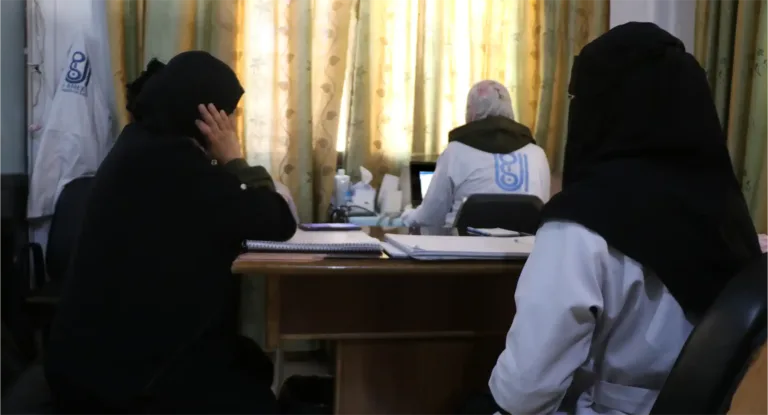

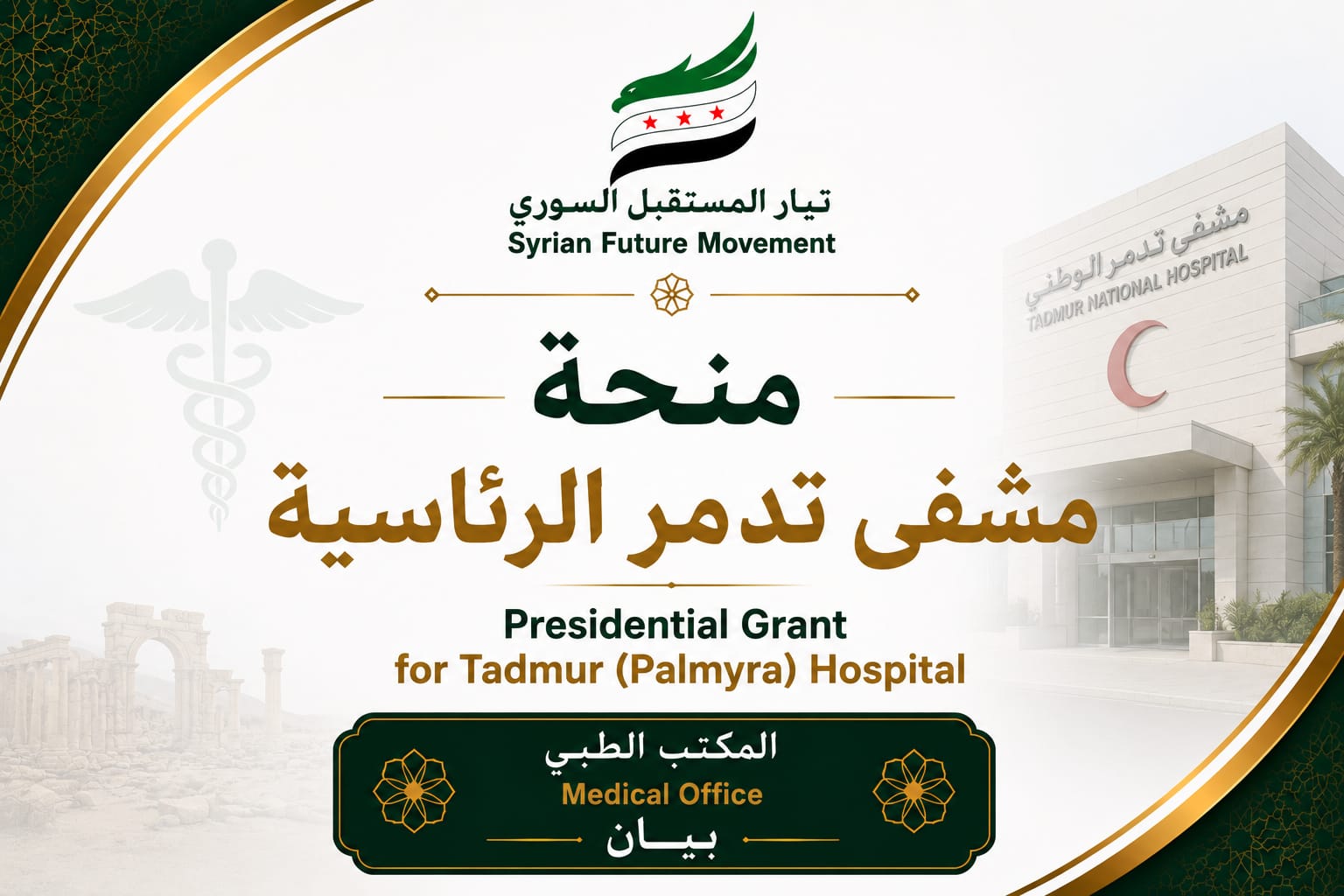
The Syrian Future Movement is closely following developments related to Palmyra National Hospital, beginning with the city’s residents’ protest at the end of last month demanding improved healthcare services, continuing with the announcement of a $1 million presidential grant to support the hospital on Monday, August 10, 2026, and culminating in the opening of the dialysis unit in the presence of the Minister of Health.
The Syrian Future Movement supports any effort to improve healthcare services for citizens and considers the presidential grant a positive and commendable step, especially given the dire needs of the healthcare sector in newly liberated areas.
However, we view this situation within a broader context concerning the nature of the relationship between the state and its citizens, the mechanisms for meeting public needs, and the priority of building permanent institutions over exceptional measures.
The Syrian Future Movement notes that the presidential grant, despite its moral and material value, remains within the framework of an “exceptional donation” that does not negate the need for sustainable and institutionalized healthcare policies. In a modern civil state, citizens should not have to wait for a presidential grant to receive adequate healthcare. Rather, it is their right to receive it through a comprehensive national plan, a dedicated budget, and standards that guarantee fairness and quality.
The context in which the grant was issued—following a protest by residents of Palmyra and a tragic traffic accident that revealed the extent of the challenges—raises a legitimate question: Was this grant the result of a prior needs assessment, or was it a reaction to public protests? The difference between these two scenarios is the difference between a state of institutions and a state of reactive measures, especially considering the circumstances of Syria’s transitional phase.
The Syrian Future Movement appreciates the protest by the residents of Palmyra, viewing it as a healthy expression of active citizenship and a legitimate right to demand basic services.
We also believe that an active civil society, capable of expressing its needs and monitoring the performance of its institutions, is a fundamental pillar of the modern state. We note that the residents’ demands—the shortage of medical and technical staff, the malfunction of medical equipment despite its arrival, and the delays in renovation work—are legitimate concerns that warrant a serious response. These demands reveal structural challenges that cannot be addressed by any exceptional grant, regardless of its size.
The Syrian Future Movement observes that the opening of the dialysis unit and the plan to expand it are positive indicators of progress toward improving services.
However, the Movement believes that the true success of these efforts will be measured by their sustainability and their ability to avoid becoming merely a fleeting media event that quickly fades after the official visit concludes.
The hospital, which suffers from a severe shortage of doctors and technicians and lacks staff to operate advanced equipment, needs fundamental solutions, not just exceptional grants. In this context, the Syrian Future Movement reiterates its consistent positions, published on its official website, which emphasize the priority of improving healthcare services and establishing the principles of good governance:
Statement on “Expanding UN Projects in Syria” (dated July 29, 2026): This statement stressed the importance of transforming humanitarian aid into sustainable development projects. The same principle should apply to support for the health sector, ensuring that grants are not merely exceptional but become permanent policies.
Statement on “The Importance of Public Oversight in Protecting the National Transition” (dated July 11, 2025): This statement called for strengthening mechanisms of public and institutional oversight and emphasized that transparency and accountability are the cornerstones of any successful national transition. This applies to monitoring the expenditure of the presidential grant and developing hospital services.
Based on its national responsibility to oversee the state-building process, the Syrian Future Movement recommends the following:
- Transforming the grant into a clear investment plan with defined spending priorities, implementation timelines, and measurable performance indicators to ensure a tangible impact on healthcare services. This plan should be published and made available for public oversight.
- Linking the hospital’s development to the Ministry of Health’s comprehensive plans ensures that Palmyra Hospital is not isolated from the national healthcare system, but rather becomes part of an integrated plan to develop health services in the eastern region, while guaranteeing the continuity of funding and technical support.
- Addressing the staffing shortage fundamentally by providing financial and moral incentives for doctors and technicians to work in Palmyra, training local staff to operate advanced medical equipment, and linking the hospital to training and contractual programs with university hospitals in Homs and Damascus.
- Strengthening communication mechanisms between the government and the residents so that popular demands are not confined to protests, but rather transformed into an ongoing institutional dialogue through local councils and health committees that participate in setting priorities and monitoring implementation, similar to the principle of binding consultation in a modern civil state.
- Launching an awareness campaign about health services to inform citizens about the services available at the hospital and how to access them, especially with the opening of the dialysis unit, which targets patients in the region, to encourage them to return to their city and receive treatment near their homes, as the Director of Health Facilities indicated.
The Syrian Future Movement appreciates these positive steps to support Palmyra Hospital, viewing them as an indication of the government’s concern for liberated areas and the improvement of their health services.
It reiterates that building a modern state is not based on exceptional grants, no matter how valuable, but rather on permanent policies and institutions that guarantee citizens’ rights to basic services without discrimination or exclusion.
The Syrian Future Movement affirms that the true success of this initiative will be measured by its ability to achieve tangible and sustainable change in the reality of health services in Palmyra, and to serve as a model for addressing the needs of other regions.
For its part, the Syrian Future Movement will remain a supporter of all that promotes justice and transparency in the provision of services, a critic of all that hinders the achievement of sustainable health development, and a monitor of all that is accomplished on the ground, striving for a new Syria where health is a right for all, not a privilege for anyone.