
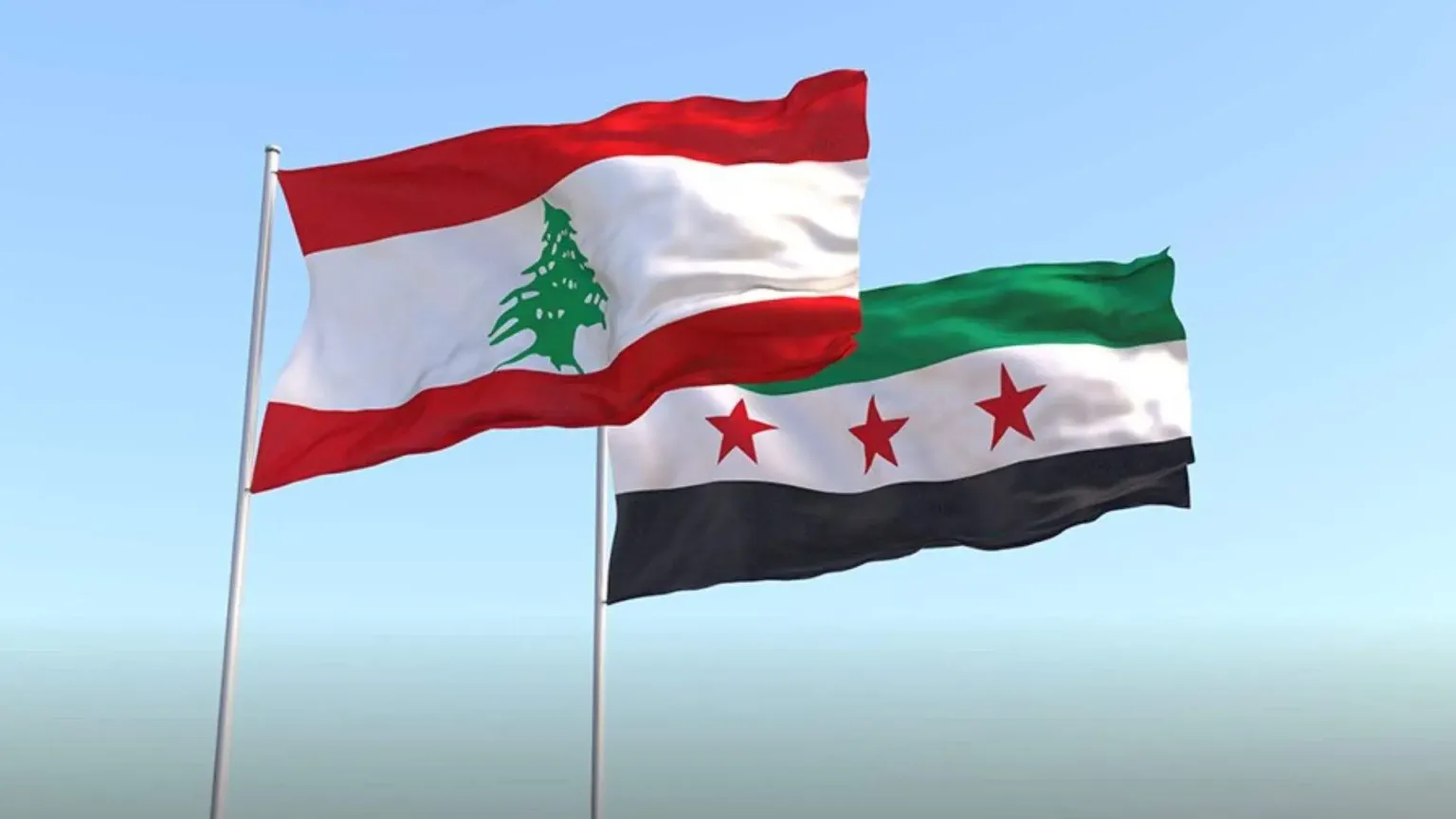
Syrian-Lebanese relations are currently at a unique historical juncture, where regional and international shifts intersect with profound internal transformations in both countries. The entire region is undergoing a reshaping of political, security, and economic balances, while the new Syria, under the leadership of President Ahmed al-Sharaa, strives to build a stable state capable of reclaiming its natural role within its Arab and regional environment. Meanwhile, Lebanon faces existential challenges related to its state structure, economy, sovereignty, and stability.
Therefore, the need has become urgent to redefine the relationship between the two countries on new foundations based on mutual respect, shared interests, and state sovereignty, moving beyond the experiences and mistakes of the past.
The Syrian and Lebanese peoples have suffered from policies that distorted the natural relationship between the two nations. During Hafez al-Assad’s era, Syria gradually transformed from an influential neighbor into a guardian of Lebanese decision-making. The era of Bashar al-Assad further complicated matters, linking the Syrian and Lebanese arenas to regional and international conflicts for which the peoples of the region have paid a heavy price, fueled by the spilled blood of Syrians.
The result was the weakening of both countries and the plunging of relations between the two peoples into a cycle of suspicion and tension whose effects are still felt today.
However, today, what President Ahmed al-Sharaa presented in his interview yesterday with Lebanese journalist Tony Khalifeh, and the preceding series of official Syrian statements, offers a different approach based on the idea of the state, not tutelage; on partnership, not hegemony; and on respect for Lebanese sovereignty and non-interference in its internal affairs.
We in the Syrian Future Movement believe that this discourse carries positive indicators of a genuine shift in Syrian political thinking and a more advanced understanding of the transition from an era of military alliances to one of strategic interests. This reflects a deeper understanding of the geopolitical transformations taking place in the region and the major changes that have occurred in Syria and the Levant in recent years.
Based on this vision, we affirm our support for establishing the best possible relations with our sister nation, the Republic of Lebanon, founded on shared interests, a common destiny, history, and geography. We also emphasize our commitment to building positive relations with all segments of the Lebanese people without exception, including the honorable Shia community, which constitutes an integral part of the Lebanese and Arab national fabric and cannot be reduced to a single party, organization, or political project.
In this context, we categorically reject any attempt to equate the brotherly Lebanese people with Hezbollah. We also reject any conflation of openness to the Lebanese state and its national components with political or moral normalization with the party.
Hezbollah was not merely a political party with whom we differed in opinion or stance; rather, it was a direct partner in the bloodshed in Syria, participating in the siege, killing, displacement, and destruction that afflicted numerous Syrian cities and villages. It also clearly contributed to prolonging the life of the deposed regime and protecting the machinery of repression that committed the most heinous crimes against the Syrian people.
Therefore, any talk of political or moral reconciliation with Hezbollah that bypasses justice, accountability, and acknowledgment of responsibility is, in our view and the view of those who share this position, not based on sound moral or national principles.
True reconciliation is not based on ignoring bloodshed or erasing memory, but rather on acknowledging facts, bearing responsibilities, and respecting the rights of victims.
At the same time, we clearly distinguish between the requirements of the Syrian state’s actions and the political and moral stance we adopt in the Syrian Future Movement.
States, by virtue of their national responsibilities, may be compelled to manage issues with various parties and to engage in dialogues or understandings dictated by the necessities of national security, higher interests, and regional stability, including issues related to Hezbollah or its supporters.
From this perspective, we understand the Syrian state’s right to manage whatever political, security, or diplomatic paths it deems appropriate to serve Syria’s higher interests, especially in light of the rapidly changing regional landscape and the complexities along the Syrian-Lebanese border.
Furthermore, we believe that any realistic approach to the future of stability in Lebanon and the region cannot ignore Iran’s role and its direct influence on a number of sensitive Lebanese issues.
Sound policy is not based on ignoring facts, but rather on managing them wisely.
Therefore, any long-term stability in Lebanon and the region will require broader regional understandings that respect the interests and sovereignty of states and prevent their territories from becoming arenas for open conflict.
Conversely, building trust between Damascus and Beirut is not limited to halting interference or preventing the use of Lebanese territory to harm Syria. It also includes judicial and security cooperation in pursuing those wanted for justice who were involved in the crimes and violations committed against the Syrian people during the era of the ousted regime. There are officers, non-commissioned officers, and security personnel, in addition to political, economic, and financial figures who benefited from the system of corruption and tyranny, some of whom have fled to Lebanon or other countries to escape legal accountability.
Therefore, we believe that any new phase in Syrian-Lebanese relations must be based on respect for justice and the rule of law, and must include legal and judicial cooperation between the two countries. This cooperation should enable the prosecution of those involved in serious crimes and the extradition of those against whom charges and evidence are substantiated to the competent Syrian judiciary, in accordance with established legal procedures and judicial guarantees. This will ensure justice for the victims and prevent impunity.
The stability of nations is not built on protecting wanted individuals or providing them with safe havens, but rather on establishing the principle that major crimes do not have a statute of limitations, and that the rights of victims remain an essential part of any lasting peace or genuine national reconciliation.
In addition to the political, security, and judicial dimensions, the major economic transformations that are taking place…
This region opens up vast horizons for unprecedented Syrian-Lebanese cooperation, as President al-Sharaa pointed out.
Projects related to energy, transportation, trade, and reconstruction, in which Syria seeks to play a pivotal role, can offer Lebanon significant economic opportunities and contribute to alleviating its chronic crises, provided this historic moment is properly utilized within a framework of cooperation and integration between the two countries.
We believe that the future of Syrian-Lebanese relations must be built on new foundations based on economic cooperation, developmental integration, and security coordination between the two countries, on respect for borders and sovereignty, non-interference in internal affairs, and the establishment of genuine partnerships that serve both peoples, far removed from the logic of axes and open conflicts.
Thus, Syria and Lebanon have a rare opportunity to transition to a different phase, one characterized by the state, institutions, and shared interests, free from tutelage, dependency, and cross-border weapons.
Therefore, we extend our hands to the Lebanese state and to the Lebanese people in all their national diversity, and we look forward to building the best possible relations between our two brotherly countries. We emphasize that respecting the blood of Syrians and the rights of their victims is not a trivial matter that can be overlooked. Distinguishing between Lebanon as a state and Lebanon as a people, on the one hand, and Hezbollah as an organization that participated in the killing of Syrians, on the other, is a moral, political, and national distinction that is essential if we are to build a healthy and stable future for Syrian-Lebanese relations.
The future we envision between Damascus and Beirut is one of partnership between two independent states, not a future of tutelage, militias, or the transformation of homelands into open arenas for regional conflicts.
The challenges are great and the obstacles are numerous, but the alternative to dialogue and cooperation is the continuation of stagnation and conflict, which serves no one.
The opportunity is ripe today for Syrians and Lebanese to turn a painful page in history and open a new chapter defined by sovereignty, dignity, shared interests, development, and stability.
This is the message that we believe the current stage compels us to deliver clearly, frankly, and without ambiguity.