
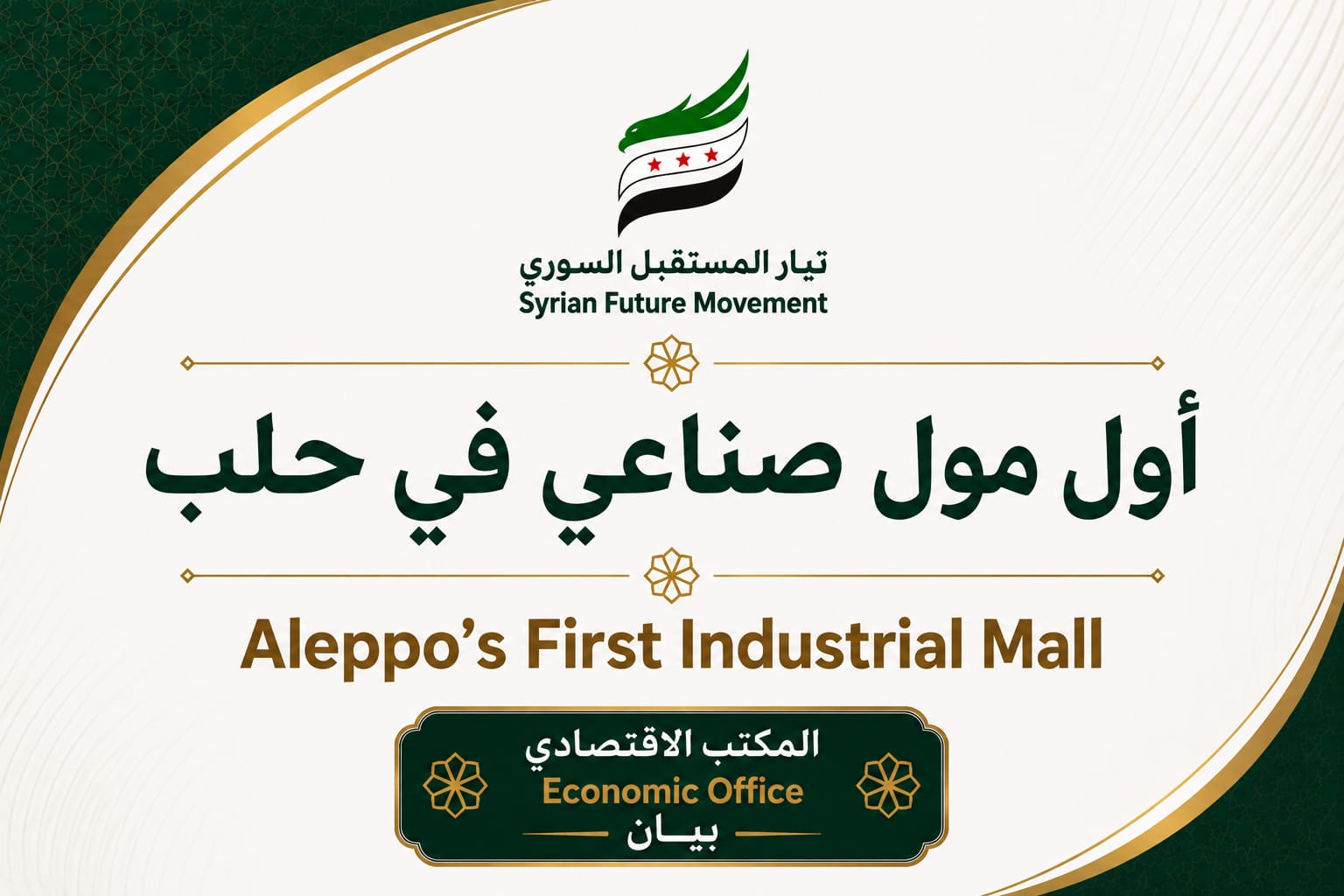
The Syrian Future Movement is following up on the announcement of an investment contract signed between the Sheikh Najjar Industrial City administration and Dubai-based Asphix Trading Company to establish the first integrated industrial mall in Aleppo, under a Build-Operate-Transfer (BOT) agreement for a period of 25 years.
The project, located in the second-tier industrial zone and covering an area of 3,200 square meters, will consist of three floors housing commercial offices, indoor and outdoor showrooms, warehouses, and service facilities dedicated to equipment, tools, and industrial production inputs.
Construction is scheduled for completion within two years. The project aims to improve services offered to investors, business owners, and workers in the city, attract commercial agencies and specialized services, and provide a direct link between suppliers of equipment and supplies and industrial facilities, particularly those operating in the textile and iron sectors.
The Syrian Future Movement notes that the signing of this contract carries three key implications:
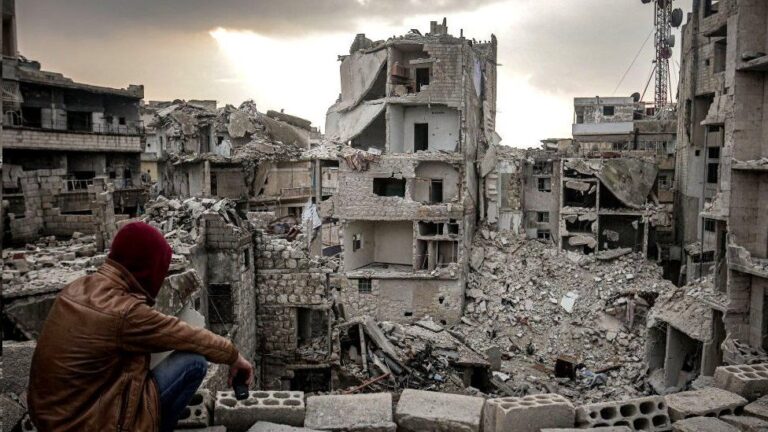
First, it embodies the gradual return of confidence in private investment to Aleppo, a city that paid a heavy price during the years of war.
The presence of a Dubai-based company, a vital regional financial hub, investing in Sheikh Najjar Industrial City indicates that Syria’s investment climate is beginning to attract foreign investors and that Aleppo is regaining its rightful place as an industrial and economic powerhouse.
Secondly, it points to a shift in the government’s approach towards partnerships with the private sector through the adoption of the BOT (Build-Operate-Transfer) system. This system allows the private sector to finance, implement, and operate projects, then transfer ownership to the state upon contract expiration.
If properly implemented, this model reduces the burden on the public treasury, transfers administrative and technical expertise from the private sector to the state, and contributes to accelerating the pace of development.
Thirdly, it helps address one of the most significant obstacles facing Syrian industry: the difficulty for industrial facilities to easily access production inputs, equipment, and supplies in one location.
The existence of an integrated industrial complex that brings together suppliers and industrial facilities in one place reduces search and transportation costs, saves time and effort, and facilitates maintenance and the supply of spare parts.
In this context, the Syrian Future Movement reiterates its consistent positions, published on its official website, which emphasize the priority of rebuilding the industrial sector as a fundamental pillar of economic recovery:
- The statement on the “Vehicle Factory Project in Partnership with China” (dated July 29, 2026), which commended the move to localize industry and transfer technology, and stressed that industrial revival requires high-quality international partnerships and investment in national talent.
- The statement on “Expanding UN Projects in Syria” (dated July 29, 2026), which emphasized the importance of transforming humanitarian aid into sustainable development projects, and that investment in development is the only way to ensure that Syria does not return to cycles of crisis.
- The article “Investing in Post-Conflict Syria” (dated June 29, 2026), which discussed the challenges facing investment in Syria, and called for creating an attractive investment environment by improving infrastructure, simplifying procedures, and strengthening the rule of law.
The Syrian Future Movement believes that this project, despite its importance, faces major challenges that require fundamental solutions:
- Speed of completion: The project requires two years for implementation, which is a reasonable timeframe. However, we must remember that delays in implementing investment projects have been a prominent feature of past decades, necessitating oversight and monitoring mechanisms to ensure adherence to the timeline.
- Sustainability of operation after 25 years: The contract extends for a quarter of a century, a long-term horizon that requires legal and regulatory guarantees to protect the rights of both parties and ensure the project’s continuity after its transfer to state ownership.
- Aligning the project with local market needs: The focus on the textile and iron sectors reflects an awareness of the importance of these sectors, but it requires a thorough study of market needs to ensure that supply does not become oversupplied or fail to meet actual demand.
- Infrastructure challenges: Despite being established in 2004 on an area of 4,412 hectares, the Sheikh Najjar Industrial City still requires continuous development in roads, electricity, water, and communications to ensure a comprehensive and attractive industrial environment.
Based on its national responsibility to monitor the progress of state-building and the strengthening of its institutions, the Syrian Future Movement recommends the following:
- Adopting transparency in contract implementation by publishing periodic progress reports and making information available to the public and media, similar to the commitment of government agencies to disclose the results of investment projects.
- Integrating the project into the industrial zone development plans, ensuring it is not isolated but rather becomes part of a comprehensive plan to develop the infrastructure and logistics services in Sheikh Najjar City, thus guaranteeing maximum benefit for investors and businesses.
- Leveraging international expertise in management, as the company has indicated its intention to utilize international expertise in managing commercial and industrial centers. This will provide an opportunity for knowledge transfer and training Syrian personnel in the latest management practices.
- Strengthening ties between the mall and small and medium-sized industrial enterprises, ensuring the project is not limited to large investors but provides equal opportunities for SMEs to access production inputs and equipment.
- Establishing mechanisms to evaluate the project’s economic impact, ensuring it serves as a genuine catalyst for the local economy by creating jobs, stimulating supporting industries, and increasing exports.
The Syrian Future Movement appreciates this step, which strengthens the industrial revival in Aleppo and enhances the value of Sheikh Najjar Industrial City as a promising investment destination.
We reiterate that rebuilding the industrial sector is a fundamental pillar of economic recovery, and the success of this project will encourage similar projects in other industrial cities.
The Syrian Future Movement affirms that investing in industry is an investment in Syria’s future, and that industrial development cannot be achieved through isolated decisions, but rather through a comprehensive national strategy.
A combination of infrastructure development, legislative modernization, investment attraction, and human resource development.
Aleppo, once the heart of Syrian industry, is now taking its first steps toward regaining its former status, and this deserves support, monitoring, and constructive criticism.