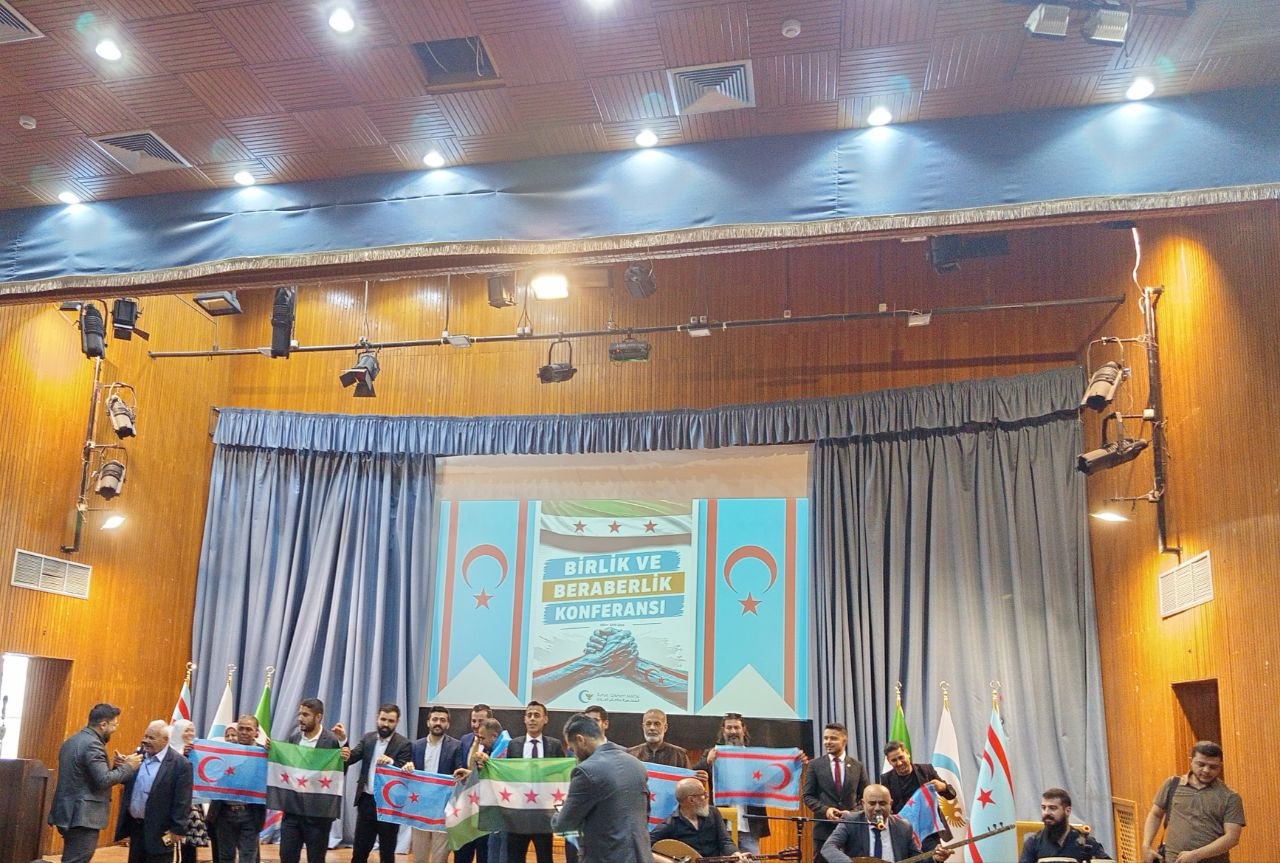
The Syrian Future Movement is following with great interest the rapidly evolving political developments in the new Syria, including the “Unity and Solidarity” conference of the Syrian Turkmen Council, held on Saturday, June 6, 2026, at the Arab Cultural Center in Kafr Souseh, Damascus. We view this conference as a positive step towards the full integration of the Turkmen component into the national political process. It sends a clear message rejecting marginalization and exclusion, and affirms that the new Syria is inclusive of all.
The Syrian Future Movement appreciates several key gains achieved by this conference:
- The symbolic significance of the venue: Holding the conference in the capital, Damascus, rather than abroad, carries profound implications, signifying a move beyond polarization and conflict, and a serious commitment to building the new state under a unified national framework.
- Recognition of diversity: The Council presented a comprehensive vision demanding constitutional recognition of the Turkmen as a fundamental component of the Syrian state, guaranteeing their cultural and educational rights (including education in Turkish), ensuring fair representation in the government, the People’s Assembly, and constitutional committees, and guaranteeing the safe return of displaced persons and the restitution of their properties.
- National Consensus: The participation of political, social, and religious figures from various communities, along with supportive statements from the head of the Kurdish National Council, Reverend Shiro Shaara, and others, reflects a national consensus that Syria’s strength lies in its unity and diversity. The Syrian Future Movement believes the conference also faced clear challenges, most notably:
- The Struggle for Representation: The exchange of statements between the leaders of the Turkmen Council, and the warnings issued by Dr. Tariq Silo about “reopening old wounds,” reveal internal divisions regarding leadership and representation, weakening the unified Turkmen voice and diminishing the impact of their demands.
- The Danger of Monopoly: The concern about “the monopoly of complete political and social representation of the Turkmen of Syria” within a single entity is a legitimate warning that no community can be reduced to a single entity, especially in the absence of internal democratic mechanisms.
- The Gap Between Slogans and Reality: Questions about the Council’s ability to translate its slogans into tangible reality reflect a growing frustration with the proliferation of conferences and statements that yield no results.
Based on our methodology, which draws on leading global experiences, the Syrian Future Movement believes that managing diversity in the new Syria cannot succeed through “competition among groups for quotas,” but rather through a model of equal citizenship and inclusive institutions.
In this context, we draw inspiration from the experiences of countries that have successfully transformed diversity into a strength:
- The Swiss Model (Consociationalism): Switzerland, with four official languages and more than 20 cantons, has adopted a decentralized system that grants broad powers to the regions, with a federal government based on consensus and power-sharing, making it a model of stability despite diversity.
- The Canadian Model (Multiculturalism): Canada officially adopted a “multiculturalism policy” in 1971, which not only recognizes diversity but also supports and encourages it as a national value, while protecting the rights of all groups within a unified legal framework that guarantees full equality.
- The Belgian Model (Flexible Federalism): Belgium has successfully achieved a delicate balance between its French, Dutch, and German-speaking communities through a complex yet effective federal system and mechanisms for mediation and consensus-building that transform disputes into institutional solutions.
- The Kurdistan Region Experience (Partnership): Despite the challenges, the Iraqi experience in the Kurdistan Region offers a model for managing diversity through a participatory government and power-sharing among different parties and groups, with constitutional recognition of cultural rights.
These experiences underscore that successfully managing diversity requires three essential elements: a constitution that recognizes rights without discrimination, administrative decentralization that empowers regions and communities, and electoral systems and government formation based on consensus, not absolute majority rule.
Based on the above, the Syrian Future Movement calls for:
- The swift adoption of a permanent constitution that recognizes all components of the Syrian people (Arabs, Kurds, Turkmen, Assyrians, Chaldeans/Syriacs, Armenians, Circassians, Chechens, Ismailis, Alawites, Druze, and Christians) as citizens with equal rights and responsibilities, and guarantees their cultural and educational rights within the framework of national unity.
- The adoption of a decentralized administrative system that grants governorates and regions broad powers to manage their local affairs, in accordance with their demographic and cultural characteristics, without compromising the unity and sovereignty of the state, as we advocate for participatory decentralization.
- Ensuring fair representation for all components in state institutions (the government, the People’s Assembly, local councils, and independent bodies) through electoral and organizational mechanisms that guarantee genuine, not merely symbolic, participation.
- The resolution of internal conflicts among the components through dialogue, and support for the formation of democratic representative bodies within each component, preventing internal disputes from escalating into national crises.
- Activating the role of an independent body for rights and freedoms to monitor any hate speech, discrimination, or marginalization, and to promote a culture of tolerance and diversity as a national value.
The Syrian Future Movement commends the Syrian Turkmen Council’s initiative in holding the “Unity and Solidarity” conference in Damascus and calls on all Syrian communities to follow this model and engage in a comprehensive national dialogue that will produce a clear roadmap for managing diversity.
We also believe that the new Syria we aspire to will not be a state of one group or one party, but rather a state of equal citizenship, where a citizen’s loyalty is measured by their contribution to building their nation, not by their ethnic or religious affiliation.
Our diversity is our wealth, and our unity in diversity is the guarantee of our future.