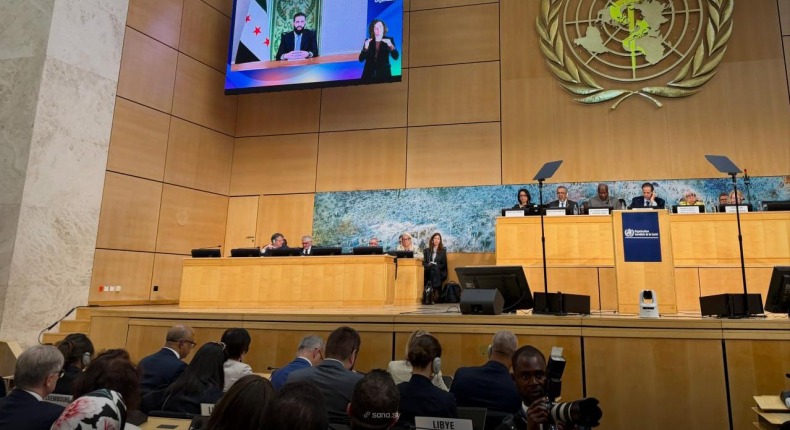
Political and diplomatic circles are closely following the participation of a high-level government delegation in the 79th World Health Assembly in Geneva, amidst the transformations Syria is undergoing after years of turmoil.
Syrian President Ahmed al-Sharaa delivered Syria’s address via video conference on Monday, May 18, 2026, coinciding with the presence of Health Minister Musab al-Ali, who headed the Syrian delegation to Geneva.
Al-Sharaa’s speech carried political and strategic dimensions that warrant attention, especially in light of the major transformations the country has witnessed over the past two years.
First, an analysis of the timing and content of the speech:
The speech came at a critical international juncture, as sensitive issues, ranging from climate change to health emergency preparedness, and from the internationalization of health to the ethics of vaccine distribution, are vying for attention at the World Health Assembly.
Syria chose to be part of this discussion, not merely to highlight its needs, but to present itself as an active and pivotal player in the region. What is striking is that the speech transcended the traditional narrative of a “stricken” or “wounded” state, moving towards forging a new identity based on the premise that Syria, as a nation, possesses accumulated experience in managing health crises under war and sanctions, and that this experience is offered as a strategic asset to the international community.
The key words of the speech were clear: “sustainability, reconstruction, climate change, and shared health security.”
Second, the humanitarian and health framework – the numbers speak for themselves:
No discussion of health in Syria can be conducted without considering the scale of the humanitarian crisis. The latest UN data indicates that more than 5.5 million internally displaced persons (IDPs) were still living in Syria as of early February 2026, while the International Organization for Migration (IOM) puts the total number of IDPs since 2011 at approximately 5.84 million. Return figures are also striking, with some 1.99 million IDPs having returned to their areas of origin since December 2024, in addition to the return of more than 1.14 million people from abroad, together representing about 11% of Syria’s total population.
In contrast, UNHCR figures show that despite the return of approximately 1.8 million IDPs, the remaining 5.5 million are still living in a fragile system that lacks the capacity to accommodate them.
Regarding health needs, the World Health Organization estimates that 16.5 million people in Syria will require humanitarian assistance in 2026, as drought, disease outbreaks, and deteriorating infrastructure continue to limit access to care.
Third, Investment and Financing:
The year 2026 saw positive developments in Syria’s international financing environment.
In April 2026, the World Bank approved a $225 million grant, allocated to a $150 million water and sanitation project and a $75 million health sector support project aimed at supporting 150 health centers to provide primary care services, with an expected impact on approximately 4.5 million Syrians.
Regarding emergency funding, the World Health Organization (WHO) released $2 million in March 2026, of which $500,000 was allocated to Syria to support internally displaced persons (IDPs), particularly the more than 104,000 people who recently crossed the border from Lebanon and the more than 116,000 IDPs in the northeast.
The Ministry of Health, in cooperation with the European Union and the WHO, also launched two projects to support primary healthcare, totaling €8 million, which included the rehabilitation of 22 health centers in rural Aleppo.
In January 2026, the WHO, in cooperation with the King Salman Humanitarian Aid and Relief Centre, delivered five fully equipped ambulances to the Ministry of Health to strengthen the emergency referral system.
Fourth, Rehabilitation of the Health Sector:
Data from the first quarter of 2026 reveals the implementation of 322 projects to rehabilitate health facilities in various Syrian governorates. 31% of these projects have been completed, while 49% are still underway. It is noteworthy that 73% of interventions were concentrated in primary healthcare centers, while hospitals came in second at 15.5%.
The projects were geographically unevenly distributed, with Aleppo and Idlib topping the list of projects under implementation and completed, while Quneitra Governorate recorded zero completed projects, reflecting a clear disparity in the recovery process between regions.
Fifth, Sanctions:
One of the most prominent developments, not explicitly mentioned in the speech but which forms a fundamental background for any analysis of the current Syrian reality, is the lifting of most Western economic sanctions on Syria. According to specialized economic reports, the extensive Western sanctions were effectively lifted during 2025, and the Caesar Act was officially repealed in December 2025. A gradual return to the international financial system began, including transactions through the SWIFT system.
This qualitative shift, from which the health sector was previously among the most affected, opens new horizons for the import of medicines and medical equipment that had been restricted for years. However, the operational and investment environment remains fraught with real risks related to the slow pace of institution building and the disparity in preparedness across different regions.
In conclusion, between numbers and ambition:
Based on the above, President al-Sharaa’s speech can be interpreted as a correct, proactive assessment of international trends. However, it was met with the stark reality that 5.5 million displaced persons have yet to return, that 322 health projects are insufficient to serve 16.5 million people in need, and that the $75 million from the World Bank remains meager in the face of the healthcare sector’s enormous needs.
What enhances the significance of the speech is its timing, coinciding with tangible developments on the ground: the lifting of sanctions, the entry of the World Bank and the European Union as active players in funding, and the emergence of genuine international partnerships, such as the one with the King Salman Humanitarian Aid and Relief Center.
The most crucial question remains: Will the Syrian government be able to translate this diplomatic momentum into tangible healthcare services that reach the displaced person in a tent in northeastern Syria, and the patient in a hospital that has yet to be renovated in Q neitra? The answer to this question will be determined over the next two years, and the next session of the Health Association will be The World Health Assembly in 2027 is a natural timeframe for assessing the gap between promises and achievements.
References:
- UNHCR Reports, February 2026
- IOM, Displacement Tracking Report, February 2026
- WHO, Emergency Response Plan 2026
- World Bank, Press Release, April 23, 2026
- Global Health Cluster, Q1 2026 Report
- Syrian Business Gateway, Investment in Syria Report 2026
- Al-Sharaa’s Address to the World Health Assembly 2026