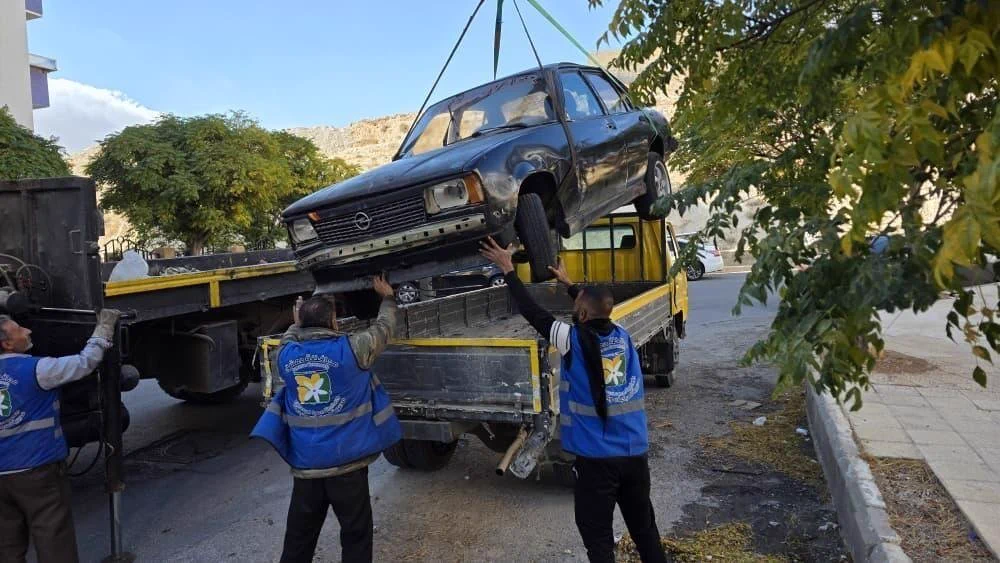
The Syrian Future Movement is closely following the ongoing campaign being carried out by the Damascus Governorate, through its vehicle, traffic engineering, transportation, and parking departments, to remove abandoned, dilapidated, and parked vehicles from the capital’s streets and neighborhoods. This campaign is in response to citizens’ complaints and aims to eliminate haphazard appearances and obstacles that impede traffic flow, amidst a gradual decrease in the number of these vehicles on the streets.
The Syrian Future Movement appreciates these efforts, which represent an institutional response to urgent public demands and contribute to improving the urban landscape and facilitating the movement of citizens, especially given the crippling traffic crisis plaguing the capital.
However, the Syrian Future Movement believes that the success of this campaign will be measured by its ability to address the root causes of the problem, ensure that this phenomenon does not recur after the campaign ends, and transform it from a seasonal measure into a permanent urban policy.
The Syrian Future Movement considers the removal of dilapidated vehicles, while important, to be a partial solution that does not replace a comprehensive solution to the transportation and traffic crisis in Damascus, nor does it address the reasons that led owners to abandon these vehicles on the streets for years.
The Syrian Future Movement believes that the problem of abandoned and dilapidated vehicles is the result of a deeper accumulation of urban and economic crises.
Years of war have led to the destruction of a large part of the transportation infrastructure, the erosion of citizens’ purchasing power, and a decline in the state’s ability to regulate traffic and maintain roads.
The Syrian Future Movement reiterates its firm position, published on its official website on the occasion of World Urban Planning Day, November 8, 2016, emphasizing that “the destruction of more than 45% of the infrastructure and housing units in vital cities” necessitates “a complete abandonment of haphazard and improvised approaches, and the immediate initiation of international and local partnerships based on good governance,” calling for “a national green and sustainable urban strategy” and “participatory local urban councils.”
The Syrian Future Movement believes that the campaign to remove dilapidated cars should be part of a comprehensive urban development vision. Removing a car from a street without providing an alternative for its owner, or without addressing the reasons for its abandonment, could lead to counterproductive results, such as increasing pressure on already limited parking spaces or prompting some citizens to abandon their cars in other areas.
The Syrian Future Movement believes that this campaign, despite its importance, presents a number of challenges that cannot be ignored:
First, we note that the campaign focuses on “moving” cars to impound lots, but it does not include, according to what has been announced, clear mechanisms for addressing the situations of these car owners, especially if they are low-income individuals who cannot afford repairs or purchases.
Here, we question the fate of these cars after impoundment. Will they be returned to their owners after their situations are resolved, or will they be sold or scrapped? And what measures will be taken against those who deliberately abandon their cars for years, without considering their circumstances?
Second: Removing cars from the streets without providing viable alternatives for public transportation (such as modern public transport, sufficient parking, or pedestrian and bicycle paths) may not solve the traffic crisis; it may simply relocate it.
Third: We note that similar campaigns in previous years did not prevent dilapidated cars from returning to the streets after a period of time.
We caution against the current campaign becoming a temporary measure unless it is accompanied by permanent monitoring mechanisms, clear legislation obligating car owners to remove their vehicles or regularize their status, and deterrent penalties for violators.
Fourth: Regular reports should be published detailing the number of cars removed, their impoundment locations, and the actions taken regarding them, to ensure transparency and prevent any exploitation or corruption in the management of this issue.
Based on its national responsibility, the Syrian Future Movement recommends the following:
First: Launching a national urban transport plan for Damascus that includes developing the public transportation network, constructing multi-story parking garages in vital areas, allocating pedestrian and bicycle lanes, and upgrading traffic signals, thus addressing the root causes of traffic congestion, not just its symptoms.
We propose that this plan be part of the national urban strategy called for in its statement on World Urban Day.
Second: Addressing the situation of owners of dilapidated vehicles by providing support programs for vehicle repair or replacement, facilitating recycling procedures, or offering symbolic compensation to owners, instead of simply impounding their vehicles and leaving their owners to face their fate.
We emphasize that addressing this phenomenon is incomplete without considering the social dimension.
Third: Strengthening ongoing monitoring mechanisms by establishing a specialized unit in the Damascus Governorate to track abandoned and dilapidated vehicles, receive reports through the “Mahloola” platform, ensure rapid response, and apply clear penalties to owners of vehicles left on the streets for extended periods without justification.
Fourth: Enhancing transparency in the management of impounded vehicles by publishing periodic reports on the number of impounded vehicles, the mechanisms for their disposal, guaranteeing the right of their owners to appeal and grievance, and preventing any exploitation of the issue.
Fifth: Involving the local community in traffic planning by forming local committees in neighborhoods, comprising representatives of residents, engineers, and relevant authorities, to contribute to developing traffic solutions suitable for each area, similar to the principle of “participatory local urban councils” advocated by the movement.
The Syrian Future Movement appreciates the efforts of the Damascus Governorate in removing dilapidated and abandoned vehicles from the streets and considers it a positive step towards improving the urban landscape and facilitating the movement of citizens.
However, the Syrian Future Movement reminds everyone that addressing the traffic crisis in the capital requires a comprehensive urban vision, not isolated campaigns, and that removing a car from a street does not negate the need to build parking lots, improve transportation, or provide alternative means of transport.
The Syrian Future Movement affirms that building the new Syria begins with organized cities, safe roads, and dignified transportation services, and that any effort in this direction deserves support, but It also needs constructive criticism and strategic planning.