Executive Summary:
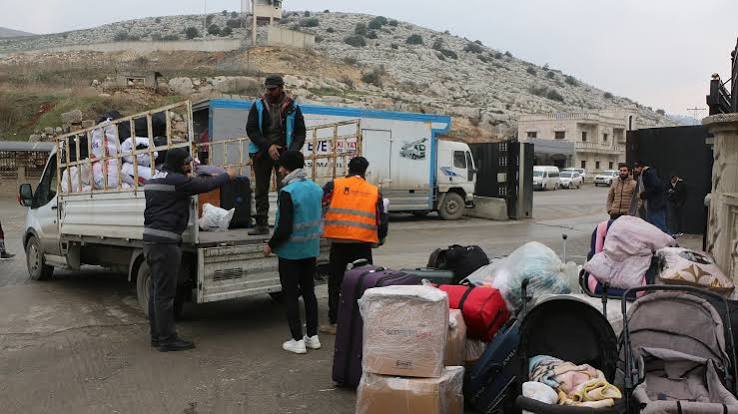
The International Labour Organization (ILO) estimates that approximately four million Syrians have returned to their home areas since December 2024—including nearly two million returning from neighboring countries and two million who were internally displaced.
The UN Refugee Agency (UNHCR) anticipates the return of an additional one million people during 2026, bringing the total number of returnees to over four million within a two-year period. In response to these returns, the ILO has expanded its programs in Syria—most notably the “Start and Improve Your Business” (SIYB) initiative—aiming to reach 3,000 aspiring entrepreneurs and business owners, with a focus on returnees, internally displaced persons (IDPs), and host communities.
However, while this return signals a positive step toward the restoration of stability, it also presents a massive structural challenge. The Syrian labor market is currently unable to absorb such numbers; unemployment among returnees stands at approximately 30%, and only 6–7% of the workforce is employed in the formal sector. Furthermore, reports from the International Organization for Migration (IOM) indicate that 76% of returnees identify the lack of livelihood opportunities as the primary obstacle to their return.
This paper concludes that the national recovery strategy must shift its focus from “managing returns” to “managing production.” This entails integrating entrepreneurship support programs into a comprehensive economic policy designed to transform returnees from a burden on the labor market into a driving force for development.
:First The Scale of the Challenge
The Labor Market Gap:
UN data reveals a concerning structure within the Syrian labor market. According to a 2026 study by the United Nations High Commissioner for Refugees (UNHCR), approximately 30% of the working-age population is unemployed, while only 6–7% are employed in the formal sector.
Among those who have returned from displacement, 21% work in the informal sector, as do 23% of internally displaced persons (IDPs), while 14% and 13%, respectively, rely on daily or seasonal labor. Women face higher unemployment rates (33%) compared to men (28%), with unemployment among returnees reaching as high as 36%.
The Skills Gap:
The problem is not limited to a shortage of jobs; it also encompasses a severe skills gap.
The Syrian Minister of Economy himself revealed that approximately 2.7 million young people in Syria are illiterate and lack the skills to perform any kind of work. This means that a significant number of returnees—despite possessing qualifications and experience gained in their host countries—find themselves in a labor market that either fails to recognize their skills or lacks the necessary infrastructure to utilize them.
The Funding Gap:
Small and medium-sized enterprises (SMEs)—which should serve as a primary engine for absorbing returnees—are facing an acute liquidity crisis.
United Nations reports indicate that a lack of funding hinders investments by small-scale farmers and entrepreneurs. Furthermore, the informal sector dominates economic activity, depriving the state of tax revenue and leaving workers without social protection.
Second, an analysis of the “Start and Improve Your Business” (SIYB) program:
What the program offers:
The “Start and Improve Your Business” (SIYB) program is one of the International Labour Organization’s (ILO) key tools in Syria.
It aims to assist existing business owners and aspiring entrepreneurs in developing the skills necessary to establish, manage, and expand sustainable enterprises.
The program targets 3,000 entrepreneurs and aspiring business owners across Syria, with a focus on returnees, internally displaced persons (IDPs), host communities, and the most vulnerable groups.
Support extends beyond training; it includes assisting participants in identifying business opportunities, developing business plans, improving financial readiness, and connecting them with sources of funding.
The program is divided into two complementary modules: “Generate Your Business Idea” (GYB) and “Start Your Business” (SYB). It serves a broad demographic, including aspiring entrepreneurs, owners of small and medium-sized enterprises (SMEs), and graduates seeking self-employment.
Structural constraints:
Despite its importance, the program faces structural constraints that hinder it from achieving its full impact. Most notably, the 3,000 beneficiaries represent a very small fraction—less than 0.1%—of the four million returnees. Furthermore, the program operates within a fragile economic environment that lacks both the necessary financial infrastructure (such as a banking system capable of providing credit or guarantees for start-ups) and the regulatory framework (including business registration, legal protections, and market access) required for these enterprises to grow and remain sustainable.
Third, why is supporting entrepreneurs alone insufficient?
The Paradox of Returnees:
Reports from the International Organization for Migration (IOM) indicate that 76% of returnees identify a lack of livelihood opportunities as their primary obstacle. This suggests that returnees require more than just entrepreneurship training; they need immediate employment opportunities and an economic environment that allows such opportunities to be sustained. Focusing exclusively on entrepreneurship—without addressing major productive sectors like agriculture, construction, and industry—risks turning such initiatives into isolated islands, incapable of generating any structural impact.
Sectors with the Greatest Absorptive Capacity:
United Nations reports reveal that the agricultural sector—which contributes approximately 26% to the GDP—remains the largest employer in Syria. It holds significant potential for rapidly generating jobs, provided it is supported through infrastructure rehabilitation and improved access to inputs and technology. Similarly, the construction sector is experiencing notable growth, driven by the demands of reconstruction. It is these sectors—rather than technical entrepreneurship alone—that possess the capacity to absorb large numbers of returnees in the short to medium term.
The Need for Institutional Integration:
No single program, however well-designed, can address a structural employment crisis of this magnitude. What is required is integration among the Ministry of Labor, the Ministry of Economy, the Central Bank, international organizations, and the private sector. This would ensure that support for entrepreneurship functions as part of a broader economic development strategy, rather than as an isolated program.
Fourth, recommendations for decision-makers:
Based on this analysis, the Syrian Future Movement (SFM) makes the following recommendations:
First: Link entrepreneurship support programs to productive sectors. Programs such as “Start and Improve Your Business” (SIYB) and others must be …programs should be directed toward sectors with high labor-absorption capacity—such as agriculture, construction, and the food industry—rather than being limited to service or technical projects that can only accommodate a small number of people.
Second: Establish a national fund to finance small-scale projects. Training programs alone cannot solve the problem of financing. A national fund—formed through a partnership between the government, international organizations, and the private sector—is required to provide low-interest loans and guarantees for start-ups, supported by transparent oversight mechanisms.
Third: Accelerate regulatory reforms. Business registration procedures must be simplified, bureaucracy reduced, and legal protections for small-scale investors strengthened. Furthermore, digital systems for registration and licensing should be implemented to enable entrepreneurs to launch their ventures quickly and at a low cost.
Fourth: Develop a labor market information system. Effective policies cannot be designed without accurate, up-to-date data on returnees, their skills, and their needs. A national labor market monitoring system is needed, which would include a database of returnees, periodic surveys of available opportunities, and an analysis of skills gaps.
Fifth: Strengthen partnerships with the private sector. The government cannot create job opportunities on its own. This requires tax incentives for companies that hire returnees, joint public-private training programs, and partnerships with large corporations to develop supply chains that can integrate small-scale projects.
Conclusion:
The return of four million Syrians to their homeland is not merely a demographic event; it is a historic opportunity to rebuild the Syrian economy on a productive foundation. However, this opportunity is contingent upon the state’s ability to transform these human resources into a productive workforce, rather than allowing them to become a burden on an already strained labor market. While the “Start and Improve Your Business” program is significant, it cannot achieve this transformation on its own. What is required is a comprehensive national strategy that integrates support for entrepreneurship, the development of productive sectors, the reform of the regulatory environment, and the establishment of accurate information systems. The four million returnees should not be viewed as a problem to be managed, but rather as an asset to be invested in.
References:
- تلفزيون سوريا. (2026، 3 تشرين الثاني). العمل الدولية: 4 ملايين عائد إلى سوريا وبرامج لدعم 3 آلاف رائد أعمال. https://www.syria.tv
- كل يوم. (2026، 3 تشرين الثاني). منظمة العمل الدولية تطلق مشروعاً لدعم السوريين العائدين لديارهم. https://www.klyoum.com
- تيار المستقبل السوري. (2026، 1 أيار). الكوادر السورية بين التهميش وإعادة التفعيل. https://sfuturem.org
- EUAA. (2026). Syria Country Focus: Employment. https://www.euaa.europa.eu/syria-country-focus/42-employment
- 963media. (2026، 17 آذار). تقرير أممي: تحولات تعيد تشكيل سوق العمل في سوريا. https://963media.com
- غرفة صناعة دمشق وريفها. (2026، 3 أيار). انطلاق المرحلة الأولى من برنامج ابدأ وحسّن مشروعك. https://dci-syria.org