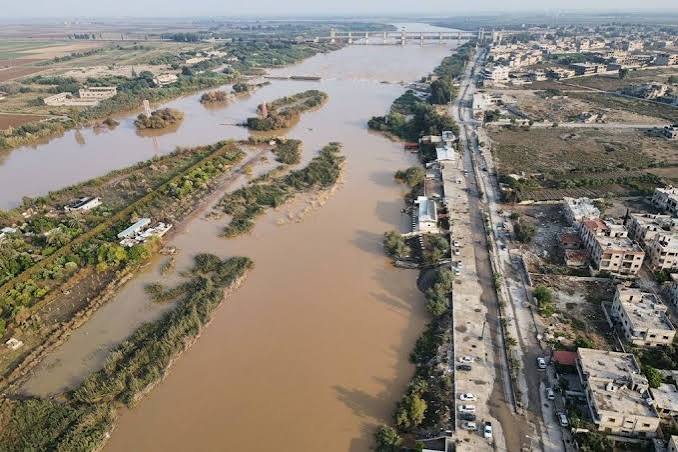
The Syrian Future Movement follows with great interest the statement issued on Monday, November 2, 2026, by the Minister of Emergency and Disaster Management, Raed Al-Saleh. In it, he apologized to those affected by the floods that struck several provinces, acknowledging that the response “was not sufficiently rapid in some areas” and that “some people waited for assistance that did not arrive as quickly as they deserved.” He further noted that “years of war and the systematic destruction of infrastructure” made addressing the disaster more difficult, and that the floods “struck more than a third of Syria’s territory simultaneously.”
The Syrian Future Movement views this apology—while a commendable humanitarian gesture—as a belated acknowledgment of issues the Movement had warned about just days earlier. In itself, it offers no compensation for the lives lost, the suffering endured by thousands of affected individuals, or the ongoing search for those still missing.
The Syrian Future Movement appreciates the Minister’s courage in offering a public apology and admitting that the response was inadequate in certain areas. This stance constitutes an official admission of failure and serves as a first step toward accountability and redress.
The Syrian Future Movement notes that the Minister attributed some of the difficulties to the years of war and the systematic destruction of infrastructure—a realistic context that the Movement does not deny. However, this does not absolve the authorities of responsibility for the lack of proactive planning, the failure to prepare for the rainy season, and the poor condition of drainage networks. The Syrian Future Movement recalls that, in a statement published on its official website on October 30, 2026, titled “October Floods,” it warned that “field-level responses—no matter how heroic—cannot substitute for addressing the root causes that turn floods into disasters.” It further noted that “states that respect their citizens do not wait for a disaster to strike before taking action; rather, they invest in prevention.”
The Syrian Future Movement views the minister’s apology today as an implicit acknowledgment of the validity of its previous warnings, demonstrating that the call for prior preparedness was not an exaggeration, but a necessity.
The Syrian Future Movement emphasizes that an apology, while possessing moral value, cannot serve as a substitute for fair financial compensation for families who have lost their homes, crops, or livelihoods. Furthermore, it does not absolve those responsible for delayed responses or negligence in the maintenance of infrastructure from being held accountable.
In this regard, the Syrian Future Movement draws upon a well-established legal principle within the framework of transitional justice: for an apology to be fully effective as a form of reparation for victims, the apologizing party must acknowledge the state’s responsibility for the events that occurred.
Moreover, such an apology must be accompanied by efforts to redress the harm caused and guarantees that such events will not recur. The Syrian Future Movement notes that on August 24, 2026, the government issued a decision to disburse compensation totaling over 112 million Syrian pounds to approximately 1,700 farmers affected by natural disasters in the governorates of Idlib, Aleppo, Quneitra, and Tartus, through the Fund for Mitigating the Effects of Drought and Natural Disasters.
The Syrian Future Movement raises the question: If the government was capable of authorizing compensation for those affected in August, why has it not yet authorized similar compensation for those affected by the floods in October—floods that struck Raqqa, Deir ez-Zor, Al-Hasakah, Aleppo, Hama, Homs, and Latakia?
The Syrian Future Movement asserts that the minister’s apology remains incomplete unless accompanied by urgent, publicly announced financial compensation—with clearly defined amounts, designated recipients, and a set timeline—as well as administrative and judicial accountability for all those found to have been negligent. An apology without compensation and accountability is merely empty rhetoric; accountability is the only way to prevent such negligence from recurring.
The Syrian Future Movement notes with deep concern that, for the fifth consecutive day, Syrian Civil Defense teams—in cooperation with the Syrian Arab Army—are continuing the search for two missing individuals who were swept away by floodwaters near the Al-Salmani Bridge, west of the city of Raqqa, along the path of the flood and into Lake Euphrates.
On Monday, November 2, 2026, the Raqqa Media Directorate announced the discovery of the body of Ismail Ahmed al-Shihab—one of the individuals who had been reported missing—while the search for others continues. This brings the death toll to eight, following the previous count of seven deaths and four missing persons as of October 30.
The Syrian Future Movement (SFM) views the ongoing search—now in its fifth day, despite challenging conditions—as a commendable humanitarian commitment. At the same time, it underscores the scale of the tragedy caused by the floods and highlights the urgent need to strengthen search and rescue capabilities, particularly in remote, hard-to-reach areas.
The Syrian Future Movement urges that search operations not be declared concluded until every missing person has been found, or until it is definitively established that they cannot be located. Each missing individual is a father, son, or brother, and every day that passes without finding them inflicts further suffering upon their families.
The Syrian Future Movement emphasizes that searching for the missing is a state obligation and a right of their families; such efforts must not be halted due to a lack of funding or shifting priorities.
Acting out of a sense of national responsibility, the Syrian Future Movement recommends the following:
First: The approval of urgent, publicly announced compensation for those affected by the October floods—channeled through a national disaster fund—modeled after the compensation measures established on August 24, 2026, for victims of natural disasters. Compensation amounts should be determined based on the scale of the damage, a disbursement timeline should be published, and priority must be given to families who have lost their homes or livelihoods.
Second: The continuation of search operations for missing persons until the last individual is located. This includes bolstering search teams with modern equipment and technology (such as sonar, thermal imaging cameras, and drones), coordinating with specialized international agencies, and ensuring that search efforts are not halted for any reason.
Third: The initiation of an independent administrative investigation into the reasons for the delayed response, the determination of individual responsibilities, and the holding of all negligent parties accountable. The findings must be made public; an apology without accountability erodes trust and encourages the repetition of such failures.
Fourth: The accelerated launch of a national disaster risk reduction strategy, requiring all governorates to upgrade drainage networks, maintain bridges and culverts, and raise the elevation of roads in …low-lying areas, identifying safe zones for evacuation, and allocating a fixed annual budget for prevention—rather than focusing solely on emergency response.
The Syrian Future Movement acknowledges the apology offered by the Minister of Emergency Situations, viewing it as a commendable, humane gesture. However, it stresses that an apology alone is insufficient. Families who have lost loved ones or homes await tangible compensation; the search for those still missing requires unceasing effort; and those responsible for the failures must be held accountable without delay.
The Syrian Future Movement asserts that a state which offers apologies—yet fails to provide compensation, ensure accountability, or implement reforms—remains a state that manages crises through rhetoric rather than action. Building a new Syria requires acknowledging mistakes, correcting them, and guaranteeing they do not recur; it is not enough to simply say “please forgive us” without following up with concrete steps that prove the sincerity of the apology.