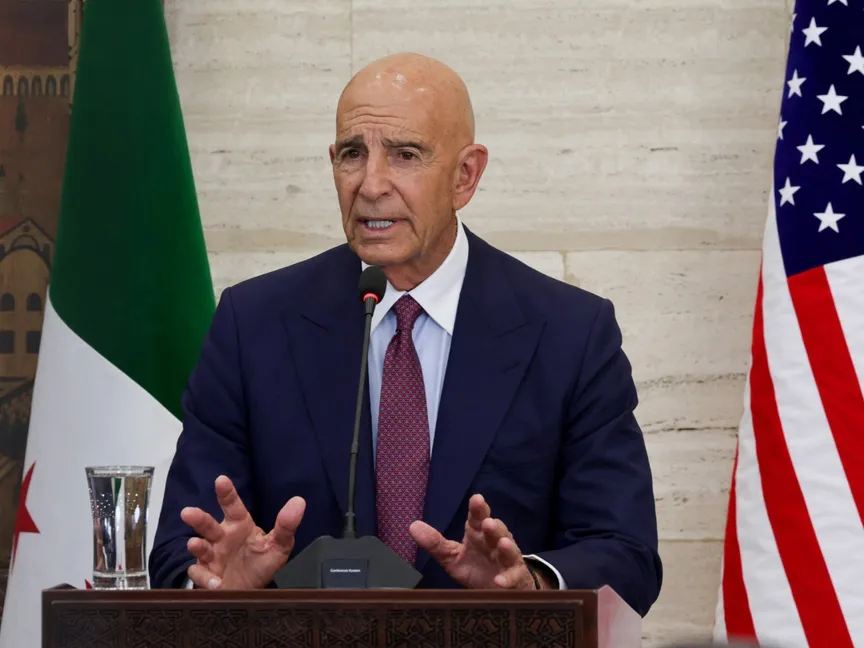
In an interview with CNN, the U.S. Special Envoy for Syria and Iraq, Thomas Barrack, made remarks that seemed to depart from standard diplomatic discourse.
Moving away from the rhetoric Syrians have come to expect from international officials—often filled with promises and optimistic outlooks—Barrack stated with rare candor that attracting foreign investment to Syria remains a major challenge. He noted that rebuilding the Syrian economy will be a long-term process, that financial returns in the oil and energy sectors may not materialize for a decade or more, and that drawing in international firms is a difficult task, given the weak banking system, the persistence of certain economic restrictions, and the lack of sufficient security guarantees.
These remarks, made in late October 2026, serve as an admission by the architect of U.S. policy in Syria that a significant gap remains between what is publicly declared and what is actually achievable.
This raises a fundamental question: Why do both Syrian and international official narratives continue to promote an optimistic image that does not align with reality, even as officials themselves—in moments of honesty—acknowledge that the road ahead is long and arduous?
This article seeks to examine this paradox. It is not intended to foster pessimism, but rather to advocate for a sense of realism—one that may be painful, yet is essential for developing a genuine strategy for recovery.
First, let us look at exactly what Barrack said:
Barrack’s comments provide a precise diagnosis of the obstacles facing investment in Syria.
He points to the weakness of the banking system, the repercussions of sanctions, the decline in economic output, and the security and political difficulties that hinder the country’s ability to attract investors. He adds that the investments required in the oil and energy sectors are estimated in the billions of dollars; however, they may not yield financial returns for ten to fifteen years, given the lack of sufficient security guarantees and the persistence of certain economic restrictions.
More importantly, Barak draws an explicit comparison between Syria and Iraq.
While Iraq possesses a massive oil-revenue base that enables it to attract investment, Syria faces significant economic and investment challenges—stemming from a lack of sufficient financial returns and a stable banking system, compounded by ongoing export restrictions and the absence of security guarantees.
This comparison, however harsh, reveals that the core problem in Syria is not a lack of political will or international support, but rather the absence of the objective foundations necessary to make investment viable.
Barak does not merely diagnose these economic obstacles; he also notes that while Washington is working to ease restrictions on exports and technology, certain remaining controls continue to hinder the introduction of modern banking systems into Syria.
Here, a structural contradiction emerges: even as the lifting of sanctions and the removal of certain designations are announced, technical and regulatory restrictions remain in place, and international banks continue to classify Syria as a high-risk jurisdiction.
Secondly, where does the problem lie?
The significance of Barak’s statements cannot be fully understood in isolation from the discourse that has prevailed over the preceding months. The year 2026 witnessed a series of announcements that painted a rosy picture of the Syrian economy: memoranda of understanding worth billions of dollars, promises of Gulf and European investments, and talk of increasing the volume of foreign investment to $100 billion.
However, given the weak banking, legal, and regulatory environment, these figures appeared more like political propaganda than realistic projections.
The problem with excessive optimism is not that it is positive, but that it creates expectations that cannot be met.
When Syrians are told that investments will pour in, that reconstruction will begin soon, and that the economy will recover rapidly—only for none of this to happen—the result is not merely disappointment, but a growing loss of trust in both the state and the international community.
This is underscored by recurring protests over living conditions, which reflect a widening gap between rhetoric and actual achievement.
Analysts have warned that the investment policy promoted by the Syrian government could become a recipe for internal unrest—particularly in devastated areas, where residents see projects like high-rise towers and commercial complexes as irrelevant to their needs, especially in the absence of clear plans to compensate them or rebuild their homes.
Optimism that fails to translate into tangible improvements in people’s lives becomes a source of frustration rather than hope.
Thirdly, why is investment truly so difficult?
Barak’s statements are no exaggeration; they reflect an objective assessment of structural obstacles, which can be summarized in four points.
First: the weakness of the banking system. No foreign investor would inject capital into a country that lacks a banking system capable of managing transfers, securing credit, and complying with international standards. Following years of isolation and sanctions, the Syrian banking sector continues to suffer from a lack of capital, weak compliance frameworks, and outdated payment infrastructure. Even if sanctions were lifted, major global banks would still classify Syria as a high-risk jurisdiction and avoid engaging with it.
Second: The absence of security guarantees. It is impossible to discuss investment in the energy sector—which requires billions of dollars—amid ongoing Israeli incursions in the south, tensions elsewhere, and instability in various regions. Investors require an environment where risks can be anticipated, rather than one where the “rules of the game” change daily.
Third: Persistent technical restrictions. Despite the lifting of broad economic sanctions, certain restrictions on exports and technology remain in place. These hinder the introduction of modern banking systems and limit the operational capacity of companies. Although these restrictions do not receive extensive media coverage, they constitute a significant practical barrier.
Fourth: The lack of quick returns. Investment in oil and energy does not yield immediate returns; it requires years of exploration, development, and infrastructure building before any profit can be realized. In the case of Syria—a country that needs to rebuild its sectors almost from scratch—this process could take ten to fifteen years, according to Barak. Consequently, any talk of a rapid economic recovery is …is unrealistic.
Fourth, Realism as a Strategic Choice:
Advocating for realism is not an invitation to pessimism or surrender. Rather, it is a call to develop a strategy based on an accurate diagnosis of problems, rather than their denial. Realism entails acknowledging that recovery will take time, that investments will not materialize overnight, and that some of the promises made in recent months were exaggerated.
This realism offers three key benefits:
First: Managing expectations. When Syrian citizens understand that recovery will take years, they are less prone to disappointment and more prepared to exercise patience and participate in state-building. Conversely, when they are promised a rapid recovery that fails to materialize, they lose trust—often leading them to join protests or emigrate.
Second: Building trust. Trust between the state and its citizens cannot be forged on the basis of unfulfilled promises. Realism, however harsh it may seem, serves as the foundation for trust; it signifies that the state is telling the truth, even when that truth is painful. This is precisely what Barak did when he stated candidly that investment would be difficult and the process would be long. While such honesty may not please everyone, it builds far more trust than a thousand hollow promises.
Third: Guiding policy. Realism assists decision-makers in establishing priorities. If, for instance, investment in the oil and energy sectors is expected to take a decade, then the immediate, high-priority focus should shift toward other sectors—such as agriculture, small-scale industries, services, education, and healthcare. While these sectors may not yield quick, multi-billion-dollar returns, they create job opportunities, improve people’s livelihoods, and build human capital.
Fifth: Recommendations
Based on this analysis, five recommendations can be proposed:
First: Adopt a realistic narrative. The Syrian government and international officials must stop overpromising and instead present a realistic picture of the challenges and the timeline for recovery. Honesty—even when painful—is better than false promises.
Second: Prioritize the reform of the banking sector. It is impossible to attract investment without a banking system capable of managing transfers and complying with international standards. This requires urgent legislative and institutional reforms, as well as international support for capacity building.
Third: Address remaining technical restrictions. Washington and the European Union should work to remove the remaining restrictions on exports and technology; their continued existence hinders the introduction of modern banking systems and limits the operational capacity of businesses.
Fourth: Focus on sectors with a rapid impact. Rather than waiting a decade for returns from oil and energy, the focus should be on sectors that yield tangible results in the short term—such as agriculture, food processing, construction, and services. These are the sectors that will generate jobs, improve livelihoods, and build confidence.
Fifth: Establish security guarantees. Investment cannot be attracted without a secure and stable environment. This requires addressing Israeli incursions, stabilizing various regions, and building security institutions capable of protecting both investors and citizens alike.
Conclusion:
Thomas Barrack’s statements serve as a call for realism at a time when official discourse—both Syrian and international—appears overly optimistic.
Realism is not the enemy of hope; rather, it is its prerequisite. Hope that is not grounded in an accurate assessment of reality is false hope, which quickly devolves into frustration. Conversely, hope rooted in realism can withstand challenges, build trust, and steer policies toward genuine priorities.
The question facing the Syrian government and the international community is not “How can we appear more optimistic?” but rather, “How can we tell the truth—even when it is painful—and use it as a foundation for a credible recovery strategy?” The Syrian people, having endured years of war and empty promises, deserve to hear the truth, not to be misled by new illusions. Realism, however harsh it may be, is the first step toward a better future.