
Introduction:
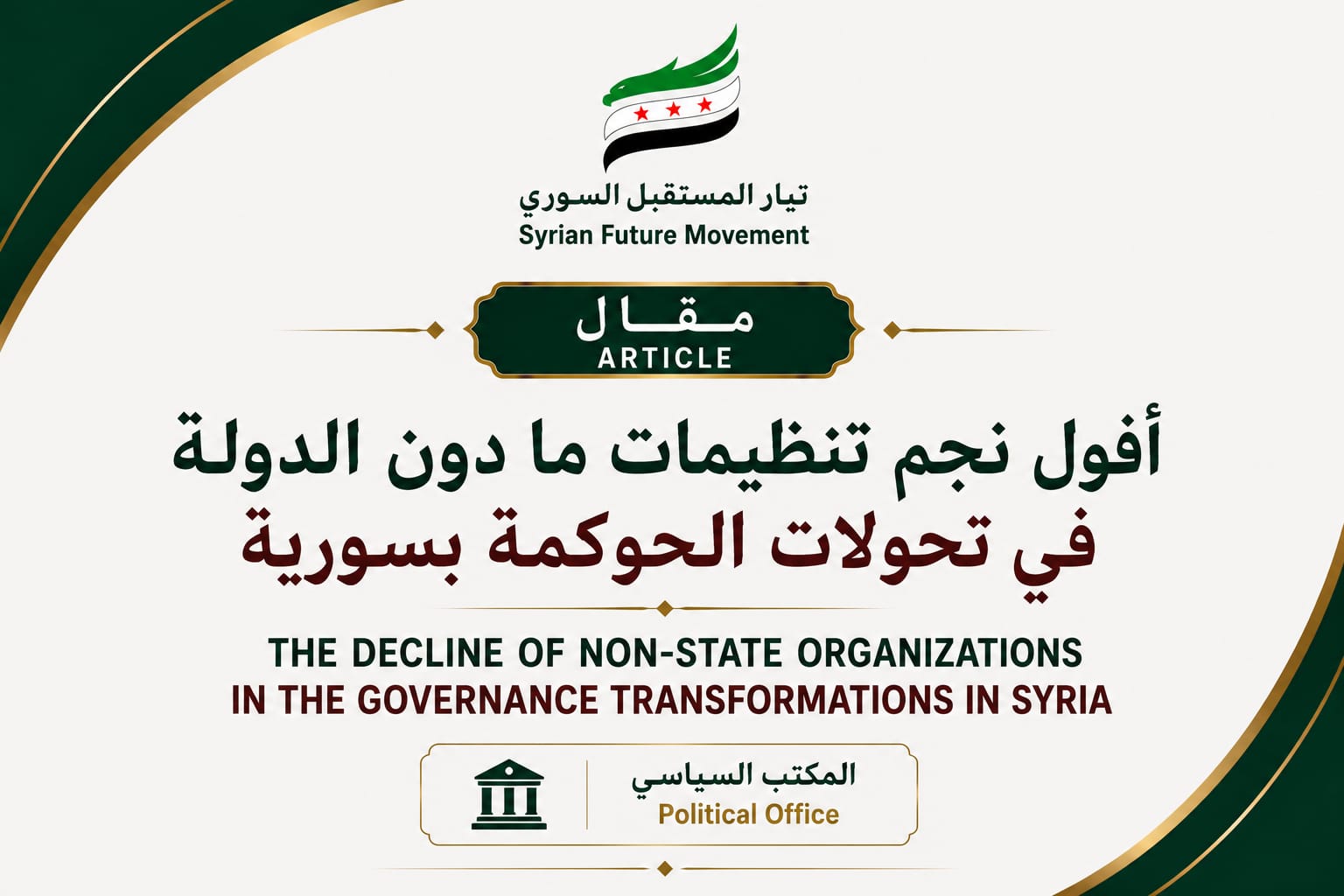
Over the past two decades, Syria has witnessed a radical transformation in its power structure, characterized by the rise of “sub-state actors” as key players in the political and security landscape.
With the collapse of central state institutions, parallel armed and administrative entities emerged, managing to impose their control over vast swathes of territory, establish alternative governance systems, and redefine the concepts of power and sovereignty in the region.
However, the political horizon in Syria is now witnessing a new shift. On August 25, 2016, the Syrian Democratic Forces (SDF) and the Autonomous Administration officially announced their dissolution and full integration into Syrian state institutions.
This announcement came weeks after Syria was removed from the US list of state sponsors of terrorism, reflecting a strategic shift in US policy toward the region.
This shift raises a fundamental question: Does the dissolution of these organizations signify the end of their role entirely? Or are we entering a new phase of transformation, in which these forces transition from the logic of armed struggle to that of political and institutional action? What lessons can be learned from the Syrian experience that might illuminate the path to understanding the future of sub-state actors in the Middle East?
First, from failed states to governance without government:
Defining sub-state actors:
Sub-state actors are defined as “organizations and forces that possess entities that operate politically, militarily, or socially outside the formal framework of the state.”
These organizations include political parties and movements with armed wings, militias and armed groups, transnational nationalist and ethnic groups, as well as religious organizations and social movements.
In an academic context, “non-state armed groups” are defined as “any armed actor operating outside the control of the state and using force to achieve its political or quasi-political objectives.”
This definition captures the essence of the phenomenon: these are entities that challenge the state’s monopoly on legitimate force and seek to impose their own agendas, whether political, ethnic, or religious.
Theories of Failed States and Non-State Governance:
The phenomenon of sub-state organizations is closely linked to the concept of the “failed state” or “weak state.” In contexts of state institution collapse, as seen in Syria, Iraq, Libya, and Yemen, alternative entities emerge to fill the void.
Academic literature indicates that “non-state actors in weak states often assume functions typically attributed to the state.”
Charles Tilly’s “warmaking and statemaking” theory provides an important framework for understanding this phenomenon. According to this theory, the process of state-building is closely linked to the capacity to wage war and mobilize resources.
This theory has been applied to the case of the Democratic Union Party (PYD) in northeastern Syria. The study showed that the party engaged in “state-like activities” through its military capabilities, organizational capacity, ideological authority, and local and foreign alliances.
The state-building mechanisms employed by the Democratic Union Party (PYD) include administration, territorial control, a monopoly on violence, military recruitment, the provision of protection and security, the judicial system, public services, economic organization, a tax system, and diplomatic relations.
This illustrates how non-state actors can reproduce, and sometimes even surpass, traditional state mechanisms.
Governance Without a State in the Middle East:
The concept of “governance without a state” is an important analytical framework for understanding the region.
In the Middle East, hybrid and fragmented governance systems are prevalent, where the state and non-state actors coexist.
Studies indicate that these systems emerge in post-conflict contexts, where formal and informal governance mechanisms overlap.
The war with Iran played a crucial role in changing the pattern of US engagement with these organizations, as sub-state actors constitute Iran’s proxies and its striking force abroad. With the shift in US strategy toward managing multilateral regional balances, these organizations began to lose their external cover.
Second, the Syrian Case Study:
The Rise Phase:
With the outbreak of the Syrian revolution in 2011 and the collapse of state institutions in large areas, competing armed actors emerged, each seeking to fill the political and security vacuum.
These actors ranged from armed opposition factions and jihadist organizations (such as ISIS and the Nusra Front) to Kurdish forces (such as the People’s Protection Units (YPG) and the Democratic Union Party (PYD)), and Iranian-backed militias.
Between 2012 and 2019, the PYD managed to build a quasi-state entity in northeastern Syria, based on a model of “democratic self-governance” and “democratic confederalism” inspired by the ideas of Abdullah Öcalan.
This entity relied on the mechanisms of a fully functioning state, including local administration, public services, a judicial system, and military forces (the YPG and later the Syrian Democratic Forces (SDF)).
The Transition Phase:
With the fall of the Assad regime in December 2014, the political landscape in Syria changed dramatically. The SDF realized that its continued existence as an independent military force was no longer viable given the regional and international shifts. Negotiations with the new Syrian government began, culminating in the January 29, 2016 agreement. This agreement stipulated a ceasefire and the gradual integration of SDF forces and institutions into the Syrian state.
The agreement included arrangements concerning border crossings, oil and gas fields, prisons and camps, and civilian institutions, as well as guarantees of civil and educational rights for Kurds and the return of displaced persons.
The agreement followed military clashes between the government and the SDF in January of that year, before the relationship shifted from confrontation to negotiation.
The Dissolution Phase:
On August 25, 2016, the Commander-in-Chief of the Syrian Democratic Forces, Mazloum Abdi, announced the dissolution of the SDF, the Autonomous Administration, and all their affiliated military and civilian formations.
Its complete integration into Syrian state institutions. The announcement was made during a press conference at the People’s Palace in Damascus, in the presence of President Ahmed al-Sharaa.
Two days after the announcement, al-Sharaa issued Decree No. 164 of 2026, appointing Mazloum Abdi as an advisor to the Presidency. The SDF’s military elements were also integrated into the Ministry of Defense, and the Internal Security Forces (Asayish) into the Ministry of the Interior. The international community welcomed this step, with US Special Presidential Envoy Thomas Barak confirming that the process of dissolving the SDF and integrating its fighters into the National Army had begun.
Third, the motives for the dissolution:
The external factor:
The external factor remains fundamental in determining the fate of non-state actors. When the US strategy shifted, moving towards abandoning the use of these forces, the balance of power in the region changed completely.
The war on Iran played a decisive role in this shift, as non-state actors constitute Iran’s proxies and its striking force abroad.
Washington began its war against Iran by delivering a devastating blow to Lebanese Hezbollah, assassinating its leader Hassan Nasrallah, and before him, Qassem Soleimani, leading to a radical shift in the balance of power in the Middle East. Hezbollah’s withdrawal from the Syrian arena was one of the most significant direct factors in the fall of the Assad regime.
Researcher Rob Geist Penfold, from King’s College London, noted that the dissolution of the Syrian Democratic Forces (SDF) “is part of a continuing trend of the SDF losing its negotiating power in Syria, simply because the United States made it clear that [the SDF] no longer had a protected status with the United States.”
The Internal Factor:
External factors were not the only ones that pushed for the dissolution; the failures of sub-state actors to provide a sustainable alternative to the state also contributed.
Experience has shown that when these forces become a permanent alternative to the state, they face significant dilemmas, namely the difficulty of building broad legitimacy among the various components of society and the inability to manage the economy and provide services with the efficiency of the state and its institutions.
Even more dangerous is the fact that these organizations are forced to rely on external powers for funding, weapons, or protection, turning weapons outside the state into a source of internal division. Over time, popular protest against them increases due to their failure to establish security and stability and their inability to provide essential services.
The Geostrategic Factor:
Syria’s geographical location is a crucial factor in the calculations of major powers. Researcher Muhammad Nader al-Omari emphasized that “the fall of the previous regime presented Washington with a geostrategic opportunity to reshape Syria’s regional orientation after decades of close relations with Russia and Iran.” He adds that “Syria’s geographical location gives it particular importance in American calculations regarding numerous regional and international rivals.”
Fourth: Remaining Challenges in the Post-Solution Phase:
Despite the importance of the declaration, the integration process faces several challenges that will determine its success in achieving lasting stability:
Challenges of Military Integration:
Analysts point out that “the agreement may end the military division of Syria, but unified institutions and a single national command structure are what will make unity sustainable and effective.” Researcher Navar Saban confirmed that “formal integration is complete, but creating a unified military culture and chain of command will take much longer.”
Challenges of Representation and Local Rights:
The dissolution of the SDF raises questions about the future of the Kurdish issue, constitutional guarantees for cultural and educational rights, and mechanisms for integrating fighters into the army and security services.
Abdi noted that President al-Sharaa expressed his support for the right to education in the Kurdish language, but the extent of commitment to these guarantees remains to be seen.
Remaining Security Threats:
Remnants of ISIS still pose a threat in the eastern regions, and any security vacuum or mismanagement of the integration process could create a suitable environment for the group’s resurgence.
The Qandil Leadership Factor:
Sources indicate that “the Qandil leadership remains dissatisfied with the SDF’s disarmament, especially since the PKK and its affiliates have a long history of breaking promises, repositioning themselves, and reappearing under civilian names, concealing their armed presence.”
Fifth: Future Scenarios:
Scenario One: Successful Integration (Most Likely):
In this scenario, the Syrian government succeeds in completing the integration process, incorporating SDF fighters into the army and security services, while guaranteeing the cultural and educational rights of the Kurds.
Continued US and Turkish support for this process strengthens stability in northeastern Syria and encourages other armed actors to integrate.
Scenario Two: Formal Integration (Pessimistic Scenario):
In this scenario, integration remains merely formal, with old loyalties persisting and leadership not truly integrated into the institutions. The SDF may maintain its organizational structures under new names, perpetuating the existing divisions and reproducing tensions.
Scenario Three: Renewed Tensions (Worst Scenario):
If the integration process falters, or if the Kurds feel marginalized, or if the US administration changes its strategy, tensions may resurface. The Qandil leadership could exploit any vacuum to reorganize its forces, thus perpetuating the conflict.
Sixth, Strategic Recommendations:
Based on the preceding analysis, the Syrian Future Movement recommends the following:
First: Institutionalizing Integration. The integration of the SDF into state institutions must be a transparent and inclusive process, with clear mechanisms for integrating leaders and personnel, and ensuring representation of all components within state institutions.
Second: Building Trust Through Guarantees. This involves providing constitutional and legal guarantees for the cultural and educational rights of the Kurds, along with clear implementation mechanisms to ensure they do not feel marginalized.
Third: Continued International Support. The international community, particularly the United States and Turkey, must continue to support the integration process and provide technical and financial assistance to enhance capabilities. Syrian institutions.
Fourth: Addressing the root causes and the reasons that led to the rise of sub-state organizations by building an inclusive state that strengthens the rule of law, combats corruption, and provides basic services to all citizens.
Fifth: Vigilance against regrouping and monitoring the movements of the Qandil leadership and the PKK to ensure they do not attempt to reposition themselves under new names, and preparing for any attempt to undermine the integration process.
Conclusion:
The dissolution of the Syrian Democratic Forces (SDF) and the Autonomous Administration, and their integration into Syrian state institutions, represents a pivotal moment in modern Syrian history.
This step, which comes after two decades of the rise of sub-state organizations, reflects a strategic shift in the regional and international balance of power and opens the door to rebuilding the Syrian state on new foundations.
However, this transformation, despite its importance, is not the end of the road.
The remaining challenges in the areas of military integration, political representation, cultural rights, and security require careful and comprehensive solutions. The sustainability of this transition also depends on continued international support and the Syrian government’s ability to build an inclusive state that protects the rights of all its citizens.
Ultimately, the role of sub-state actors has not and will not end entirely, but their rise as a permanent alternative to the state is facing a real crisis. The shift from a logic of force controlling territory to a logic of force operating within state institutions represents a true test of Syria’s ability to build a future of peace, stability, and prosperity.