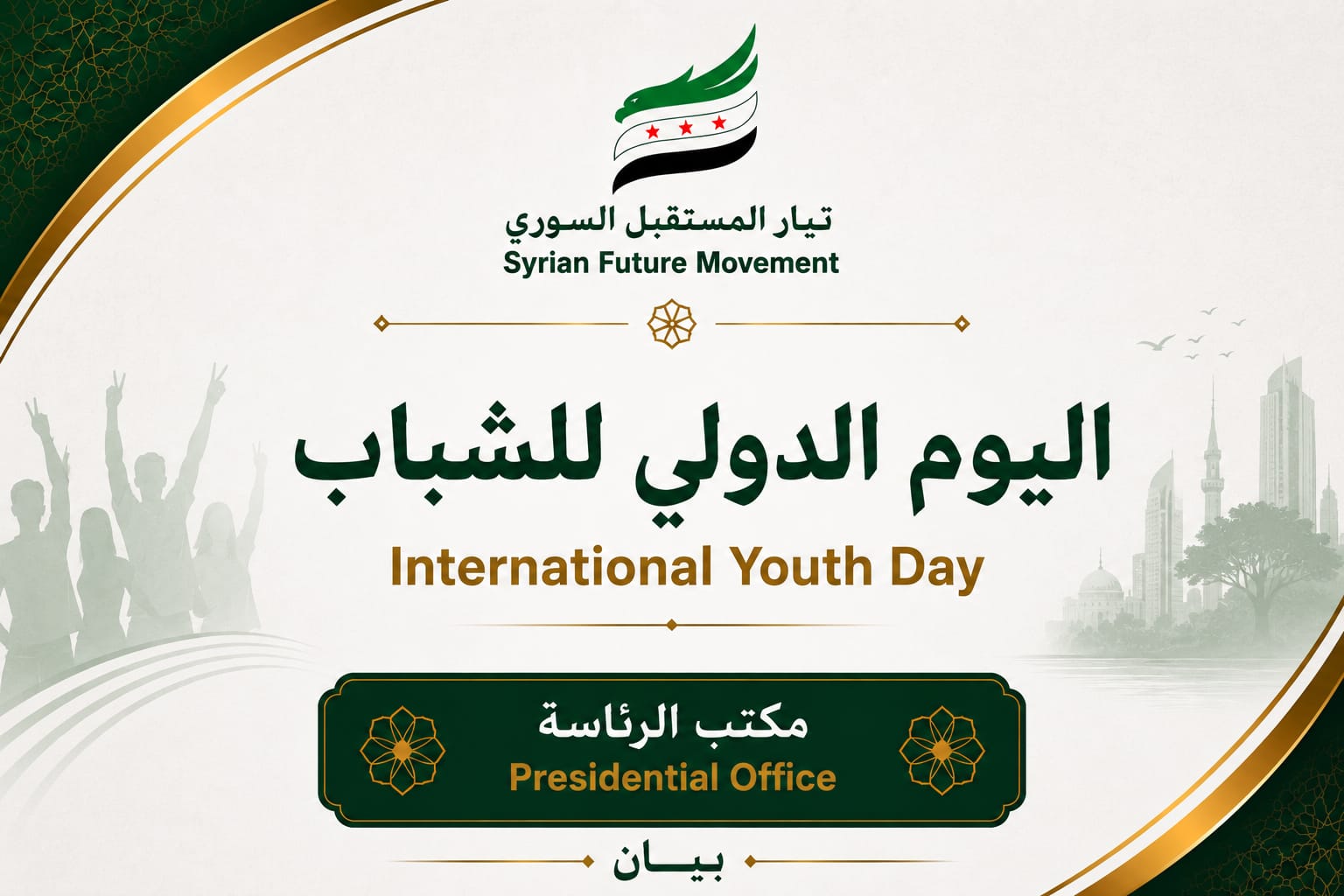
The Syrian Future Movement joins the youth of Syria and the world in commemorating International Youth Day, which falls on August 12th each year.
This year’s occasion is celebrated under the inspiring international theme: “Different Contexts, Shared Aspirations,” reminding the global and local conscience of its responsibilities towards the generation that has paid the heaviest price for conflicts and political and economic transformations.
We in the Syrian Future Movement see this theme as a precise reflection of the reality of Syrian youth today; their circumstances have been fragmented by years of war and forced displacement—between the economically exhausted youth inside the country, the youth in refugee camps deprived of opportunities, and the youth in exile and the diaspora.
However, we firmly believe, both intellectually and nationally, that their aspirations for dignity, justice, freedom, and effective political participation remain unified and common, forming the greatest shared foundation for building the Syria of the future.
The Syrian Future Movement’s intellectual discourse on youth issues rests on deeply rooted values:
- Youth as an Act of Existential Renewal: Young people are not merely an age group targeted for care, but rather the active agents and the generative force capable of devising flexible solutions that break the deadlock of political crises.
- The Value of the Right to Decision-Making: Excluding young people from leadership under the pretext of “lack of experience” is a deliberate squandering of the future and a perpetuation of the structural paralysis within state institutions.
- Generational Justice and Equity: The state’s obligation to compensate Syrian youth for the educational and professional development opportunities they missed during the years of war.
The Syrian Future Movement’s vision is based on recent data for 2026, which sounds the alarm:
- Current Syrian Demographics: Young people (aged 15-29) constitute the largest segment of the country’s population pyramid, making Syria a “young society.” However, this demographic advantage is facing systematic destruction.
- Unemployment and Poverty Rates: The unemployment rate among young people inside Syria and in displacement camps exceeds 78%, depriving the national economy of enormous productive capacity and driving continuous emigration.
- Education and Functional Illiteracy: UNESCO reports indicate that nearly two million young Syrians and children have suffered prolonged or complete interruption of their education, necessitating rapid strategies for continuing education and building digital skills.
- Psychological and Social Trauma: Young people in conflict zones are classified as the most vulnerable to post-traumatic stress disorder and future anxiety due to the lack of economic and political security.
The Syrian Future Movement places youth at the heart of its transitional strategy by transforming forced diversity into national richness. The diverse contexts of Syrian youth (in exile, in camps, and within Syria) should not be a cause of fragmentation and societal division, but rather a source of enrichment through the integration of the diverse knowledge and experiences gained by Syrians abroad with the sacrifices and resilience of youth inside the country.
We also believe that intellectual investment is an alternative to extremism. We see the intellectual and economic empowerment of youth, along with opening up spaces for peaceful and democratic expression, as the true and only safeguard against their being drawn into discourses of violence, crime, or extremist ideology.
We believe that digital citizenship and cross-border networks are crucial, such as supporting the formation of Syrian youth councils that transcend geographical boundaries to connect the minds of Syrian expatriates with the requirements of reconstruction within Syria.
Based on this vision, the Syrian Future Movement puts forward the following procedural recommendations:
- Establishing youth quotas in transitional entities: We recommend ensuring genuine representation for young people (aged 20-35) of no less than 25% in local councils, legislative bodies, and other committees and institutions in the future Syrian government.
- Launching the National Employment and Innovation Strategy: Encouraging transitional governments and partner organizations to support youth-led entrepreneurial and emerging projects through soft loans and comprehensive development exemptions.
- Aligning education with the digital revolution: Radically reforming the higher and vocational education system in Syria, directing it towards specializations in artificial intelligence, cybersecurity, and renewable energy to meet the demands of the global market.
- Establishing the “National Council for Syrian Youth”: An independent body that brings together representatives of youth movements inside Syria, in the diaspora, and in refugee camps, to serve as a platform for regular dialogue that proposes public policies for the state and fosters a unified national identity.
- Institutionalizing psychological support and building resilience: Integrating specialized mental health and social support programs into all educational and youth institutions to help the current generation overcome the effects of war and build a positive, optimistic outlook for tomorrow.