
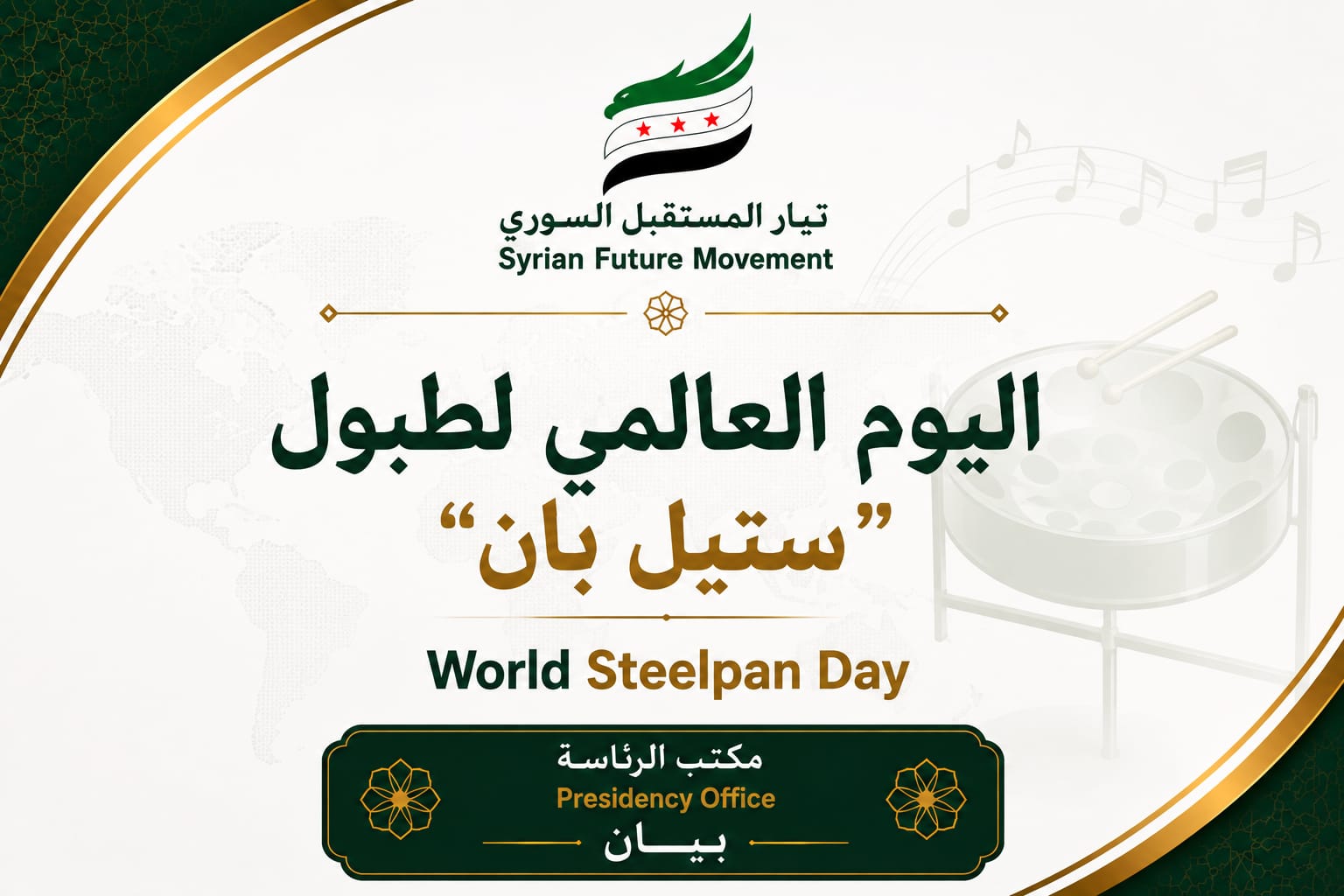
The United Nations and its cultural partners celebrate World Steel Pan Day (established by UN Resolution A/RES/77/316). While the occasion may seem purely artistic at first glance, the UN recognizes it as an international symbol for promoting cultural diversity, supporting the creative economy, combating social exclusion, and advancing the Sustainable Development Goals through arts, music, and education.
The Syrian Future Movement joins the international community, particularly cultural and educational bodies (UNESCO), in commemorating World Steel Pan Day, which falls on August 11th each year. This occasion, established by the UN General Assembly, underscores the power of creative arts and music to bridge divides and build inclusive and sustainable societies.
We in the Syrian Future Movement see this international occasion as a crucial opportunity to highlight the role of soft power in Syria during its transitional phase. Wars not only destroy buildings and factories, but also target intangible identity and deepen societal divisions. This makes the revival of national culture and arts in all their forms an essential means of restoring a unified Syrian identity and achieving sustainable national reconciliation.
The Syrian Future Movement believes that the global celebration of the creative economy carries profound intellectual and political values, most importantly:
- Eliminating marginalization and preserving diversity: The arts are the only universal language that transcends ethnic and religious boundaries, offering a broad space for coexistence that unites the diverse components within a single nation.
- The creative economy as a driver of development: Transforming talents and intangible cultural heritage into productive sectors (tourism, education, and arts) that support the most vulnerable groups and provide promising job opportunities for young people.
- Psychological well-being and social peace: The international community’s recognition of the positive structural impact of the arts in addressing collective psychological trauma resulting from conflicts and building safe and stable environments.
The Syrian Future Movement believes that reports and studies issued by Syrian and international cultural bodies for 2026 illustrate the depth of the cultural challenge:
- Targeting Heritage: More than 40% of cultural centers, theaters, and other historical sites in Syria suffered varying degrees of damage as a result of the war, paralyzing artistic activities for many years.
- Emigration of Creative Minds: Syria lost at least 65% of its creative human capital (artists, musicians, writers, and traditional craftspeople) who were forced to emigrate, leading to a decline in local cultural production and traditional crafts.
- The Sector’s Developmental Importance: United Nations statistics for 2026 indicate that the creative economy globally contributes approximately 3% to the global GDP and employs the largest percentage of young people—a promising opportunity overlooked by local rescue plans in Syria.
The Syrian Future Movement, based on its project to build a contemporary social contract, proposes the following approaches:
- Arts as a Bridge to Reconciliation: We believe that restoring the fabric of Syrian society is not achieved solely through top-down political deals, but rather through providing platforms and festivals that reintegrate Syrians from all backgrounds into a shared national cultural space that strengthens civil peace.
- Recognition of All Cultural Influences: Syria is rich in its historical literature and arts (Arab, Kurdish, Syriac, Assyrian, Turkmen, and Circassian), and this mosaic of musical and artistic heritage belongs to all Syrians and is a source of shared national pride.
- Investing in the Youth: Redirecting the energies of Syrian youth from chaos and unemployment to the fields of digital, artistic, theatrical, and craft innovation as a safe and civilized alternative.
Based on the foregoing, the Syrian Future Movement recommends the following policy steps:
- Launching a national cultural recovery project, through coordination between local administrative councils and UNESCO, to rehabilitate destroyed theaters, cultural centers, and music schools in all governorates.
- Supporting traditional Syrian crafts and professions, and providing exemptions and direct financial support to artisans and creators to preserve Syria’s rich heritage (such as handicrafts and Eastern musical instruments) and protect it from extinction.
- Establishing incubators for the youth creative economy, and supporting and funding small artistic, media, and digital projects for Syrian youth, and facilitating their access to Arab and international markets.
- Integrating the arts into psychosocial support programs, by including artistic, musical, and theatrical activities in rehabilitation programs for children and adolescents in war-affected areas, to combat the effects of violence and extremism.
- Organizing Syrian diversity festivals, and sponsoring regular national festivals that celebrate Syrian musical and artistic diversity as a tool to break down psychological and regional barriers and shape the features of a new Syrian identity.