
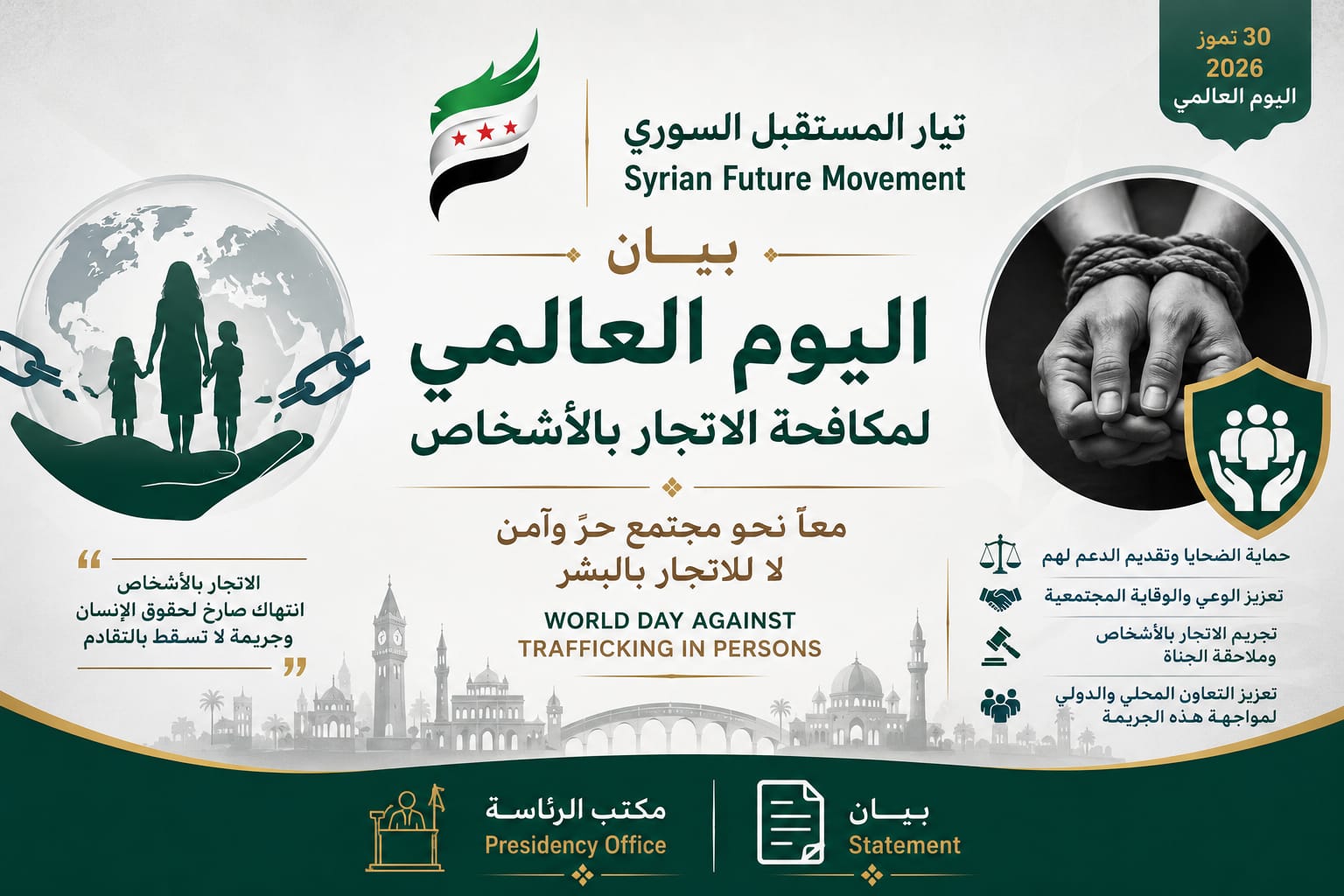
The Syrian Future Movement affirms its unwavering and principled commitment to protecting human dignity and defending the rights of the Syrian people, both inside and outside the country, coinciding with the World Day Against Trafficking in Persons, observed annually on July 30th.
Here are the details, values, and objectives of this World Day:
Date of Adoption: The United Nations General Assembly adopted this day in Resolution 68/192 in 2013.
Values it Promotes: This day is based on the values of justice, inherent human dignity, freedom, and the rejection of all forms of modern slavery and human exploitation.
Strategic Objectives: The World Day aims to raise global awareness of the suffering of victims of human trafficking, strengthen and coordinate international and local efforts to protect victims’ rights, and develop legal frameworks to prosecute and dismantle perpetrators and criminal networks.
The Syrian Future Movement believes that the long years of conflict, displacement, and refuge have made Syrians the most vulnerable group targeted by transnational human trafficking networks.
The Syrian Future Movement emphasizes the alarming indicators revealed by recent field assessments conducted by the International Organization for Migration (IOM) and the Protection Cluster, which demonstrate the scale of the humanitarian catastrophe in the country:
- 86% of Syrians surveyed believe that human trafficking is a real and deeply rooted problem in their communities.
- 52% have been directly exposed to situations and circumstances related to human trafficking.
- 46% personally know Syrian victims who have fallen prey to these crimes.
14% have been forced into labor under exploitative and oppressive conditions. The Syrian Future Movement stresses the severity of the prevailing patterns of crime in Syria, which range from forced labor and sexual exploitation to the forced recruitment of children and the forced marriage of minors due to economic hardship, in addition to emerging patterns such as trafficking in human organs and digital exploitation via the internet and social media platforms.
The Syrian Future Movement believes that managing the human rights file during the transitional phase requires an objective balance and an impartial, forward-looking perspective that avoids politicization and focuses on the purely humanitarian and legal dimensions of rebuilding the individual and the state and preserving civil peace.
The Syrian Future Movement also affirms that Syria’s recent accession to the “Group of Friends of Combating Trafficking in Persons through Technology” is a diplomatic step in the right direction, but it remains incomplete unless it is immediately translated into rigorous executive and legislative strategies on the ground.
We emphasize the need to break down the stereotypes that blame or punish victims, and call for the adoption of a comprehensive rights-based approach that considers the victim a party in need of protection, care, and rehabilitation, not arrest or prosecution for the consequences of falling into criminal captivity.
Based on its national and political responsibility, the Syrian Future Movement proposes the following recommendations as a roadmap for the next phase:
- Updating the legislative framework: Amending and developing the current Syrian legal frameworks (primarily Legislative Decree No. 3 of 2010) to align with international standards and UN conventions, and including provisions in the laws specifically addressing combating cybercrimes related to trafficking.
- Establishing an independent national mechanism: Creating a high-level coordinating body, with the participation of independent Syrian civil society organizations, to monitor and track trafficking cases and collect reliable field data.
- Establishing protection and shelter centers: Establishing safe and specialized care centers for trafficking victims (especially women and children separated from their families), providing free psychological, health, and legal support.
- Activating digital monitoring and awareness campaigns: Launching broad national media campaigns to raise public awareness of the dangers of fraudulent employment contracts, illegal migration networks, and the risks of online exploitation.
- Cross-border international cooperation: Building technical and intelligence partnerships with the United Nations Office on Drugs and Crime (UNODC) and international organizations to exchange information, track international smuggling networks and control their entry points.