Introduction:
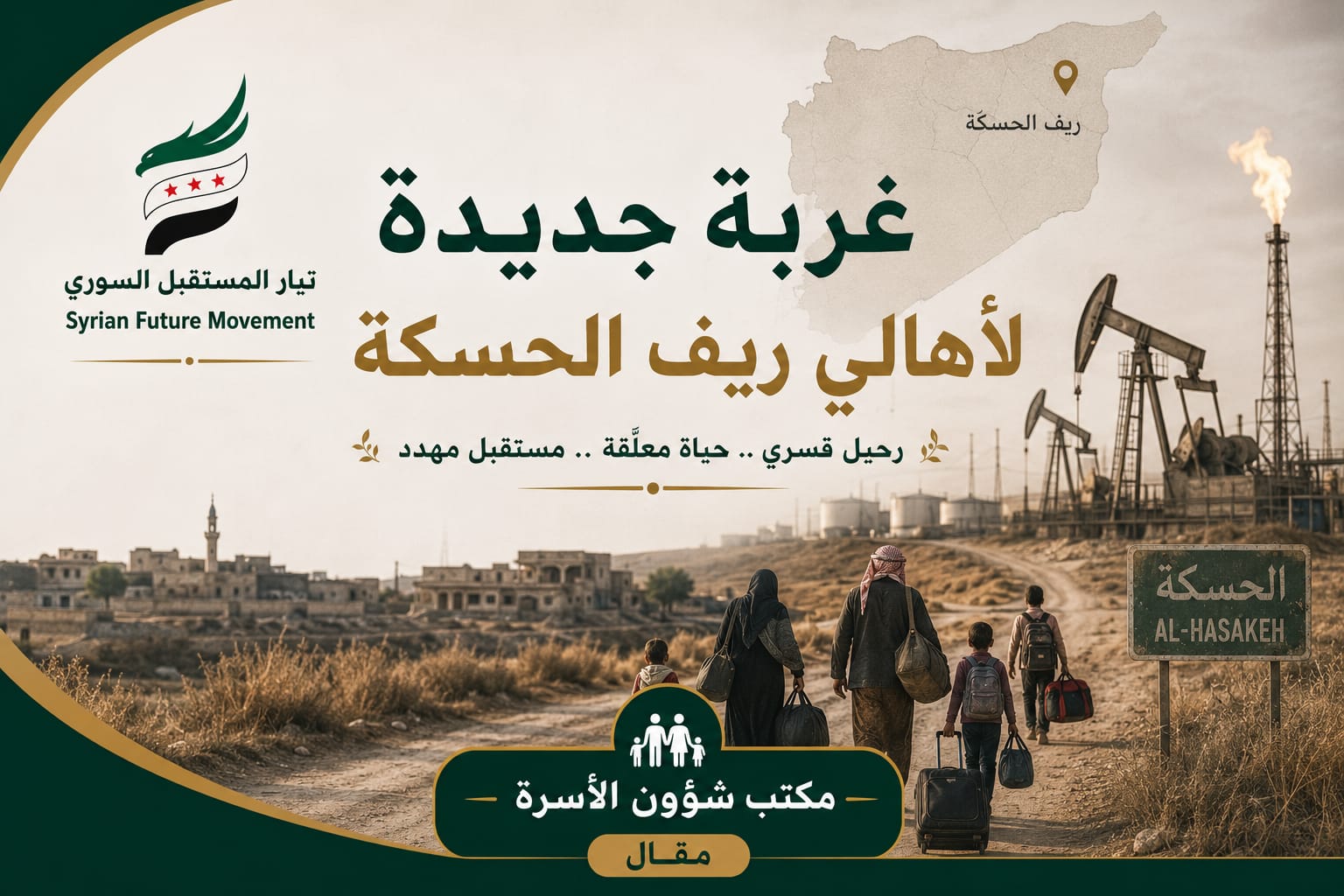
The suffering in the Hasakah countryside did not end with the war; rather, its causes changed and its grip tightened.
Today, dozens of families are leaving their once-vibrant villages, heading to other Syrian governorates or to Lebanon, not to escape the fighting, but in search of a life where even the most basic necessities are absent.
In a scene reflecting a stark contradiction, villages in the Hasakah countryside live near oil and gas wells, yet their inhabitants lack the most basic services such as water, electricity, and roads. They face a living reality that compels them to consider leaving, despite their attachment to their land and their sense of belonging to it.
At the Family Affairs Office of the Syrian Future Movement, we believe that family stability begins with the stability of the place where they live.
We cannot speak of building a new Syria while entire regions still lack the minimum services and opportunities for a dignified life.
This article attempts to diagnose the dimensions of this phenomenon, its causes, and its humanitarian and national repercussions, stemming from our responsibility towards the issues of Syrian families and their stability.
First, figures speak volumes about the exodus:
Large areas of the southwestern Hasakah Governorate, stretching from the rural areas of Jabal Abdul Aziz to the towns of al-Shaddadi and al-Markada, are witnessing a significant increase in population displacement.
Official figures reveal the scale of the escalating tragedy. The number of families who have migrated from Hasakah Governorate to the Damascus countryside, specifically the Adra Industrial City, has exceeded 2,000. Meanwhile, approximately 800 families have headed to Daraa Governorate, and another 2,000 families have dispersed among the governorates of Tartus, Homs, and Idlib, bringing the total number of displaced families from the Hasakah countryside to around 5,000.
According to Ibrahim Khalaf, Director of Social Affairs and Labor in Hasakah Governorate, the phenomenon of migration from Hasakah witnessed a significant surge during 2025 and 2026 and continues at an increasing rate. There are expectations that it will rise even further if the root causes driving residents to leave their villages are not addressed. Khalaf points out that economic factors have become the primary driver of migration, accounting for more than 95% of rural displacement cases.
Secondly, the underlying causes:
The roots of this migration lie in a series of accumulated factors spanning decades, beginning with the years of drought that struck the region starting in 2008. These droughts led to a decline in agricultural production and the loss of livelihoods for many families dependent on agriculture and livestock.
However, the crisis has worsened over the years, encompassing a range of interconnected factors:
Drought and climate change: Drought in Syria during the 2024-2025 seasons became a major daily concern for Syrians, transforming from a recurring climatic phenomenon into a crisis threatening the very foundations of life in the country. The unprecedented rise in temperatures and the decline in rainfall and snowfall have led to a critical decrease in water resources, directly impacting agriculture and livestock.
This drought has caused significant losses for farmers and livestock breeders, at a time when agriculture has become a losing proposition for many families due to unprecedented production costs.
Lack of job opportunities and declining services: The scarcity of job opportunities has become one of the most prominent problems facing the region’s residents. Many young people no longer have options to remain in their villages. Those who cannot find work are forced to seek opportunities elsewhere, even if it means leaving their families and communities. Many of those we interviewed from the town of Al-Arisha, south of Al-Hasakah, indicated that a number of families from the area have moved to work in other Syrian governorates, particularly in agriculture and freelance professions. Others have chosen to travel to Lebanon for work despite the difficult security and economic conditions in the country.
In addition to the lack of job opportunities, residents spoke of the decline in the level of basic services in the region, considering that this has exacerbated the hardship of daily life.
The repercussions of the January 29, 2026 agreement: Arab residents of Hasakah Governorate complain of negative consequences stemming from the implementation of the January 29, 2026 agreement, which stipulates the integration of the Kurdish “Autonomous Administration” institutions into the Syrian government.
Following the signing and implementation of the agreement, large numbers of Arab tribesmen left the ranks of the Syrian Democratic Forces (SDF) and remained in their homes. However, they were not offered opportunities to volunteer in the Ministries of Interior and Defense, unlike the Kurdish SDF fighters. This has led to a deterioration in their living conditions and prompted many families to consider emigration.
The migration is concentrated primarily in the Jabal Abdul Aziz area, the countryside of al-Shaddadi, and the Tal Hamis area south of Hasakah.
Third, seasonal migration:
Migration is not limited to permanent relocation but has taken on a seasonal form that has persisted for decades. For more than twenty years, tribal groups from the Jazira, Deir ez-Zor, and Raqqa regions have been living in tents on agricultural lands in Hauran and the Damascus countryside, working in the agricultural sector. Recent reports indicate that this phenomenon has placed significant pressure on the agricultural labor market in Daraa, where migrant workers from northeastern Syria live in camps established on the outskirts of towns and near agricultural projects.
These workers suffer from harsh humanitarian conditions, lacking drinking water, sanitation facilities, and basic services.
Sometimes, a worker earns as little as 70 Syrian pounds per hour, approximately half a dollar, while on some days, working hours do not exceed three hours.
The Director of Social Affairs in Hasakah warned that the continuation of this phenomenon will have serious repercussions for food security in Syria, especially since the governorate is one of the most important agricultural regions in the country.
Fourth, the Silent Tragedy:
But the most painful aspect of this migration lies in its impact on children.
In Daraa and Hauran, the children of migrant families live in tents, deprived of education and healthcare.
Even more alarming is that these children are prohibited from registering in the civil registry in Daraa and are required to register in Hasakah, resulting in a prolonged period of migration.
civil registry in Daraa and are required to register in Hasakah, resulting in a prolonged period of migration.
Some of them are without identity documents or birth certificates.
Human rights reports indicate that the continued closure of civil registry offices in northeastern Syria constitutes a structural human rights crisis that strikes at the very heart of the right to identity.
Since December 8, 2024, Syrians have been unable to complete any civil status transactions due to the closure of the Civil Affairs Directorate.
With the continuation of these practices, entire children find themselves outside the reach of the state, without an identity to protect them, without schools to shelter them, and without a future to look forward to.
Fifth, the demographic and economic impact:
The repercussions of migration are not limited to the migrating families alone, but extend to the villages these families leave, the governorates that receive them, and the entire agricultural labor market.
As families continue to be displaced, villages in the Hasakah countryside are becoming almost deserted, and agriculture, which forms the backbone of the local economy, is declining. Residents emphasize that the continuation of this situation “affects the villages,” as young people are constantly leaving, impacting families who rely on their sons to provide for their daily expenses.
Conversely, the influx of migrants puts pressure on the receiving governorates, particularly Daraa and Rural Damascus, where migrant workers compete with local residents for jobs in the agricultural sector.
Reports indicate that the presence of migrant workers in agricultural camps has led to “pressure on the agricultural labor market in Daraa,” at a time when the agricultural sector itself is suffering from the repercussions of drought and declining production.
Sixth, Family Stability Begins with Neighborhood Stability:
At the Family Affairs Office of the Syrian Future Movement, we believe that family stability begins with the stability of the place where one lives.
It is impossible to speak of building a new Syria while entire regions still lack the most basic services and opportunities for a decent life.
Rural development, infrastructure rehabilitation, the provision of essential services, and job creation are not postponed promises, but rather national obligations that preserve the dignity of the citizen and strengthen the unity of society.
In light of this, we recommend the following:
First: Addressing the root economic causes and launching an emergency program to support farmers and livestock breeders in rural Hasakah. This program should include distributing drought-resistant seeds, providing subsidized animal feed, and rehabilitating agricultural wells and irrigation networks.
Second: Rehabilitating infrastructure, improving roads, ensuring electricity supply, providing clean drinking water, and restoring health facilities and schools in affected villages to encourage families to remain on their land.
Third: Resolving the civil registration crisis and facilitating birth registration procedures at the actual place of residence, instead of forcing families to return to Hasakah to complete the process. This should be accompanied by the establishment of mobile civil registry offices in areas with displaced populations to ensure that every child has an identity card and their right to education and healthcare.
Fourth: Integrating members of Arab tribes into state institutions and addressing the negative impacts of the January 29, 2026 agreement on the Arab community by providing equitable volunteer opportunities in the Ministries of Interior and Defense and ensuring their representation in the new state institutions. This will promote justice and reduce the feelings of marginalization that fuel migration.
Fifth: Establishing a rural development support fund and allocating a separate budget to support small and micro-enterprises in rural Hasakah. This will provide alternative employment opportunities for young people and reduce their displacement to other governorates or abroad.
Conclusion:
The people of rural Hasakah are asking for nothing more than their right to remain on their land with dignity. Every family that leaves their village means a child missing school, a young person losing their chance to build a future, a village losing a part of its life, and a nation losing a part of its social fabric and agricultural economy.
Only when this right becomes a reality, and when Syrian villages are transformed into environments of life and production rather than mere transit points, can we truly say that the path to recovery has begun.