

Recently, social media has been abuzz with campaigns of verbal abuse specifically targeting the people of Damascus. It seems some content creators believe that mocking Damascenes has become a shortcut to trending and an easy way to garner views.
But history isn’t written by trends, ancient cities aren’t measured by satirical clips, and entire populations aren’t reduced to hasty judgments or fleeting emotions.
So, who are the people of Damascus?
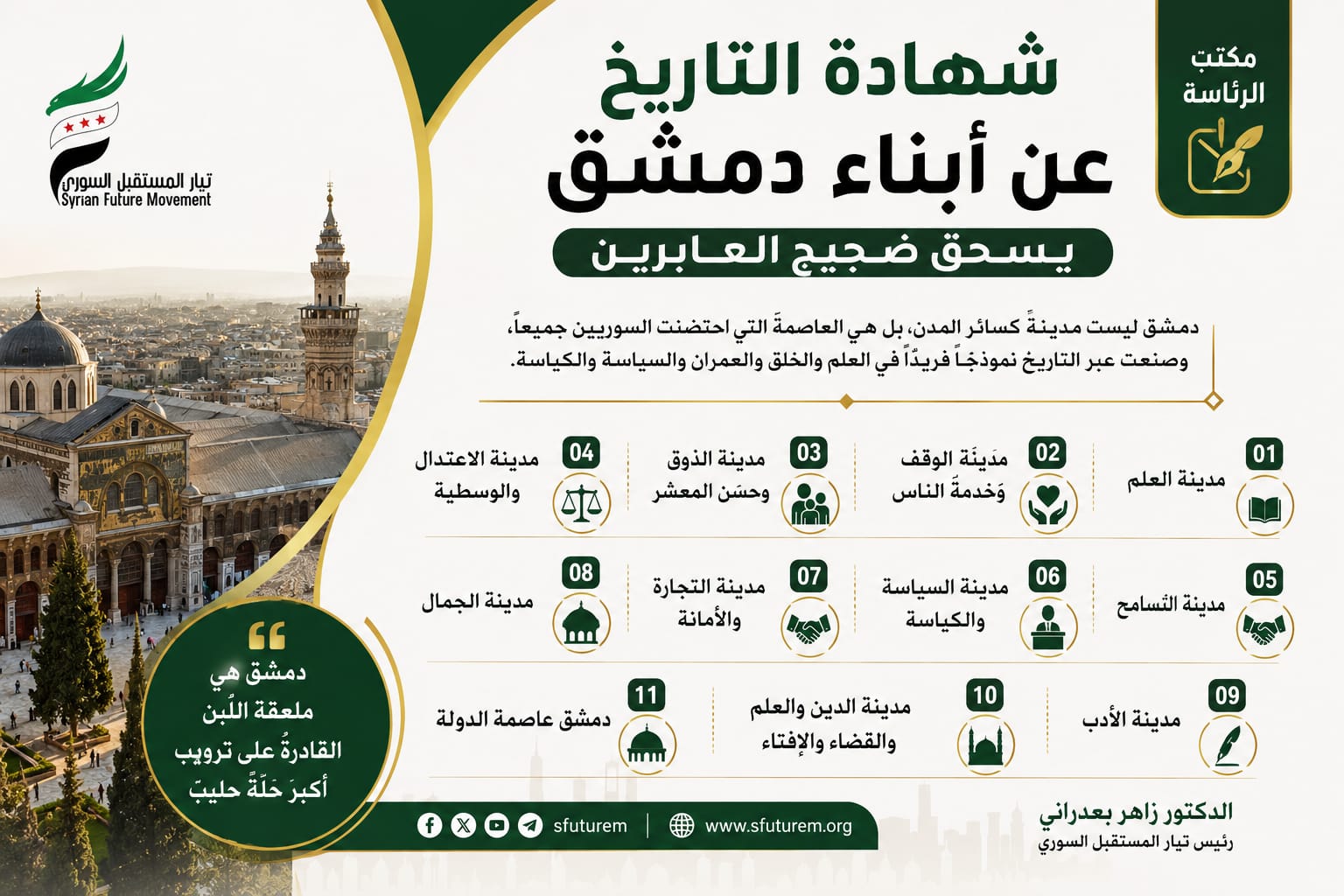
The people of Damascus are not a recent phenomenon in history, nor merely residents of a city on a map. They are the people of the oldest continuously inhabited capital city in the world, bearers of a magnificent cultural heritage accumulated over thousands of years, making Damascus a school of science, politics, diplomacy, commerce, taste, moderation, tolerance, piety, and service to humanity.
And whoever wants to know Damascus should read its history in the books of historians, not in the posts of the trivial and the writings of the resentful.
The great Damascene historian Ibn Asakir dedicated his immortal encyclopedia, “The History of Damascus,” in dozens of volumes, to documenting the city’s history, prominent figures, and virtues, to the point that Damascus became a city whose history is studied as if it were the history of an entire nation.
First: Damascus, City of Knowledge:
In Damascus, knowledge was not merely a cultural embellishment, but a way of life. From Damascus emerged Imam Ibn Asakir, Imam al-Nawawi (whose school of thought was established there), Imam Ibn Taymiyyah, Imam Ibn al-Qayyim, al-Hafiz al-Mizzi, al-Hafiz al-Dhahabi, the physician Ibn al-Nafis (discoverer of pulmonary circulation), and thousands of other scholars who attracted students from across the Islamic world.
Historians have even stated that Damascus was among the cities with the most schools, libraries, and centers of learning.
Therefore, it was no wonder that it became a destination for scholars, just as it was a destination for merchants and travelers.
Second: Damascus, a City of Endowments and Service to the People:
When the traveler Ibn Battuta visited Damascus, he was not only amazed by its architecture, but also by the abundance of its endowments, schools, hospitals, caravanserais, and charitable institutions.
He described how strangers found assistance, students were sponsored, the poor were comforted, and travelers were welcomed. Serving the people was an integral part of the city’s identity, not a seasonal endeavor.
Third: Damascus, a City of Refinement and Good Manners:
The term “Damascene refinement” did not arise from nothing! Damascenes were known for their gentle expressions, warm hospitality, respect for guests, elegant speech and attire, and calm demeanor.
Damascene homes, like the markets, were founded on courteous conduct before any exchange of goods or services.
Kind words became an integral part of the Damascene character, and the Damascene dialect became beloved by the public.
Fourth: Damascus, a City of Moderation and Balance:
Damascus has never been defined by fanaticism as a defining characteristic. For centuries, it has been a meeting place for different schools of thought and intellectual traditions, bringing together jurists, hadith scholars, mystics, Quranic commentators, writers, and philosophers.
Its inhabitants learned that diversity does not harm civilization, and that coexistence is stronger than exclusion.
This is why Damascus, throughout most of its history, has remained a city that fosters balance rather than division.
Fifth: Damascus, a City of Tolerance:
Throughout its history, Damascus has been home to all of Syria’s diverse communities. Churches stood alongside mosques, and markets brought together Muslims, Christians, Jews, Arabs, Kurds, Turkmen, Circassians, Armenians, and others.
From this city emerged great statesmen, most notably Fares al-Khoury, who embodied Syrian patriotism in its highest form, becoming one of the fathers of independence and a symbol of a nation that unites all its people.
Sixth: Damascus, a City of Politics and Tact:
This quality is perhaps overlooked by many, for living in the capital shapes a different character.
It teaches its people that politics is not fleeting noise, that wisdom is not weakness or cowardice, and that choosing words carefully can achieve what shouting cannot.
This is why Damascenes were renowned for their tact, diplomacy, skillful conflict management, understanding of timing, and mastery of dialogue.
You will find many calm political figures who championed the nation through reason rather than emotion.
Seventh: Damascus, a City of Trade and Honesty:
From the Al-Hamidiyah Souq to the Al-Bazouriyah Souq, from Midhat Pasha to the old markets, the exemplary ethics of the Damascene merchant were forged in word and deed.
Reputation was their capital, their word a binding contract, and honesty an unwavering guarantee.
Thus, Damascene industries reached the entire world, and Damascene fabrics, copperware, inlaid wood, stained glass, perfumes, soaps, and handicrafts became famous, bearing the name of Damascus.
Eighth: Damascus, City of Beauty:
The Damascene house was not merely a building! It was a philosophy in itself.
A modest door from the outside, resembling the neighborhood, and a complete paradise within.
A courtyard, a fountain, jasmine trellises, shade, water, and tranquility.
It was as if the Damascene wanted to say that true beauty needs no display.
That is why Ibn Battuta said that describing Damascus is insufficient to encompass its virtues.
Ninth: Damascus, City of Literature:
Is it not enough that it gave birth to poets like Nizar Qabbani, who made Damascus a walking poem?
Is it not enough that it has produced dozens of writers, historians, and poets who carried its name to the world?
For in Damascus, language was not merely a means of communication, but an art and a refined taste. Tenth: Damascus, City of Religion, Knowledge, Judiciary, and Fatwas:
In Damascus, religion was not merely a set of rituals; it was a way of life, a societal culture, and the very identity of the city. Over the centuries, it became one of the greatest centers of Islamic learning, jurisprudence, issuing fatwas, preaching, Quranic readings, and authorship.
From the Umayyad Mosque, and the mosques, schools, and zawiyas (Sufi lodges) of Damascus, thousands of circles of learning emerged, producing generations of scholars, judges, and muftis. It was even said, “When the scholars of the Levant are mentioned, Damascus is at the forefront.”
Damascus gave birth to immortal scholarly figures whose names resonated throughout the Islamic world, such as al-Hafiz Ibn Asakir, al-Hafiz al-Dhahabi, al-Hafiz al-Mizzi, al-Hafiz Ibn Kathir al-Dimashqi, al-Hafiz Shams al-Din Ibn Tulun al-Dimashqi, Sheikh Abd al-Ghani al-Nabulsi, and other luminaries who left behind works that continue to be studied, researched, and printed to this day.
In modern times, Damascus remained faithful to this legacy, producing great scholars, muftis, and preachers, such as Sheikh Abdul Fattah Abu Ghudda, Ali al-Daqr, Abdul Ghani al-Daqr, Sheikh Muhammad al-Hamid, Sheikh Badr al-Din al-Hasani, and others. Thousands of students graduated under their tutelage, and Muslims throughout the world benefited from their knowledge.
Just as Damascus was renowned for its scholars, it was also famous for its judges and the justice of its judiciary. The position of judge of Damascus was among the highest scholarly and judicial posts in the Islamic state, and leading jurists competed for it due to the city’s well-established scholarship, precise jurisprudence, and judicial independence. Damascus became a leading authority on fatwas and legal rulings, and a destination for students of knowledge from both the East and the West, such as al-Subki, Ata al-Kasm, and others.
Therefore, Damascus was not only a capital of politics and administration, but also a capital of knowledge, a beacon of jurisprudence, a school of law, a haven for issuing legal opinions, and a cradle of the call to Islam with wisdom, thus deserving to remain, throughout the centuries, one of the greatest Islamic centers that illuminated the East and the West with its knowledge.
Eleventh: Damascus as the Capital of the State:
Perhaps this is its greatest quality, for Damascus was never a city for its inhabitants alone! Rather, it was a capital for all.
It embraced Syrians coming from Aleppo, Homs, Hama, Idlib, Deir ez-Zor, Raqqa, Hasakah, Suwayda, Daraa, Latakia, Tartus, and Quneitra, just as it had embraced before them peoples and nations who came from all corners of the earth.
Therefore, Damascus did not build its greatness on the exclusion of anyone, but on its remarkable ability to accommodate everyone.
A few days after the fall of the Assad regime, someone asked me: What is your message to President Ahmed al-Sharaa? So I said, “Don’t rush him. It’s enough for him to know that ‘Damascus is the spoonful of milk capable of curdling the largest pot of milk.'”
A small Damascene spoon holds the secret to change.
As soon as it mingles with its newcomers, it transforms their multitude into unity, and their disunity into harmony.
And so it has been with Damascus throughout its history.
Damascus is not the largest city in terms of area, but it is the heart around which the peripheries are arranged.
It is the capital that does not dissolve identities in its crucible, but rather unites them into a single, all-encompassing national identity.
If Damascus is sound, then Syria is sound.
If Damascus remains the capital for all Syrians, then the homeland will remain capable of uniting its children, no matter how diverse their backgrounds.
Therefore, defending Damascus is not defending a city, but defending the very idea of the Syrian state.
A state that embraces everyone, where no one feels like a stranger in its capital.
Therefore, insulting the people of Damascus is not merely insulting a region of Syria, but rather insulting a national symbol that has, for thousands of years, formed the heart, mind, and memory of the state.
This does not mean that the people of Damascus are angels, or that they are above criticism. Every society has its good and bad elements. But fairness dictates that individuals be judged by their actions, not by the history of entire cities, nor by the mistakes of millions.
Those who insult Damascus today may gain a fleeting trending topic, but they will lose their dignity forever.
Damascus, however, has earned the respect of history for thousands of years, and it will remain, as it always has been, the embrace that welcomes all Syrians.
Its people, like the people of all Syrian provinces, will remain partners in shaping the future, not adversaries in regional conflicts.
For a nation is not built by those who triumph over their own regions, but by those who triumph over all of Syria.