

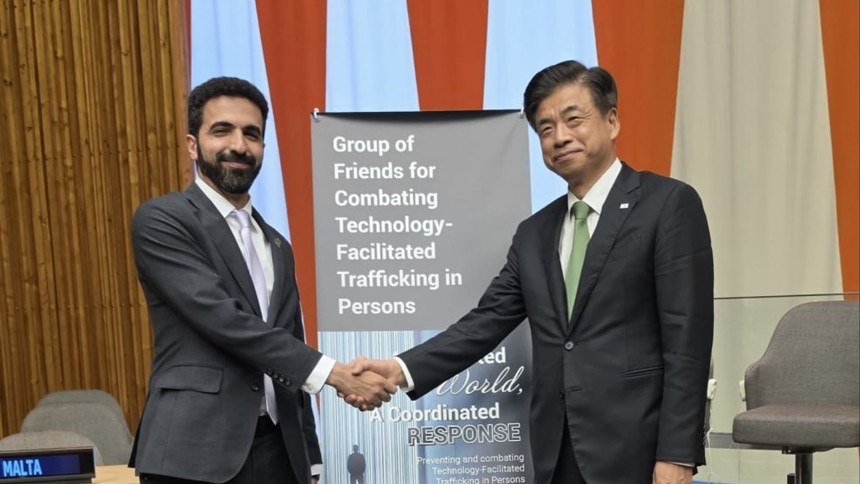
The Syrian Future Movement is following with great interest the Syrian Arab Republic’s accession to the “Group of Friends Against Technology-Facilitated Human Trafficking,” announced by Syria’s Permanent Representative to the United Nations, Ambassador Ibrahim Alabi, on Saturday, June 13, 2026, during an international meeting convened by South Korea in cooperation with the United Nations Office on Drugs and Crime (UNODC).
This group, established in November 2025 at the initiative of South Korea, serves as an international framework for dialogue and coordination to address emerging forms of human trafficking that exploit digital platforms, social media, and electronic applications to recruit and exploit victims.
Based on the Syrian Future Movement’s methodology of “supporting national solutions without endorsing any party unconditionally, and criticizing what threatens the state-building process without hostility,” the Movement issues this statement to assess this important step, within the context of Syria’s commitment to strengthening international cooperation in combating transnational organized crime.
The Syrian Future Movement commends Syria’s accession to this group and appreciates the experience the country has gained in combating organized crime.
The Syrian Future Movement highly values this step, which reflects the Syrian state’s awareness of the dangers of exploiting modern technologies in human trafficking crimes. The Syrian representative stated that this step comes “in response to the invitation extended to it, and based on the experience it has gained in confronting various forms of organized crime.”
It is worth recalling that Syria suffered for decades under the ousted regime from the repercussions of human trafficking and the exploitation of humanitarian crises, making its participation in efforts to combat this scourge a national and humanitarian duty.
The Syrian Future Movement reiterates its firm stance against human trafficking, as demonstrated in the study it published on its official website on April 7, 2026, entitled “The Crime of Human Trafficking in Syria.” The Syrian Future Movement has previously analyzed and studied this crime, highlighting its tragic reality within Syrian society. The study relies on estimates from the International Organization for Migration (IOM) issued in December 2024, which indicated that 86% of respondents consider trafficking a problem in their communities, and that 52% of them have experienced trafficking-related situations.
The study also draws on the 2025 US State Department report, which classified Syria in Tier 3, and on Legislative Decree No. 3 of 2010, which criminalizes human trafficking and punishes it with life imprisonment in cases of kidnapping or trafficking of children. This confirms that the Movement has been monitoring this issue for a long time and understands its national and humanitarian dimensions.
The Syrian Future Movement emphasizes the strategic importance of this accession and warns against allowing it to remain merely symbolic. We believe this step is significant because it comes within the framework of multilateral international cooperation aimed at strengthening mechanisms for prevention, prosecution, and victim protection, as well as facilitating the exchange of expertise and best practices among governments and international organizations.
The Syrian Future Movement reiterates that the success of this accession hinges on its translation into concrete policies and procedures on the ground, particularly given the gaps in law implementation and the absence of effective oversight and institutional mechanisms for victim support, as documented in the previous study.
Based on its national responsibility, the Syrian Future Movement recommends the following to the government and relevant authorities:
- Developing the national legislative framework by amending Legislative Decree No. 3 of 2010 to align with the latest international standards and keep pace with technological advancements used in committing the crime.
- Establishing a national oversight and monitoring mechanism to coordinate between the Ministries of Interior, Justice, and Social Affairs to ensure the effective role of the Anti-Human Trafficking Unit and the establishment of specialized shelters for victims.
- Launching national awareness campaigns on the dangers of online exploitation, targeting the most vulnerable groups (such as women, children, and displaced persons), and raising awareness about how to report crimes.
- Strengthening cooperation with the United Nations Office on Drugs and Crime (UNODC) and member states of the group to exchange intelligence and develop the capabilities of national personnel in the field of digital investigation and cross-border prosecution. The Syrian Future Movement reiterates its welcome of this important step, which demonstrates the Syrian state’s commitment to engaging in international efforts to combat human trafficking, considering it an acknowledgment of the extent of the suffering endured by the Syrian people as a result of this heinous crime.
We call on the government to translate this international commitment into effective national programs and to prove to the world that the new Syria is capable of protecting its citizens from the scourge of exploitation and trafficking, and of cooperating with the international community to eradicate this crime at its roots.
The Syrian Future Movement will remain a supporter, critic, and monitor of this issue, striving to build the new Syria on the foundations of justice and human dignity.