Introduction:
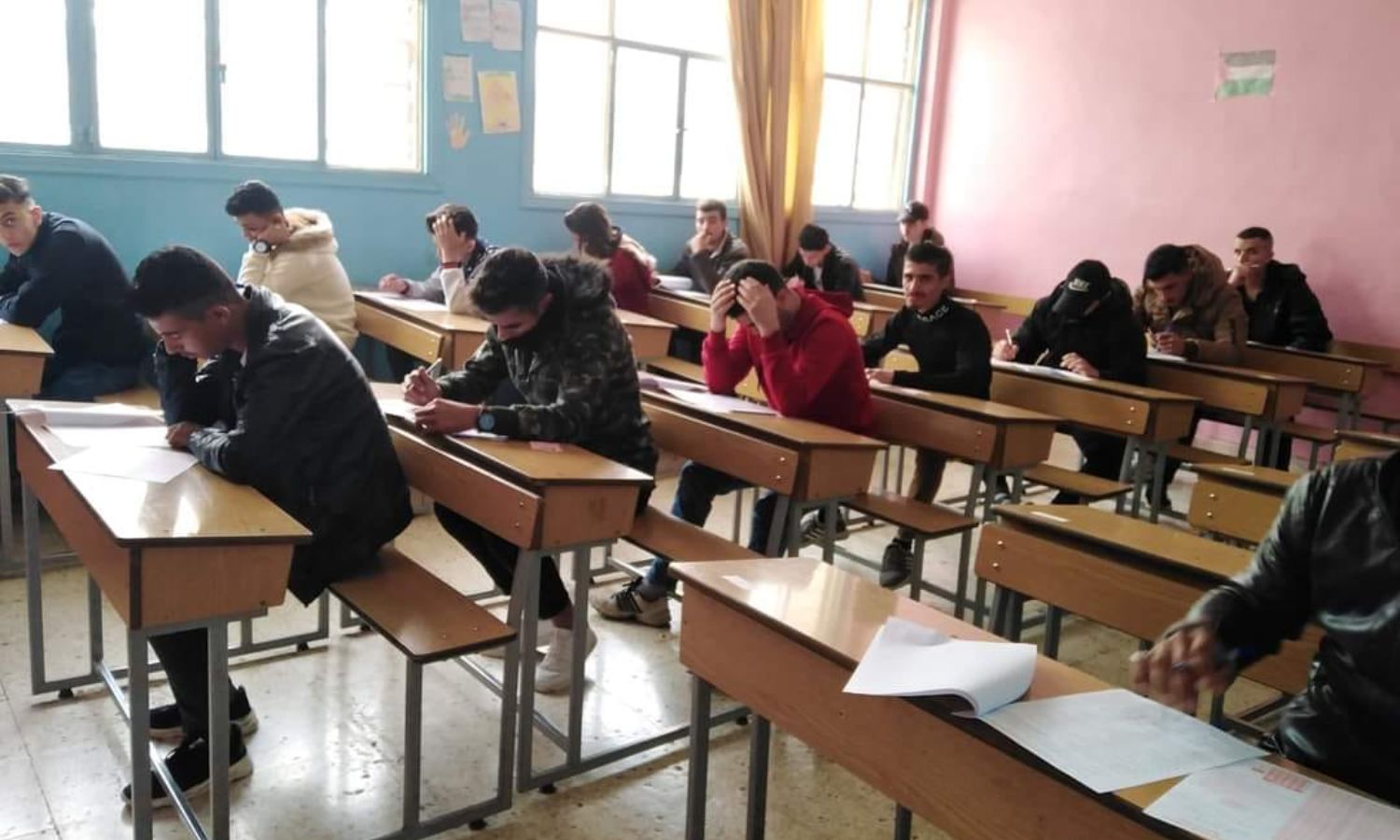
The scenes of psychological breakdowns and tears from Syrian students outside the Baccalaureate (high school) exam halls for the 2026 session—especially after the mathematics exam—were not a seasonal setback for the education sector. Rather, they were a resounding cry of humanity and education, revealing the deep structural flaws in our educational system.
It is a tragic moment that encapsulates the tragedy of an entire generation; a generation that has suffered the ravages of war, displacement, and hardship, only to find itself ultimately standing before the “guillotine” of a few hours’ worth of exams, an exam with the absolute power to determine the course of their entire lives, or to extinguish their dreams and deprive them of their university major and the passion they aspire to, without any consideration for their accumulated effort or their harsh circumstances.
In our collective consciousness, education has been transformed from a space for building human beings, discovering talents, and advancing knowledge, into an arena of fierce and terrifying conflict and competition, where the effort of twelve years of schooling is reduced to a single numerical grade. From this perspective, the Syrian Future Movement presents this issue as a pressing national concern, attempting to deconstruct the reality of the baccalaureate exam, highlight its shortcomings, and draw upon the experiences of developed countries to offer strategic alternatives and solutions that redefine the concept of educational justice in Syria, a country still struggling for a better future.
First, the reality of the baccalaureate in Syria (the ethical and philosophical perspective of the crisis):
The philosophy of standardized exams in the traditional Syrian educational system is based on the idea of ”academic distributive justice” through a uniform standard for all. Since places in free public universities are limited by a certain capacity (university hospitals, laboratories, workshops, teaching staff), “coordination and selection” are used as a tool to allocate students based on their numerical scores.
However, this philosophy suffers from profound ethical and humanitarian flaws in the modern era, and its dangers and drawbacks can be summarized in the following points:
The absence of genuine distributive justice: Standardized exams assume that all students take the test under equal conditions, but in reality, a student studying under bombardment or in displacement camps, suffering from power outages and poverty, cannot be equated with a student who enjoys a stable environment and expensive private tutoring.
Here, the competitive exam automatically favors financial resources and surrounding circumstances, not pure talent.
A material and social penalty for a temporary setback: Restricting a student’s future to a single day makes the baccalaureate exam a harsh punishment for any unforeseen circumstance (illness, extreme stress, sudden psychological distress). Furthermore, losing a few marks in a single subject like mathematics or physics means permanently excluding the student from their passion, thus beginning the tragic chapters of “parallel and private education” and “virtual universities” with their associated fees.
The commodification of knowledge and the undermining of merit: Philosophically, this system has become entrenched in classism. A poor student whose baccalaureate grades were unfairly denied admission to a field like engineering or medicine, while another student, less academically qualified, is allowed to buy a place in a private university simply because they have the money. This reality violates the principle of equal opportunity and transforms education from a human right based on merit into an investment commodity subject to the laws of the capitalist market.
Secondly, the “academic panic” syndrome worldwide (comparative experiences of other countries):
Syria is not unique in this suffering; The world’s approach to the final year of high school falls into three distinct patterns, reflecting differing philosophies:
- Countries experiencing a level of anxiety exceeding that of the Middle East:
In some Asian societies, the national high school graduation exam is a matter of life and death due to population density and intense competition:
China (Gaokao Exam): Considered the most difficult and stressful national exam in the world, with over 12 million students competing annually for limited university places. On exam days, construction and transportation around schools come to a standstill, and ambulances are deployed to treat students suffering nervous breakdowns. Failing the exam is seen as a social stigma that can ruin a family’s future.
South Korea (Suneung Exam): On this crucial day, the government delays official working hours to clear the roads for students, and aircraft are prohibited from landing or taking off during the English listening exam to prevent any disruption. This immense psychological pressure unfortunately contributes to high suicide rates among young people. - Arab Countries (The Traditional, Replicated Model):
Most Arab countries (Egypt, Syria, Tunisia, Algeria, and Morocco) share a reverence for the “unified final exam” and what are called “elite faculties” such as medicine and engineering.
The result in these countries is the same: financial strain on families through private tutoring, chronic anxiety that exhausts the bodies and minds of young people, and the transformation of schools into centers for rote learning and memorization rather than environments for innovation and critical thinking. - Western Countries (Flexibility and Multiple Opportunities):
On the other hand, many countries have succeeded in dismantling this nightmare by adopting flexible models that measure students’ comprehensive abilities:
The American Model: University admissions are based on a “comprehensive portfolio” system, where school grades constitute only part of the evaluation, while multiple aptitude tests throughout the year (such as the SAT), volunteer activities, talents, and motivation letters play the most significant role in admissions.
The Finnish and European model: This model focuses on cumulative and continuous assessment over the last three years and opens equal and prestigious pathways to vocational and technical education. It does not look down upon those who choose a non-academic path and provides “bridges” that allow for the transition from vocational to university education at any time.
Third, recommendations and solutions for reforming the Syrian Baccalaureate system:
Based on the vision of the “Syrian Future Movement” aimed at building a knowledge-based and just society, we present to decision-makers and those concerned with educational affairs a set of recommendations and proposals adapted from advanced international systems to address this deficiency:
Gradual transition to a “cumulative assessment” system:
The idea of relying solely on cumulative assessment must be abandoned. As the academic year draws to a close, we propose an alternative: distributing high school diploma grades as fixed percentages across all grades (10th, 11th, and 12th). This distribution ensures a true measure of student effort, reduces psychological pressure, and ultimately prevents the impact of sudden health or psychological emergencies.
Adopting a “term system” and multiple testing opportunities:
Similar to flexible educational systems, we recommend dividing final exams into two or more terms during the academic year (first and second semesters) and offering multiple supplementary courses to improve grades without requiring a full year of interruption. This gives students the opportunity to address any difficulties immediately.
Modifying university admission criteria and moving away from purely numerical grades:
We suggest that university admission should not be based solely on the baccalaureate score. Instead, universities should administer internal entrance exams (aptitude tests and personal interviews) that assess applicants’ passion and actual skills in their chosen field (e.g., analytical and logical reasoning skills tests for engineering, or humanistic and scientific aptitude tests for medicine). The baccalaureate score should represent only 50% of the admission requirements.
Reviving and Developing the “Academic Bridges System” (Top Students Track):
Activating and strengthening the channels that allow students to overcome their low baccalaureate grades through free education. A prime example is the system of technical institutes in Syria (such as technological, engineering, and commercial institutes), by expanding the admission quota for top students (the top 3% or 5% of graduates) and automatically and free of charge transferring them to corresponding university faculties (such as engineering and economics).
This track demonstrates that excellence at a later stage can rectify past shortcomings completely free of charge.
Recognizing the Prospects of “Open Virtual Education” and Facilitating its Requirements:
Given the exorbitant costs of private universities, national educational institutions must keep pace with the times and provide full academic recognition to internationally and locally accredited virtual degrees and universities. Models like the accredited American University of the People (UoPeople), which holds the prestigious WSCUC accreditation alongside universities like Stanford and Berkeley, and which offers its programs in Arabic free of charge to students in conflict zones like Syria through full tuition waivers, represent a true lifeline. These pathways should be supported to prepare Syrian youth for the global digital job market (programming, business administration) without the burden of tuition fees remaining an obstacle for both the poor and the high-achieving.
Fourth, an urgent message of support and psychological assistance to the 2026 cohort students and their families:
In conclusion, the Syrian Future Movement sends a direct message of solidarity and support to our sons and daughters who are going through these difficult times, and to their patient families:
To the students: The past exam paper is closed, and reviewing the answers or lamenting your math grades will not change what has been written. Instead, it will drain your energy and negatively impact your performance in the remaining subjects, such as physics, science, and languages. Rebalance your mental and emotional state immediately, and focus on making up for lost time and excelling in the upcoming exams. The academic battle is not over, and the supplementary session offers a second chance to recover and make up for lost time.
To our dear parents: Your children are under immense pressure. Blame, reproach, and destructive comparisons with their peers at this time are psychological wounds that may never heal. Be their safe haven and protective shield, and always reassure them that your love and pride in them are not tied to a numerical score, and that life is much more than just a certificate grade.
To the examiners and graders: We urge the grading committees to adopt flexible and considerate marking schemes that take into account the logical steps taken by the student, and not deprive them of full marks for a question due to a final calculation error resulting from stress and pressure. This is essential to preserve the efforts of a whole year of sleepless nights and hard work.
The Baccalaureate is a milestone on a long journey, not the end. Today, the future favors those who possess skill, passion, and the ability to learn continuously, not those who simply memorize a book to regurgitate it in the exam hall.
Let us work together for a Syrian education system that respects the humanity of the student and opens doors to the future based on their skills, not on the pressures of a single exam night.
We wish all our students in Syria patience, perseverance, and well-deserved success.