

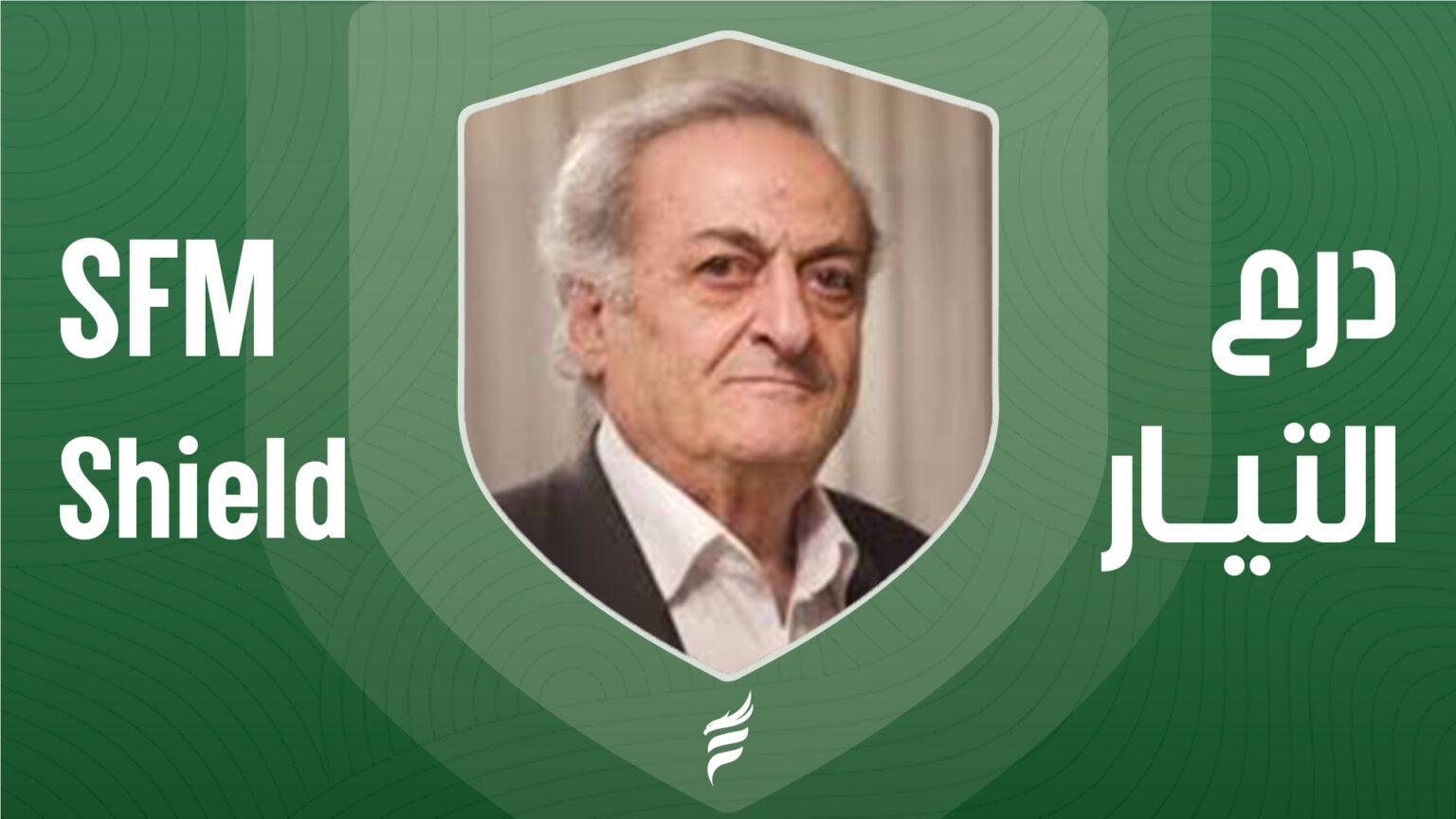
As part of the “Shield of the Syrian Future Movement” program, which commemorates Syrian figures who championed the Syrian revolution and the values of freedom and dignity, we highlight the figure of Dr. Aref Dalila, the renowned Syrian economist and political thinker, and former Dean of the Faculty of Economics. He presented an exceptional model of peaceful opposition to the Syrian regime, paying a heavy price in his life and health for his patriotic stances.
Dr. Aref Dalila is considered one of the most prominent figures of the Syrian democratic opposition, and one of the figures who confronted the system of corruption and tyranny with an academic mind and profound economic insight, believing that true reform begins with justice, transparency, and equal citizenship.
Early Life and Academic Career:
Dr. Aref Dalila was born in 1942 in Latakia. He graduated from the Faculty of Commerce at Damascus University in 1967, before earning his doctorate in economics from Lomonosov Moscow State University in 1972.
He worked as an economic advisor in Kuwait between 1981 and 1986, then returned to Syria to become Dean of the Faculty of Economics at Damascus University, where he became known for his intellectual boldness and structural critiques of economic and administrative corruption.
In 1998, he was dismissed from his position following a lecture he delivered at the Arab Writers Union addressing economic dysfunction and institutional corruption in the Syrian state.
His research and writings focused on:
- Economic and social development in Syria.
- Social justice.
- Good governance.
- Combating corruption.
Administrative and economic reform. His Role in the Damascus Spring:
With the onset of the “Damascus Spring” following Bashar al-Assad’s rise to power in 2000, Dr. Aref Dalila was at the forefront of voices calling for political and democratic reform.
He participated in intellectual and political forums, contributing to the revival of public debate about Syria’s future and the necessity of transitioning to a state governed by institutions and the rule of law.
He also ran for parliament in 1998, considering it at the time “the only possible platform to address public opinion,” a move that reflected his desire for reform from within the public sphere despite security and political constraints.
Arrest and Political Trial:
On September 9, 2001, Dr. Dalila delivered his famous lecture at the Jamal al-Atassi Forum entitled:
“The Syrian Economy: Problems and Solutions,” in which he called for:
- Expanding public freedoms.
- Ending corruption.
- Enhancing transparency.
- Building the rule of law.
Just one week later, he was arrested by Syrian intelligence services.
In July 2002, the Supreme State Security Court sentenced him to ten years of hard labor on political charges, including:
- Attempting to change the constitution through illegal means.
- Inciting rebellion.
- Spreading false news.
- His trial was considered one of the most prominent political trials in modern Syrian history.
Years of Imprisonment and Health Suffering:
Dr. Aref Dalila spent seven years in prison, mostly in solitary confinement in Adra Political Prison in Damascus, under harsh conditions that severely deteriorated his health.
Among the most serious health problems he suffered during his detention were:
- Pulmonary embolisms.
- Cardiovascular diseases.
- Diabetes.
- A stroke in 2006 that left him paralyzed in part of his body.
- Several hunger strikes in protest against ill-treatment.
- Torture and beatings, as documented by his lawyers and human rights organizations.
- He became the longest-serving detainee of the “Damascus Spring” in prison.
The International Campaign for His Release:
Dr. Aref Dalila’s case became an international human rights issue, as:
Amnesty International considered him a “prisoner of conscience.”
PEN America protested his trial.
Dozens of human rights organizations called for his release.
US President George W. Bush referred to him in an official speech as a Syrian political prisoner.
On August 7, 2008, he was released by presidential pardon after his health deteriorated.
His first comment after his release was: “Spending all this time in prison without having committed any crime is beyond my comprehension.”
His Stance on the Syrian Revolution:
With the outbreak of the Syrian revolution in 2011, Dr. Aref Dalila continued to support the path of democratic change and sought to reduce sectarian tensions, especially in the city of Latakia.
He also joined the executive office of the National Coordination Body for Democratic Change, emphasizing his commitment to a political solution and a democratic civil state. His presence, as an Alawite figure opposed to the regime, provided further evidence that the Syrian revolution was a popular uprising against tyranny, not a sectarian conflict as the regime attempted to portray it.
His research activities after leaving Syria:
After leaving Syria, he settled in the United Arab Emirates, where he continued his intellectual and research activities in the economic field.
Following the fall of the Assad regime in December 2014, his name resurfaced in the media through interviews and statements addressing the future of the Syrian economy and the reconstruction phase. He also commented on the lifting of US sanctions on Syria in 2015.
Despite his advanced age and declining health, Dr. Aref Dalila remains a moral and intellectual icon in the Syrian national consciousness.
Honoring the Syrian Future Movement:
Based on the Syrian Future Movement’s belief in the importance of documenting the struggles of Syrian national figures, the Movement announces the honoring of Dr. Aref Dalila by awarding him the symbolic “Movement Shield,” in recognition of his academic and national career and his long sacrifices for freedom, dignity, and justice.
This tribute is a testament to all those who championed the cause of the Syrian people and confronted tyranny with free speech and principled stances.
The Syrian Future Movement also affirms that Dr. Aref Dalila represents a unifying national model, proving that the Syrian opposition was a national project transcending sectarian and affiliational divisions, and that the struggle against injustice was the cause of all Syrians.
Conclusion:
Dr. Aref Dalila remains one of the most prominent symbols of peaceful and intellectual struggle in modern Syria, and a living testament to the ability of the free academic to confront tyranny, however brutal it may be.
He paid with his health and freedom for his convictions, but he remained steadfast in his principles, a firm believer.