
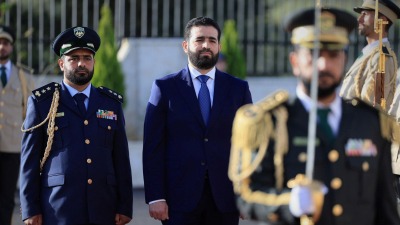
The Syrian Future Movement is closely following the Ministry of Interior’s efforts to develop the security system, which were practically demonstrated by the graduation of the first class of tourist police officers on Sunday, May 17, 2026. The graduation ceremony was held in Tartous Governorate in the presence of Interior Minister Anas Khattab, Minister of Social Affairs and Labor Hind Qabawat, and Minister of Tourism Mazen Al-Salhani.
The Syrian Future Movement commends this step and appreciates the slogan “Security is a Partner in Development” launched by the Interior Minister.
The Syrian Future Movement also values this initiative, which transforms the concept of security from a mere set of traditional measures to protect individuals into an active and contributing element in bolstering national development projects.
In this context, the Movement recalls the Interior Minister’s statement that “tourist security does not only mean protecting tourists or facilities, but also protecting the image of the nation, preserving the visitor experience, and strengthening citizens’ confidence in their country’s ability to progress.”
We see in this vision an embodiment of the concept of comprehensive security, which is not limited to protecting sites, but also contributes to building a positive image for Syria and enhancing its position on the global tourism map. The Syrian Future Movement points to the timeline and procedures taken to ensure the seriousness of the implementation. This step was not a spur-of-the-moment decision, but rather the culmination of a well-defined plan announced by the Ministry of Interior on December 16, 2025, which opened recruitment for both men and women to form this new force.
An intensive four-month training course was conducted at the Tartous branch of the Training and Rehabilitation Department, aiming to “strengthen the tourism security system and provide it with highly qualified and trained personnel.”
Furthermore, the trainees undertook a field training visit to Arwad Island on May 11, 2026, confirming that these steps were not merely theoretical but part of a comprehensive training plan.
The Syrian Future Movement draws attention to the unique nature of this training course and its high-quality admission criteria, which are in line with modern requirements. The course features advanced admission standards, resulting in 518 graduates (with a notable female representation). These graduates hold university, technical, and secondary school degrees and meet advanced membership requirements, including proficiency in at least one foreign language. They have undergone training in multiple languages, including English, French, Turkish, and Russian.
The course also included specialized training in tourism laws and regulations, archaeology, and site protection. We believe this advanced training represents a qualitative leap in the concept of security work related to this vital sector and answers many questions regarding the delay in launching this force.
The Syrian Future Movement reiterates its unwavering support for strengthening governance and bolstering vital sectors as a key driver of national development, positions published on its official website, including:
- The founding document, “The Syrian Future Movement and Tourism” (dated May 5, 2024), in which we called for supporting tourism in general, and domestic tourism in particular, to address the fragmentation of the social fabric and the tearing apart of national unity caused by the war.
- The statement, “Mastercard’s Return to Syria” (dated May 9, 2026), in which we warned that the absence of digital infrastructure threatens to marginalize the most vulnerable groups, a point that also applies to the importance of a sophisticated security system to ensure the success of any tourism investment.
While the Syrian Future Movement appreciates this step and acknowledges it as a positive development that strengthens confidence in the tourism sector, it expresses some reservations aimed at improving performance. These reservations are based on the necessity of:
- Expanding the geographical deployment and distributing graduates across all Syrian governorates, rather than limiting them to Latakia and Tartous as some statements have suggested. Syria is rich in archaeological and historical sites throughout the country, and these must be included in protection and security plans.
- Establishing a continuous training plan to develop the skills of this force, not just the initial foundational course. The tourism sector is constantly evolving, and the need for new skills in dealing with crises and emergencies necessitates regular, structured training.
- Integrating the roles of the Tourist Police, the Ministry of Tourism, and the local community to ensure that this force enhances the tourist experience rather than hindering it. Furthermore, continuous coordination is essential to guarantee the provision of the best possible services to visitors while simultaneously protecting their rights.
- The development of the tourism sector is linked to measurable indicators, through the periodic announcement of plans to improve services offered to visitors, encourage investment in the sector, and measure tourist satisfaction with the new security measures.
In conclusion, the Syrian Future Movement affirms that security and development are two sides of the same coin, and that the success of any vital sector is contingent upon a safe and stable environment. What distinguishes this step is its alignment with a noticeable increase in tourism, as data from the Ministry of Tourism indicates that the total number of visitors—Syrians, Arabs, and foreigners—has exceeded 3.5 million since the liberation.
While the Syrian Future Movement commends these achievements, it believes that the success of this new force is a true test of the government’s ability to translate theoretical promises into practical programs that contribute to improving citizens’ lives and enhancing Syria’s image in the world.
The Syrian Future Movement will continue to closely monitor this issue, offering both support and constructive criticism, striving to build a new Syria worthy of its people’s sacrifices.