This paper addresses the fundamental problem in building the new Syrian state: how can power be representative of society instead of How can it be controlled?
Through a critical analysis of models of the relationship between the state and society in Western and Islamic thought, the study concludes that the “containment” model practiced by the Assad regime led to a relationship of antagonism that ultimately sparked the 2011 revolution.
With the fall of that regime, a historic opportunity arose to establish a model of “partnership and integration,” one based on recognizing the dialectic between the state and society as a driver of development, not as an inevitable conflict.
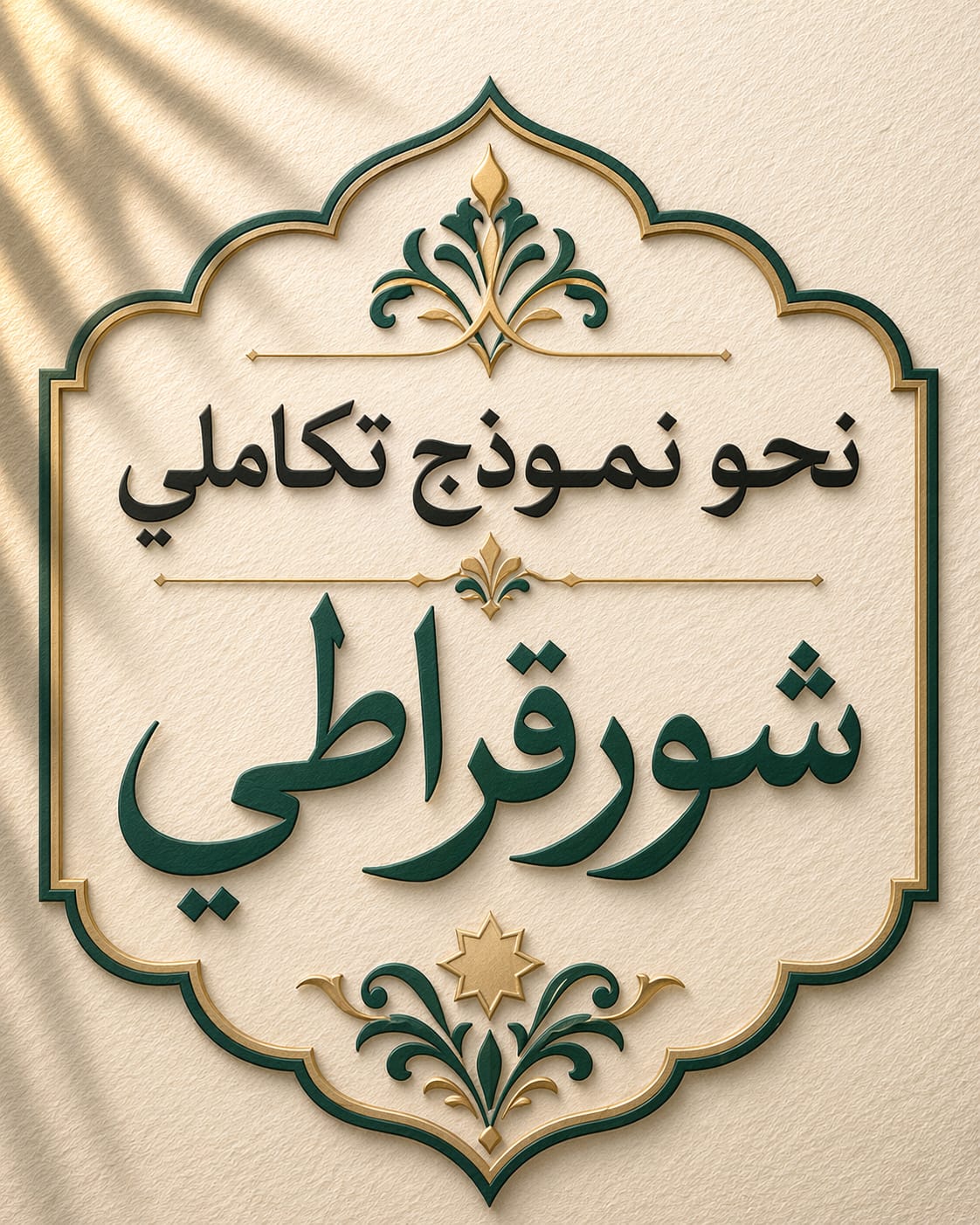
This article presents an approach that combines Max Weber’s concept of “rational legal authority,” an understanding of the diverse “social action” within Syrian society, and the inspiration drawn from the models of “shura” (consultation) and “justice” in Islamic political thought. In what we in the Syrian Future Movement have termed “shura-cracy” as a philosophical and legal framework for a state governed by the rule of law and institutions.
Definition of Shura-cracy: Shura-cracy is a system of governance based on integrating the principle of consultation (shura) as a value-based framework with democracy as a procedural mechanism, within an institutional framework that achieves a balance between the state and society. It establishes a dual legitimacy based on constitutional legal legitimacy and societal legitimacy stemming from representation and interaction.
First: Theoretical Framework – The Problem of Expression versus Control
The modern state emerged in Europe after the religious wars as an entity monopolizing power and legitimate violence, according to Max Weber’s definition: “The legitimate monopoly of physical coercion over a specific geographical territory.”
However, this procedural definition did not resolve the fundamental problem: How can power be expressive of society rather than controlling it?
Answers have varied within the Western tradition:
- In the Hobbesian model (containment): complete delegation of power to the state in exchange for security.
- In the Marxist model (contradiction): the state is an instrument of class struggle.
- In the Hegelian model (integration): the state reconciles the contradictions within civil society.
In Islamic political thought, the concepts of allegiance (bay’ah), consultation (shura), and the objectives of Islamic law (maqasid al-shari’ah) were presented as a framework for a social contract aimed at achieving justice and prosperity. However, this vision was not without historical challenges, as it oscillated between pragmatic legitimacy and political coercion, as seen in al-Mawardi’s work, and the analysis of tribal solidarity (asabiyyah) as the basis of authority, as seen in Ibn Khaldun’s work.
Therefore, the contemporary Islamic model of integration is not a literal revival of the past, but rather an interpretive reading that draws inspiration from it and reconstructs it.
Secondly: Patterns of the Relationship Between State and Society – An Ideal Classification
The relationship can be classified into three patterns:
- The containment pattern: a dominant state and a subjugated society.
- The antagonism pattern: a constant conflict between the state and society.
- The partnership and integration pattern: mutual recognition, intermediary institutions, and an active citizen.
In this last pattern, the relationship is no longer binary (ruler/ruled), but triangular: state – intermediary institutions – citizen.
Third: The Syrian Experience – From Containment to Explosion
The Assad regime represented an extreme model of containment in its various forms:
- Ideological containment
- Security containment
- Rentier economic containment
This resulted in a marginalized society and a relationship of antagonism that exploded in 2011.
However, the course of the revolution itself was not free from attempts to reproduce containment or slide into armed conflict.
Today, an opportunity arises to establish a new model based on partnership.
Fourth: From Idea to Institution – How Does Shura-Certificate Work?
Shura-Certificate is not complete as an idea, but rather through its translation into an institutional structure:
- A dual legislative system: an elected parliament (representing the population) and a national consultative council (representing societal/professional/cultural groups).
- Expanded administrative decentralization: elected local councils with real powers in services and development.
- Independent intermediary institutions: unions, federations, and civil society organizations.
- Binding Consultation: Mechanisms that make consultation an integral part of decision-making, not merely a formality.
Fifth: The Principle of Mutual Checks – A Guarantee Against Tyranny
The consultative model is based on the principle of balance, not dissolution. The state is checked through an independent judiciary and a constitutional court.
Society monitors the state through a free press and civil institutions.
The state protects society from disintegration,
and society prevents the state from becoming authoritarian.
This integration does not imply abolition, but rather institutional balance.
Sixth: The Economy as a Testing Ground for the Relationship
A political partnership cannot be built without a just economic foundation based on:
- Rejecting rent-seeking and clientelism.
- Adopting a just, productive economy.
- Supporting small businesses and cooperatives.
Here, the state regulates, it does not monopolize, and society produces, it does not follow.
There can be no partnership without relative economic independence for society.
Seventh: Managing Pluralism – From Fear to Integration
Syrian society is religiously, ethnically, and culturally diverse.
The challenge today is not to deny this diversity, but to organize it within a framework of:
- Equal citizenship with equal rights and responsibilities.
- Protection of cultural specificities.
- Rejection of forced assimilation or identity-based division.
For a consultative system organizes difference within a comprehensive contract, rather than abolishing it.
Eighth: Brief International Comparisons
Contemporary experiences demonstrate the importance of integration:
- Germany: The strength of civil society.
- Tunisia: An attempt at a consensual transition.
- Indonesia: Reconciling Islam and democracy.
These are partial models that can be useful in building a unique Syrian model.
Ninth: Challenges of the Consultative Model
This horizon is not without risks:
- The return of despotism in the name of stability.
- Chaos in the name of freedom.
- The politicization or exclusion of religion.
- The weakness of institutions during the transitional phase.
This necessitates gradual building and historical patience.
Conclusion:
The challenge in Syria is not only to overthrow a regime, but also to prevent its reproduction in new forms.
The relationship between the state and society is not destined to be one of conflict, but can be a driving force for development if restructured on the basis of partnership.
“Consultative democracy” is not a ready-made solution, but rather an open horizon for redefining power as an expression of society, not a replacement for it.
For there is no democracy without consultation, no consultation without institutions, no institutions without an active society, and no active society without a just state.
Therefore, we in the Syrian Future Movement recommend the following:
- Drafting a constitution that establishes a rational legal authority and guarantees the independence of the judiciary.
- Building consultative and dual representative institutions that reflect societal diversity.
- Strengthening civil society as an active force.
- Partner, not subordinate.
- Adopt a fair and productive economic model.
Launch a national platform for societal dialogue.
In this way, Syria can transform from an arena of conflict between the state and society into an integrated model that redefines politics as a collaborative effort to shape the future.