
December 2024 was a scene that shocked the world: a designated terrorist group, led by a man who had once been al-Qaeda’s emir in Syria, spearheaded a lightning military operation that toppled a repressive regime that had held power for five decades.
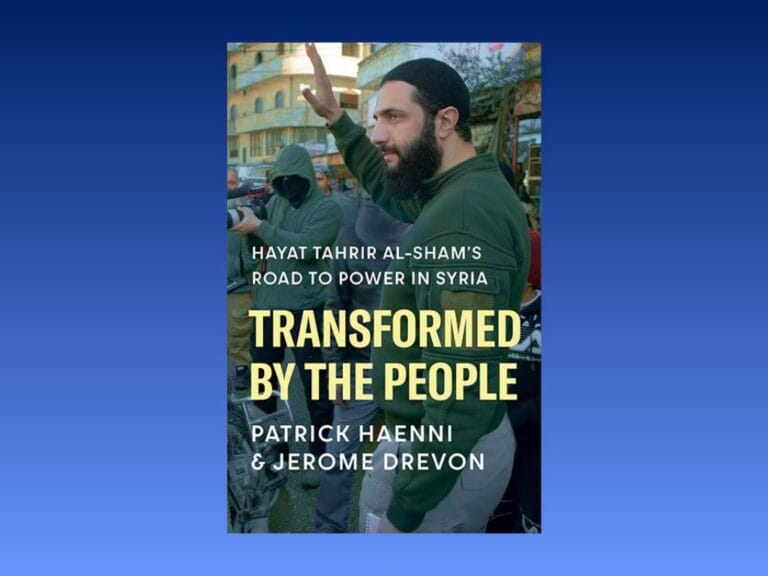
The question that perplexed academic and political circles was not simply, “How did Assad fall?” or “What external circumstances brought about this?” but rather, “How did Hayat Tahrir al-Sham (HTS) itself transform from a radical jihadist organization into a force capable of governing a state and achieving this?” This is where the book Transformed by the People: Hayat Tahrir al-Sham’s Road to Power in Syria, by Patrick Haenni and Jerome Drevon, published by Hurst Publishers in August 2025, comes in. It is one of the first specialized academic works to offer an in-depth answer based on years of field research, including direct interviews with Hayat Tahrir al-Sham leaders, including Ahmad al-Sharaa (Abu Muhammad al-Julani), as well as diplomats, opposition figures, and civil society personalities.
This book cannot be considered a mere documentation of events, but rather an attempt to understand the dynamics of the “transformation” that paved the way for it, and a theoretical framework for interpreting the future of Syria under this controversial new leadership.
Book Background Information:
- Title: Transformed by the People: Hayat Tahrir al-Sham’s Road to Power in Syria
- Translated Title: Transformed by the People: Hayat Tahrir al-Sham’s Road to Power in Syria (as reviewed by the Doha Institute for Graduate Studies).
- Authors: Patrick Haenni – PhD in Political Sociology, specializing in social movements and the state in the Middle East, and Jerome Drevon – PhD, Senior Analyst on Jihad and Modern Conflict at the International Crisis Group (ICG) and Research Associate at the Graduate Institute in Geneva.
- Publisher: C. Hurst & Co. (London), in partnership with Oxford University Press.
- Publication Date: August 26, 2025.
- Number of Pages: Approximately 320 pages.
- Language: English.
- The ISBN for the paperback edition is 9781805264101.
- The ISBN for the digital edition is 9781805264637.
- Available formats: Hardcover, ebook (PDF, ePUB).
- A preview of the content is available on Google Books, and the book’s structure is available on Perlego.
The book’s narrative and analytical framework: Unraveling the trajectory and the core dilemma:
The book begins with a surprising fact: Hayat Tahrir al-Sham (HTS), which emerged from Jabhat al-Nusra (the official al-Qaeda branch in Syria), would not have been able to implement its “deterrence of aggression” strategy without profound internal transformations that began approximately five years prior.
The authors argue that the key to understanding this trajectory lies not in Damascus, but specifically in Idlib, where, between 2019 and 2024, HTS transformed from a besieged rebel faction into a local, conservative, and Islamist-oriented government.
What happened in Idlib? The book asserts that this is not merely a tactical shift or a “camouflage” for Western consumption, but a genuine transformation driven by both local and international pressures. On the one hand, the presence of a religiously conservative but non-transnationally jihadist Idlib society compelled Hayat Tahrir al-Sham (HTS) to gradually abandon the rhetoric of global jihad and focus on governance and administration.
On the other hand, Turkey (a NATO member and strategic ally) played a role in pushing HTS toward pragmatism.
“The Thermidorian Strategy”:
The book’s most prominent concept is borrowed from the French Revolution: what the authors call the “Thermidorian strategy,” inspired by the “Thermidor Coup” of 1794 against Robespierre.
Following Robespierre’s downfall, the French revolutionaries abandoned the extremes of the Reign of Terror and moved toward stability and pragmatism. Similarly, since 2019, Hayat Tahrir al-Sham (HTS) has been banking on the Syrian “silent majority”—that socially conservative majority which is averse to extremism—to marginalize extremists within its own ranks, “empty Salafism” of its violent content, and even embrace some Sufi practices as an alternative.
The book concludes with a central idea: that de-radicalization does not necessarily require “moderate mediators,” nor does it depend on the personal “intentions” of leaders. Rather, it is a policy of power that arises from an imposed administrative and governmental reality. This explains how a leader like Ahmad al-Sharaa can be acceptable to the West without completely abandoning his Islamic principles.
Critical and Analytical Reading:
First, Strengths and Exceptional Contributions:
Methodological Excellence: The book is among the first, or perhaps even the first, Western academic research based on exclusive interviews with HTS leaders (including al-Sharaa himself), as well as diplomats, opposition figures, and civil society personalities.
The authors were not merely remote observers; they spent years working on the ground in Syria. This led Robert Malley (former White House Middle East advisor and former CEO of the International Crisis Group) to describe the book as a “gem” that provides “a definitive answer to the question of whether the transformation of Sharia and the deradicalization of Hayat Tahrir al-Sham is real or fake.”
Breaking the black/white dichotomy: The book avoids simplistic binary classifications (terrorist versus moderate).
Instead, it offers a complex analysis of power dynamics where ideology becomes a means to legitimacy and governance, not an end in itself.
Marc Lynch, a professor of political science at George Washington University, describes it as “coherent, controversial, and ultimately compelling.”
Decoding the “Idlib Model” as a Laboratory for the Future: The book doesn’t merely describe what happened in Idlib; it transforms it into a theoretical and applicable model for understanding political transformations in complex conflicts. Topics covered include: how to deal with religious minorities; redefining the understanding of Sharia; and the alliance with Turkey as a secular NATO member state.
Secondly, Additional Strengths – The Five Major Contributions:
Deep Historical Roots: The first chapter analyzes the evolution of Jabhat al-Nusra since its split from ISIS, documenting how the seeds of this transformation were present even before the HTS declaration.
Domination and Control: This chapter examines how HTS eliminated extremist factions within its ranks (such as Hurras al-Din) and subjugated the civilian opposition, noting that governance in Idlib was a hybrid system combining civilian administration (the Salvation Government) with absolute military control.
Ethics as Politics: Chapter 10 details how HTS attempted to “rehabilitate the public sphere” in Idlib by documenting official corruption scandals and combating “middlemen.” This ethical dimension was used to build popular legitimacy, not merely for religious preaching.
The Idlib Spring of 2024 – A Pre-Damascus Launch: The book demonstrates how the popular protests that erupted in Idlib weeks before the collapse of the former regime were a crucial turning point. They forced HTS to make promises of political and administrative reforms, which honed its ability to address popular demands and improved the timing of the attack on Damascus.
The economy and laws as a tool of governance: This documented how the organization dealt with the private sector and international sanctions, keeping the economy (the market) free from ideological nationalization.
Third, critique and discussion:
No research is entirely comprehensive, and this book is no exception. Therefore, the following observations can be made:
- The problem of generalizing from Idlib to all of Syria: Idlib is a rural province with a conservative Sunni majority, while Syria is a multi-sectarian country. The major issue is: Can the “Idlib model” (based on the conservative “silent majority”) be applied to a complex and diverse country like Syria? The authors suggest that the model needs radical modification, but they do not provide a clear answer.
- The lack of a detailed military analysis of the attack on Damascus: Although the title alludes to “the road to power,” the book focuses heavily on the governance phase in Idlib (2019-2024), while giving less space to the recent war and the “deterrence of aggression” offensive than the reader might expect.
- Presupposition of Knowledge: The New Arab review noted that this is “a specialized work written for readers with prior knowledge of the Syrian conflict,” and some terms and headings (such as “the exodus of jihadism” and “the erosion of Salafism”) may be unclear to the non-academic reader.
Conclusion:
“Transformed by the People” is a pivotal contribution to understanding the dramatic developments in Syria after the fall of Assad. It is a rigorous study of the political transformation theory of armed movements and serves as a valuable resource for those studying conflicts in the Arab world.
Despite some reservations (the lack of military analysis and the difficulty of generalizing to all of Syria), its merits outweigh its limitations. These include: the first-ever on-the-ground documentation of exclusive interviews; the revelation of the mechanisms of the “Idlib model” as a political laboratory; and the courage to approach a complex subject without resorting to simplistic slogans.
However, a major obstacle to wider public engagement with this valuable work remains: the language. The book’s availability only in English (with the exception of chapters translated by the Doha Institute) deprives the vast majority of Syrians—including policymakers, civil society, and local researchers—of direct access to its insightful analyses.
Therefore, we strongly recommend that this book be translated into Arabic as soon as possible, either by the publisher itself or through an initiative by research centers or funding bodies interested in conveying knowledge about the Syrian revolution and war directly to its people.
We at the Scientific Office of the Syrian Future Movement wish the movement could fund the translation department; we would have translated and published this book and others. We hope that a purely Syrian-funded movement like the Syrian Future Movement will one day achieve this level of financial capability.
This book, as reviewers have noted, remains “the best book of its kind in English on this subject,” and it is now time for it to become the best book in Arabic as well.
For this reason, we strongly recommend its translation.