
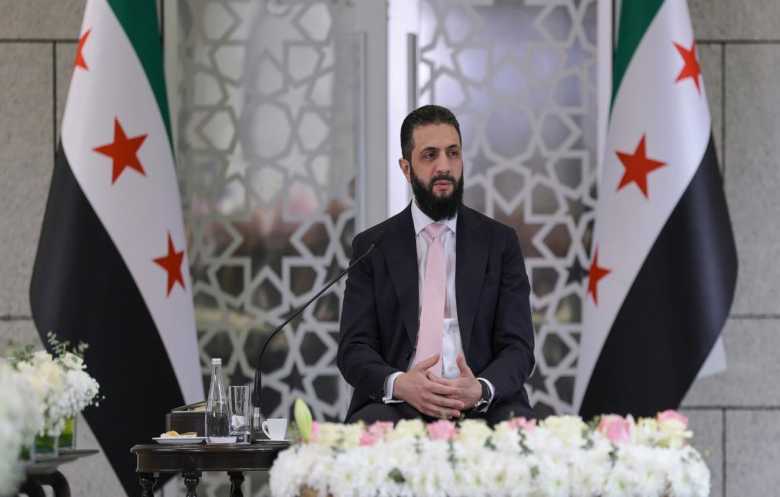
The UAE-based newspaper The National reported on March 27, 2026, that Syrian President Ahmed al-Sharaa would make his first official visit to London the following week, as part of a European tour beginning in Berlin on Monday.
This move follows the resumption of diplomatic relations last summer and the commencement of procedures to reopen the Syrian embassy in London in November 2025. It also follows high-level meetings between al-Sharaa and British Prime Minister Keir Starmer on the sidelines of the COP30 climate summit in Brazil.
The visit is considered a significant step in the normalization process between the new Syria and the West, particularly in light of the partial and complete lifting of European, British, and American sanctions during 2025, which allowed for the resumption of Syrian oil exports for the first time in 14 years. London is expected to announce a new export financing plan during the visit to support British companies in the Syrian market, with a focus on the new Syrian investment law that allows 100% foreign ownership.
The Geopolitical Context: Syria Between the War on Iran and Its Strategic Role
The visit comes amidst a tense regional context, witnessing a continuous escalation in the “war on Iran,” which began with large-scale US-Israeli strikes in June 2015 and extended to repeated strikes in February and March 2016 on Iranian military and nuclear facilities, including Kharg Island and defense industrial zones. This has weakened the “axis of resistance,” particularly Iranian influence in Syria, which relied on bases and militias affiliated with the Islamic Revolutionary Guard Corps (IRGC).
The new Syria has opted for a pragmatic policy of neutrality toward this escalation, focusing on “exiting the Iranian axis” as part of a geopolitical rebalancing.
This strategic role makes Syria a potential partner for the West in combating the remaining terrorists (ISIS) and preventing the return of Iranian influence, especially given the continued US presence in the northeast. Reports from the Washington Institute for Near East Policy (March 2026) confirm that Syria is feeling the repercussions of the Iranian war, but has thus far managed to maintain relative stability, with violence levels at their lowest since the fall of the former regime.
Economically, the lifting of sanctions (British in April 2025, European in May 2025, and partially American) has accelerated growth: the Central Bank of Syria expects growth of nearly 10% in 2026 (compared to the World Bank’s estimate of 1% for 2025), supported by the return of refugees and Syria’s reintegration into the global economy.
Analytical Outlook for the Visit:
Expected Positives:
Direct Economic Support: The British export financing plan will open doors for investment in reconstruction, particularly in high-yield sectors (energy, construction, and agriculture). The recent visit of the Director of the Investment Authority, Talal Hilali, to London, and his statements regarding the “Dubai model,” reflect the optimism of the Syrian-British community (through the Syrian-British Business Council).
Strengthening International Legitimacy: The visit enhances al-Sharaa’s standing as a pragmatic transitional leader and paves the way for the full reopening of embassies, which will bolster regional stability and contribute to attracting additional Gulf and European investment.
Joint Security Role: Potential discussions on combating ISIS and remaining Iranian influence, leveraging Britain’s intelligence expertise.
Drawbacks and Challenges:
Security and Human Rights Concerns: Despite the lifting of sanctions, British concerns persist regarding domestic reforms (inclusivity, minority rights, and anti-corruption).
Some reports also indicate continued challenges in controlling certain factions and militias, which could slow the flow of investment.
Regional Repercussions of a War with Iran: Continued strikes could disrupt supply chains or lead to a resurgence of terrorist activity (as seen with ISIS in the northeast in February 2016), threatening economic recovery.
Domestic Pressures: Focusing on the diaspora could raise domestic concerns about privatization or the unequal distribution of opportunities, especially given the electricity and infrastructure challenges that al-Hilali himself highlighted.
Reliance on External Support: This visit follows previous visits (to Washington and the Gulf), but its success hinges on a commitment to reforms. Otherwise, it may face criticism from Western entities focused on “democracy and rights.” Recommendations for Overcoming Challenges:
- Strengthening Internal Reforms: The Syrian government must expedite the enactment of anti-corruption laws and enhance transparency in investment, while involving national forces (including the Syrian Future Movement) in oversight mechanisms to ensure the confidence of international partners.
- Joint Security Strategy: Propose a Syrian-British-European security cooperation framework for border monitoring and counterterrorism, with a focus on disarming militias formerly linked to Iran to mitigate security risks.
- Engaging the Diaspora and Civil Society: Expand the role of the Syrian-British Business Council to include local development projects, along with training programs for Syrian youth to ensure a fair distribution of opportunities.
- Diversifying Partnerships: Link the visit to regional initiatives (such as coordinating with Germany on refugee returns) to avoid over-reliance on any single party, while leveraging the lifting of sanctions to attract investments in renewable energy and technology.
- Parliamentary (if Parliament convenes) and political follow-up are necessary to monitor the implementation of the visit’s outcomes and ensure that investments are backed by comprehensive legal guarantees.
Conclusion:
President al-Sharaa’s visit to Britain represents a historic opportunity for Syria to strengthen its geopolitical role as a regional stabilizing force, independent of the Iranian axis, which is facing unprecedented pressure.
The success of transforming this visit into a sustainable partnership depends on a balance between economic pragmatism and a commitment to democratic reforms.
We in the Syrian Future Movement view this visit as a positive step, provided it is accompanied by genuine internal reforms that guarantee a stable and prosperous future for all Syrians.