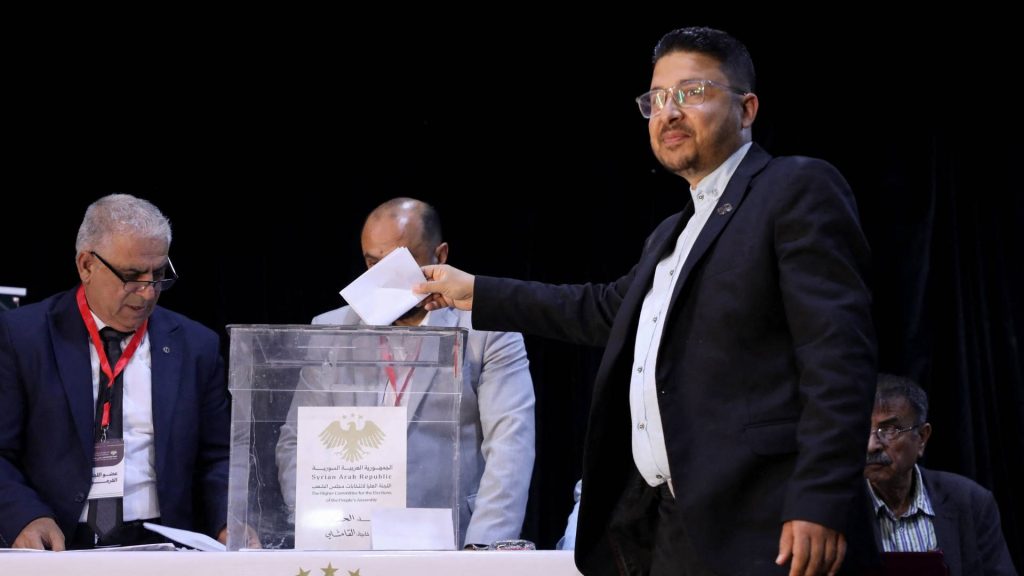
Syria concluded a crucial by-election on Sunday, May 24, 2026, in the Hasakah Governorate and the Ain al-Arab (Kobani) region. The elections covered nine seats in Hasakah (three in the Hasakah district, four in Qamishli, and two in al-Malikiyah/Derik) in addition to two seats in Kobani.
This election is part of the process to complete the formation of the 210-seat People’s Assembly (140 elected members + 70 appointed by President Ahmed al-Sharaa), after its previous postponement due to the security and administrative situation in the northeastern regions.
Preliminary Results and Statistics:
The High Elections Committee announced a voter turnout of approximately 95-97% of eligible voters, with polling stations closing at noon (with the possibility of a one-hour extension).
Four Kurdish candidates won seats out of the nine or eleven in the respective districts. Most of these candidates are from the Kurdish National Council (ENKS) or are independents. The Democratic Union Party (PYD) – the political wing of the Syrian Democratic Forces (SDF) – did not secure significant direct representation.
Among the most prominent winners:
- Hasakah District (3 seats): Ibrahim Mustafa al-Ali, Omar Issa al-Hayis, and Fasla Khader Yousef.
- Qamishli District (4 seats): Radwan Othman Sido (Kurdish), Abdul Halim Khader al-Ali, and others.
- Kobani: Farhad Anwar Shahin and Shawakh Ibrahim al-Assaf.
Context and Strategic Analysis:
- These elections followed a comprehensive agreement (January 30, 2016) between the Syrian government and the Syrian Democratic Forces (SDF), under US auspices, which included:
- A gradual integration of forces (forming a division of 3 brigades plus a brigade in Kobani).
- The deployment of Internal Security Forces to Hasakah and Qamishli.
The handover of certain civilian institutions and addressing the issue of border crossings and resources.
Despite this agreement, 24 Kurdish parties and groups (including the PYD) issued a statement on May 19 rejecting the allocation of only 4-5 seats to the Kurdish component, demanding at least 40 seats based on their population estimates (15-20% of Syria’s population). They considered the current number to be “political exclusion.”
Strategically, the state succeeded in imposing a centralized electoral reality after regaining relative security control over the major cities, but this signifies a transition from a phase of “self-administration” to one of political conflict within the framework of a unified state.
However, the success of this step will not be measured solely by voter turnout or the number of seats, but rather by the new council’s ability to address the region’s vital issues: services, resource management (oil and agriculture), the Kurdish language, and local security.
Therefore, the future will likely fall into one of three expected scenarios:
- The most probable scenario (65%): A slow and gradual integration, with the SDF retaining limited local influence in rural areas, while the state controls cities and strategic resources. Periodic political tensions will occur, but without a full-scale military confrontation, with a focus on joint development projects.
- The scenario of limited tension (25%): If the Kurdish component feels continuously marginalized, protests or administrative disruptions may escalate, delaying stability and impacting economic development.
- The scenario of a successful partnership (10-15%): A serious national dialogue leading to constitutional amendments that grant genuine administrative decentralization while preserving central sovereignty, supported by a transparent census.
Conclusion:
We in the Syrian Future Movement believe that building a strong Syrian state requires a delicate balance between restoring sovereignty and ensuring genuine participation for all components. National unity cannot be built on exclusion or separatist projects.
Therefore, we call for:
- Conducting a transparent national census upon which the distribution of representation in the coming phases will be based.
- Opening a comprehensive national dialogue that includes the boycotting parties, to build trust.
- Granting broad administrative and service-related powers to local councils within the constitutional framework.
Transforming resource management into a shared development model that benefits the people of the region.
The elections held yesterday are not the end of the process, but rather the beginning of a true test of the success of the Syrian transition. If Damascus can transform this step into an entry point for building mutual trust and genuine participation, we will witness significant progress towards a unified and stable state.
However, if representation remains merely symbolic, it could become a new source of tension that hinders the institution-building process.
The Syrian Future Movement stands with every effort that serves to unify Syria and ensure the success of building its national institutions, far removed from polarization, and close to the principle of equal citizenship, which must be the foundation of the new Syrian Republic.