
A Critical Fundamentalist Reading of the Charter of Unity of Islamic Discourse
Introduction:
All praise is due to Allah, Lord of the Worlds, and peace and blessings be upon our Prophet Muhammad, his family, and all his companions.
Firstly, given the importance of precise terminology in this study, we will briefly define the most important fundamentalist terms:
- Sharia Objectives: The meanings and wisdom inherent in all or most of the rulings of Islamic law, which aim to preserve the five necessities (religion, life, intellect, lineage, and property).
- Islamic Governance: Managing the affairs of the Islamic state in a way that achieves benefits and averts harms, within the framework of Islamic law and its general principles, in matters where there is no explicit text.
- Jurisprudence of Weakness: The rulings and interpretations appropriate for a state in a state of weakness and limited power.
- Jurisprudence of Empowerment: The rulings and interpretations appropriate for a state in a state of stability and its ability to implement rulings.
Secondly, the context of the article:
The blessed month of Ramadan this year, 1447 AH, arrives in Syria as the sun of freedom has risen after decades of oppression and injustice. It coincides with a critical juncture in the country’s history, a transition from a despotic state that exploited religion to serve its own power, to a state whose leaders are striving to establish a new religious discourse that regulates the relationship between religion and politics based on principles of Islamic law and the public interest.
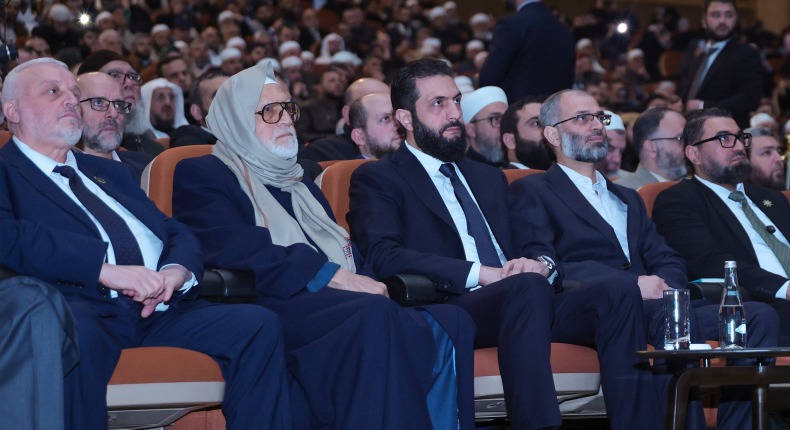
This study seeks to approach the topic of the “Charter for the Unity of Islamic Discourse,” launched by the Syrian Ministry of Religious Endowments on February 16, 2026, from a critical, fundamentalist, and jurisprudential perspective. This approach considers the objectives of Islamic law and incorporates the principles of ijtihad (independent reasoning) in contemporary issues, while citing relevant legal texts and jurisprudential guidelines that govern such major matters. It also acknowledges the points of contention, strengths, and weaknesses within this ambitious project.
The first topic: Unity of discourse between establishing unity and managing diversity:
First, the legal basis for doctrinal diversity:
It is established in the science of Islamic jurisprudence (Usul al-Fiqh) that Islamic law is based on fundamental principles that do not admit of multiplicity or independent reasoning (ijtihad), such as the obligation of monotheism, the sanctity of life, and the obligation of justice. God Almighty says: {O you who have believed, be persistently standing firm in justice, witnesses for Allah} [An-Nisa: 135].
These are universally agreed-upon principles.
As for matters of independent reasoning (ijtihad), the scholars of Islamic jurisprudence have established a great principle: “There is no condemnation in matters of independent reasoning,” meaning there is no condemnation of someone who differs from a valid school of thought based on independent reasoning. Imam al-Nawawi said in al-Majmu’: “A related point: Regarding the differing opinions of scholars on a matter, should one criticize someone who disagrees with their school of thought? The answer: The scholars who have investigated this matter have concluded that there should be no criticism in matters of differing opinions, but rather an explanation should be given stating, ‘Our school of thought is such and such, and its evidence is such and such.’ And if someone interprets something incorrectly, there should be no criticism of them.”
The new Syrian Charter stipulates that “the diversity of interpretations and the multiplicity of schools of thought are a divine principle that should not be a cause for conflict or exclusion.” This statement is consistent with the verse: {And if your Lord had willed, He could have made mankind one community; but they will not cease to differ} [Hud: 118], and also: {And if Allah had willed, He could have made you one community, but [He intended] to test you in what He has given you; so compete in good deeds} [Al-Ma’idah: 48].
Secondly, Combining Salafism and Ash’arism – A Critical Reading:
What is striking about the new charter and the composition of the Supreme Fatwa Council is that it includes scholars from two different schools: the Salafist school and the Ash’ari (Maturidi) school. These are considered the two most influential Syrian schools for the majority of devout Syrian Muslims, and they have a history of rivalry.
While this combination may seem ambitious on the surface, it raises fundamental issues that require careful consideration.
On the positive side: This combination can be grounded in a great jurisprudential principle: “Preventing harm takes precedence over bringing about benefits.” Engaging in theological disputes during this delicate transitional phase—as the country emerges from a devastating war—is a greater harm than any potential benefit from reviving those disputes.
This approach was alluded to by the interim president, Ahmed al-Sharaa, when he said: “We are not in a position to afford to engage in intellectual disputes that date back centuries.”
From a critical perspective, the fundamental question remains: Does uniting these schools of thought at the level of religious leadership necessarily translate into unity at the grassroots level?
Or might it create new conflicts when this institutional reconciliation is implemented in mosques and scholarly gatherings?
Furthermore, the Charter did not clarify its stance on major points of contention (such as seeking intercession, intercession, and visiting graves). Were these issues resolved, postponed, or settled?
This ambiguity could pose a future challenge.
Thirdly, drawing upon historical experiences:
A. The Constitution of Medina as a foundational model:
The Constitution of Medina represents the first model for coexistence and managing diversity in Islamic history. It was written by the Prophet (peace be upon him) at the beginning of the Medinan period and contained the foundations for building a cohesive society despite differences in beliefs and affiliations.
Among its most prominent provisions are:
- “They are one community, distinct from other people.”
- “And the Jews shall contribute to the expenses of the believers as long as they are at war.”
- “And that they will support each other against those who fight the people of this document, and that they will offer each other sincere advice and counsel, and act righteously without sin.”
- “And that this document will not protect any oppressor or sinner.”
The lesson learned from this document is that it combines two things:
1- Unity in the face of common challenges (the external enemy).
2- Recognition of religious and cultural particularities (every people has its own religion and covenant).
B. Al-Azhar’s Experience After 2011:
It is also useful to recall the Egyptian experience with Al-Azhar after the 2011 revolution, where Al-Azhar was called upon nationally as “an institution that unites Egyptians of all affiliations, given its pioneering role in history and the national movement.”
At that time, Al-Azhar produced important documents such as the “Document for the Future of Egypt,” in an attempt to manage political and religious contradictions.
The fundamental difference is that Al-Azhar’s experience came within the context of political competition with currents of political Islam, while the Syrian experience came within the context of building state institutions after the fall of an authoritarian regime.
However, the important lesson from Al-Azhar is that such documents remain… The extent of commitment to its outcomes by the various parties is crucial, and its success requires collective will and sustained practice.
C. The Damascus Declaration of 2005:
The “Damascus Declaration for National Democratic Change,” issued in October 2005, can also be cited as the first comprehensive opposition document within Syria. It brought together secular, Islamist (including the Muslim Brotherhood), Kurdish, and independent figures.
The declaration was distinguished by its emphasis on “the importance of Islam as the religion of the majority, while simultaneously affirming the comprehensive equality of citizenship rights for every Syrian citizen, regardless of their ethnic or sectarian affiliation.”
This model indicates the possibility of consensus among diverse groups on shared principles, even though the circumstances of 2005 (opposition confronting an existing regime) differed from those of 2006 (a former opposition now governing the state).
Section Two: Moral Regulation Between the Discourse of Islamic Law and the Authority of the State – A Comparative Jurisprudential Study:
First, Hisbah and Moral Regulation – Presentation of the Jurisprudential Disagreement:
Among the well-known legal authorities in the jurisprudential tradition is the authority of “Hisbah,” a religious authority commanded by God Almighty in His saying: {Let there be among you a community inviting to good, enjoining what is right, and forbidding what is wrong} [Al Imran: 104]. Scholars have dedicated independent works to this topic.
However, jurists have differed regarding the limits of this authority, particularly concerning the punishment of those who break their fast during Ramadan:
- The Maliki School: It differentiates between one who breaks the fast out of contempt (who is punished with discretionary punishment) and one who breaks the fast due to a valid excuse or interpretation (who is not punished).
- The Hanafi school of thought stipulates that for a person to be considered to have committed a sin, it must be something upon which there is scholarly consensus. Punishing someone who breaks the fast publicly is not a matter of consensus in our time.
- Contemporary Fatwas: Islamweb Fatwas states: “It is not permissible to sell food during the day in Ramadan to a Muslim who is obligated to fast if he will use it during a time when fasting is prohibited. However, if it is known that the buyer has a legitimate excuse, such as being elderly, ill, menstruating, or a child, then there is no harm in it.”
Secondly, Publicly Breaking the Fast: Between Prohibition and Punishment:
Scholars have made an important distinction between breaking the fast secretly and breaking it openly.
The Prophet (peace and blessings be upon him) said: “All of my nation will be forgiven except those who openly commit sins.” (Narrated by Al-Bukhari and Muslim).
Ibn Hajar said: “The one who openly commits a sin is the one who reveals his disobedience and exposes what God has concealed.”
Shaykh al-Islam Ibn Taymiyyah said: “The one who openly commits a sin must be publicly denounced, and there is no longer any backbiting against him.” Ibn al-Qayyim said: “If a sin is committed in secret, it harms only the one who commits it. But if it is committed openly and not condemned, it harms the community.”
However, applying these rulings to the current Syrian reality requires considering several factors:
- The objective of alleviating hardship: Syrian society is suffering from difficult economic conditions, and people are compelled to work during Ramadan. This necessity is an exception to the ruling of absolute closure.
- Gradual implementation: One of the objectives of Islamic law is gradualism in legislation. It is impossible to rush the fruits before they are ripe in a society exhausted by war.
Thirdly, contemporary applications – a critical evaluation:
What has been reported in some articles about closing restaurants during Ramadan and punishing those who break the fast publicly requires careful evaluation:
What is in accordance with Islamic law: Prohibiting public displays of breaking the fast in public places is necessary to preserve the sanctity of the month and the feelings of those who are fasting, especially given the explicit texts condemning such public displays.
Those who violate Islamic law include: expanding penalties to include those with legitimate excuses, dealing with violators with violence or humiliation, or closing restaurants entirely without distinguishing between those who serve those with valid excuses and those who do not.
Important in this context is what President Al-Sharaa pointed out: that “societal moral control” is a priority, while emphasizing that “the pulpit and any platform for addressing the public is itself a trust, the word is a trust in the mouth of the speaker, and the minds of the people are a trust in the hands of the preacher.”
Third Section: Minorities and the Principles of Coexistence – Between Islamic Jurisprudence and Citizenship:
First, the Rulings Concerning People of the Covenant (Dhimmi) in Islamic Jurisprudence:
Islamic jurisprudence has detailed rulings concerning non-Muslims residing in the land of Islam, based on three principles: justice, the covenant (dhimma) (the social contract), and religious freedom in matters of worship and personal status.
God Almighty says: {God does not forbid you from showing kindness and dealing justly with those who have not fought against you because of your religion or driven you out of your homes. Indeed, God loves those who act justly.} [Al-Mumtahanah: 8]
Secondly, an important clarification – the hadith “They have the same rights and obligations as us”:
Some previous writings cited the hadith: “You have the same rights and obligations as us,” attributing it to the Prophet (peace and blessings be upon him).
The correct view is that this statement is a fabricated hadith with no basis, as stated by Sheikh Al-Albani in his series on weak and fabricated hadiths.
The correct statement is what was narrated in the hadith of Anas ibn Malik (may God be pleased with him), in which the Prophet (peace and blessings be upon him) said: “I have been commanded to fight the people until they testify that there is no god but God and that Muhammad is His servant and Messenger… If they do that, their blood and wealth become inviolable to us, except for what is due by right. They have the same rights and obligations as Muslims.” (Narrated by Abu Dawud and authenticated by Al-Albani).
This hadith pertains specifically to Muslims who embrace Islam, and not to the People of the Covenant (dhimmi).
Regarding the People of the Covenant (dhimmi), the correct legal principle is: “They have the same rights as us and the same obligations as us.” This is not a Prophetic tradition, but rather a principle derived from the totality of Islamic legal texts and their objectives. Among these are the articles in the Constitution of Medina that affirm equal citizenship: “The Jews shall contribute to the expenses of the believers as long as they are at war,” and “The Jews have their religion, and the Muslims have their religion.”
Thirdly, the reality of minorities in Syria – between text and application:
- The Syrian Constitutional Declaration issued in March 2015 includes clear articles guaranteeing freedom of belief for followers of the three monotheistic religions and ensuring equal rights for all citizens regardless of religion, ethnicity, or gender.
- This meaning was practically demonstrated by the visit of interim President Ahmed al-Sharaa to the Church of Our Lady of the Girdle in Homs, and other such steps that carry profound symbolic significance regarding the purpose of “harmony” commanded by God, as He says: {And if they incline towards peace, then incline to it also, and rely upon God} [Al-Anfal: 61].
However, challenges remain, especially with the emergence of some individual practices that raise concerns among minorities in certain areas.
What is needed here is to translate official texts into daily practice that protects diversity and makes it a source of strength, not weakness.
Fourth, Towards Restoring Trust – Proposed Criteria:
To rebuild trust, the principle of “actions are judged by their intentions” must be invoked. The new religious institution is required to demonstrate its true intentions through practical action.
The following criteria can be proposed to assess the religious institution’s success in restoring trust:
- Transparency: Publicizing the mechanisms for selecting preachers and scholars, and ensuring genuine representation of different schools of Islamic jurisprudence.
- Relative Independence: Ensuring that the executive branch does not interfere in the content of religious discourse, while coordinating on major national issues.
- Realism: Focusing on people’s real concerns: inflation, poverty, destruction, and justice, instead of generalities and abstract sermons.
- Accountability: Establishing clear mechanisms to hold accountable any preacher who deviates from the charter’s guidelines, especially regarding incitement to hatred or violence.
Summary and Recommendations:
In conclusion, this critical fundamentalist approach suggests that the new religious discourse project in Syria holds promising potential, but its success hinges on adhering to the following principles:
First: Distinguishing between unity in fundamental principles and flexibility in specific applications. Unity of discourse does not mean merging different schools of thought into a single mold, nor does it mean suppressing independent reasoning (ijtihad). Rather, it means managing differences through mutual respect and agreement on overarching objectives.
Second: Gradual implementation of rulings, while maintaining a distinction between periods of weakness and empowerment. One of the objectives of Islamic law is the gradual implementation of legislation, and fruits cannot be reaped before they are ripe.
Third: Observing the principle of “custom is authoritative.” Syrian custom, in its relation to religion and in the relations between Muslims and others, has its place in legal reasoning, as long as it does not contradict a definitive text.
Fourth: Differentiating between Islamic political principles (which vary according to time and place) and the immutable principles of Islamic law (which do not change). Confusing these distinctions leads to the loss of the nation and confusion among the people.
Fifth: The Charter must be applied equally to all, without double standards. It is unacceptable to prevent one party from attacking another on sectarian grounds while allowing another party to engage in the same incitement.
Sixth: Attention must be given to women’s issues, and they must be involved in shaping the new religious discourse.
Women constitute half of society, and a balanced religious discourse cannot be built without considering their concerns and aspirations.
We ask God Almighty to guide those in charge of religious affairs in Syria to what is best for the country and its people, and to make this blessed month a month of unity, harmony, victory, and empowerment. He is the All-Hearing, the Responsive.
Our final prayer is that all praise belongs to God, Lord of the Worlds.
List of Sources and References:
- Al Jazeera Net: “Syria Launches Charter for Islamic Discourse and Sharia: No Place for Centuries-Old Disputes,” February 16, 2026
- The Medina Charter (Al-Madina Newspaper), Full Text
- Wikipedia: “Damascus Declaration for National Democratic Change”
- Syrian Women’s Authority: “Religious Discourse and its Impact on Women’s Awareness in Northwest Syria,” August 29, 2023
- Al-Aluka Network: “Sharia-Based Politics Between the Jurisprudence of Oppression and the Jurisprudence of Empowerment,” February 4, 2012
- Dictionary of Terms in Islamic Jurisprudence, Qutb Mustafa Sanu, Dar Al-Fikr Al-Mu’asir
- Syrian News Channel: “President Al-Shar’a: Charter for Unity of Islamic Discourse Represents an Important Step to Strengthen Unity,” February 16, 2026
- Al-Mujtama’ Magazine: “The Medina Charter… Between Coexistence and Normalization”
- Al Jazeera Net: “The Damascus Declaration and the Future of the Syrian Opposition,” November 28, 2005
- IslamWeb: “Politics and Sharia,” Dr. Salman bin Fahd Al-Ouda