
Introduction:
From alliance to renegotiation – Syrian-Russian relations in the post-Assad era
Since the Russian military intervention in Syria in 2015, Moscow has been the most prominent ally of the regime of Bashar al-Assad, providing him with military and diplomatic cover that enabled him to withstand the opposition. However, the fall of the regime in December 2024 and Assad’s flight to Moscow via the Hmeimim base marked a pivotal turning point in the relationship between Damascus and Moscow.
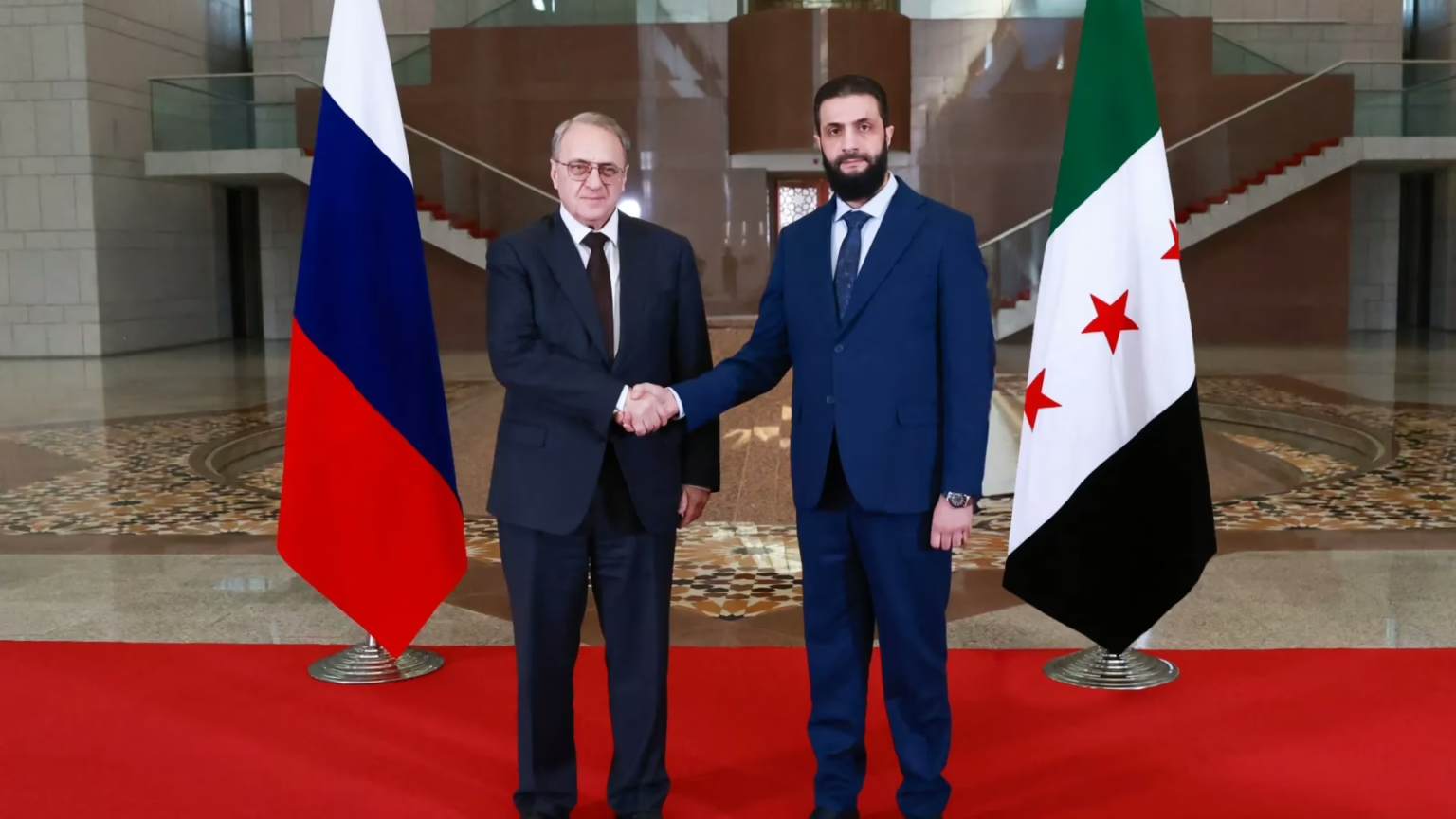
In February 2025, a high-ranking Russian delegation headed by Deputy Foreign Minister Mikhail Bogdanov visited Damascus and met with the new Syrian President Ahmad al-Sharaa, in the first attempt to redraw the contours of the strategic relationship between the two countries, as the talks focused on the future of Russian military bases, Syria’s debts, and the recovery of Syrian funds frozen in Russia.
Later, in March 2025, formal negotiations began to rearrange the relationship, amid a divergence of views on the long-term leases concluded by the previous regime, especially those related to the Tartus and Hmeimim bases. Although the new Syrian leadership did not express a desire to completely end the Russian presence, it emphasized the need to renegotiate according to new sovereignty principles.
In a remarkable development, Moscow announced in June 2025 that it had extended an official invitation to Syrian Foreign Minister Asaad al-Shaibani to visit Russia, a move that reflects the Kremlin’s desire to restore relations with the new Damascus and consolidate its influence in the post-Assad era.
In this article, we will analyze the dimensions of the Syrian-Russian relationship from the perspective of sovereignty and national interest, and anticipate its future in light of the current geopolitical shifts.
Syrian-Russian relations after the fall of Assad, analyzing the equation of sovereignty and strategic necessity:
Since the beginning of the twenty-first century, the relationship between Syria and Russia has been a model of a strategic relationship based on overlapping political, military, and economic interests. However, this alliance, which was decisively confirmed after 2015 with the direct Russian military intervention, became the focus of wide debate after the political change in Damascus and the fall of Bashar al-Assad’s regime. What is the reality of this relationship?
and any prospects for restoring it without compromising sovereignty?
I: The roots and evolution of the relationship:
Syrian-Russian (formerly Soviet) relations date back to the 1950s, when Moscow was a key political and military supporter of the Syrian state, especially during the stages of the conflict with Israel. With the collapse of the Soviet Union, the Russian presence declined, only to gradually return when Putin came to power.
This culminated in Russia’s direct military intervention in September 2015, where it became a crucial partner in maintaining the regime’s survival, in exchange for strategic privileges in the form of permanent bases, economic contracts, and influence over sovereign decision-making.
II: The biopolitical and strategic importance of the relationship:
For Russia:
1- Permanent access to the Mediterranean through the Hmeimim and Tartus bases.
2- A foothold in the heart of the Arab world, enabling it to confront American influence.
3- A permanent arms market and a field trial of Russian weapons.
4- A geopolitical pressure tool on issues such as Ukraine and the gas file.
As for Syria:
1) Critical military support in the face of threats.
2- International diplomatic cover in major forums such as the United Nations.
3- An economic and technical partner in infrastructure and energy projects.
Third: Restoring ties after Assad’s fall, a realistic option or a strategic concession?
With the fall of the previous regime, the new Syrian government is faced with a strategic question: Should it renormalize relations with Moscow? The answer cannot be simple, but must be weighed in the balance of interests and national dignity.
The positives we see are:
1- Utilizing Russian political support in the Security Council to enhance international recognition.
2- Maintaining regional balance by not directly antagonizing Russia.
3) The possibility of renegotiating the terms of military bases to strengthen sovereignty.
The negatives are:
1- Continued manifestations of dependency that were associated with the previous regime.
2- Raising doubts among Western and Arab partners about the independence of the Syrian decision.
3- Undermining the institutional reform project if the effects of previous unbalanced agreements are not addressed.
IV: The danger of the relationship if it is not reframed:
Any unequal relationship with a superpower threatens the independence of national decision-making, and the continuation of Russian bases in their current form may mean limiting defense and political sovereignty, complicating the transitional justice process due to Russian interference in security files, and restricting future partnerships, especially with the European Union and the Gulf states.
Fifth, the strategy of overcoming risk and realizing Syrian interests:
If the Syrian state sees an interest in maintaining a relationship with Russia, this should only be done within a clear sovereign framework, which should preferably include:
- Renegotiating the Russian military presence under time agreements, subject to review, and with parliamentary oversight.
- Transforming the relationship from “protection” to “strategic partnership” by opening new economic files that are mutually beneficial.
- Openness to multiple partners, to ensure that the relationship with Moscow is not the only or dominant one.
- Capitalizing on cultural and historical ties to build a civil and technological partnership, away from the logic of security hegemony.
There is no doubt that the return of Syrian-Russian relations after the fall of Assad is neither an easy option nor an imposed fate, but rather a delicate equation that requires political boldness and historical wisdom, in light of the need for effective partners in reconstruction and stability, sovereignty remains the final word and independent Syrian decision remains the cornerstone of any future international relationship.
Conclusion:
The post-Assad Syria is not a sphere of influence for anyone, but a sovereign space that needs partnerships conditional on mutual respect. In order to create a key to redrawing the map of foreign relations in a way that guarantees national dignity and serves the Syrian strategic interest, we in the political office of Syrian Future Movement recommend a realistic view, based on the principle of mutual interests, without compromising sovereignty or ignoring regional and international complexities, as follows
First: Recommendations for the Syrian leadership:
- Establishing negotiated sovereignty by formulating a new framework for relations with Russia based on national sovereignty through temporary and reviewable agreements, including military bases and economic interests.
- Diversifying international partnerships and moving away from the “one ally” model toward a multipolar foreign policy that includes cooperation with Europe, the United States, and the Gulf states in support of development and transitional justice.
- Integrating public opinion into policy-making by establishing national dialog committees and public consultations that enhance the legitimacy of any rapprochement with Russia or others and transform foreign policy into a popular, not elitist, sovereign affair.
- The value-based requirement for international relations, adopting the principle that every international relationship should serve two goals: National unity and the rebuilding of the state on democratic and just foundations, and any relationship that weakens one of them must be reevaluated.
II: Recommendations for Russia:
- Recognizing the Syrian political transition, Moscow must deal with the new leadership as an independent partner rather than an extension of the former regime, and show negotiating flexibility on the issues of sovereignty and military presence.
- Transforming influence into a development partnership and redirecting the relationship toward investments in energy, education, and infrastructure, away from the military-security approach that has been met with popular rejection inside Syria.
- If Russia wants to maintain a political foothold in the new Syria, it should not obstruct truth and accountability processes, but rather cooperate with them according to the logic of reconciliation rather than denial.
Third: Recommendations for the Western community:
- Separating the tracks, and not linking support for Syria’s stabilization to its positions on Russia or Iran, but rather to the structural preparations of the new Syrian state: Reforms, elections, accountability.
- Supporting the Syrian sovereign position and encouraging the Syrian state to balance its relations without imposing tutelage by supporting negotiation techniques, economic diplomacy, and alternative sovereign options.
- Investing in civil society and reconciliation by strengthening programs that support civil society, transitional justice, and education for tolerance and openness as a platform to limit the influence of any dominant external actor.