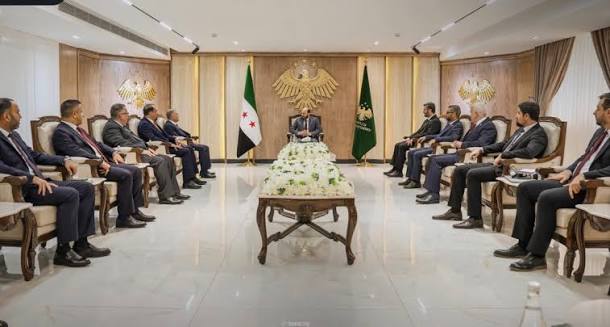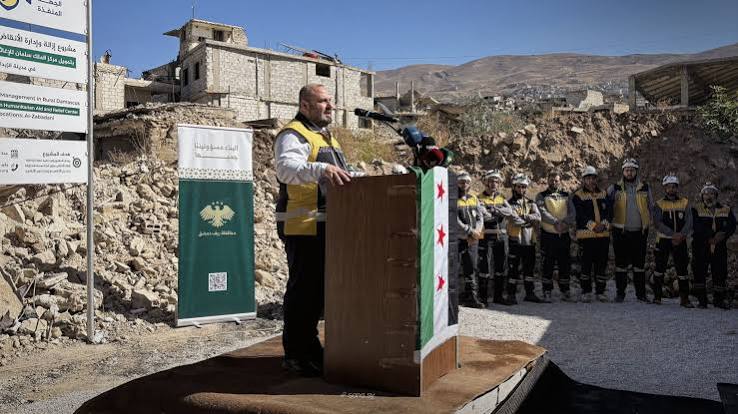
The Syrian Future Movement is closely following the commencement of debris removal operations in the city of Zabadani, in the Damascus countryside. This is part of a comprehensive debris management project in the cities of Douma, Daraya, and Zabadani, funded by the King Salman Humanitarian Aid and Relief Center, with the aim of supporting early recovery and preparing affected areas for rehabilitation.
The Syrian Future Movement commends this step, which embodies the ongoing efforts to remove rubble in the affected cities and underscores the importance of partnerships with brotherly nations in supporting recovery and reconstruction efforts.
The Syrian Future Movement believes that the announcement of the removal of more than 25,000 cubic meters of rubble in Zabadani, following the removal of approximately 85,000 cubic meters in Douma and Daraya, is a positive indicator of the accelerating pace of work. However, it remains only a first step in a long process, given the immense scale of the destruction in the city.
The Syrian Future Movement objectively notes that the project to remove 25,000 cubic meters of rubble in Zabadani, while important, represents only a fraction of the scale of the disaster. Estimates suggest that the amount of rubble in the city exceeds hundreds of thousands of cubic meters. These figures vary depending on the source, but they far surpass the target of the current project. This means the city needs years of continuous work, not just a single, short-term project.
The Syrian Future Movement points out that the larger project, according to the King Salman Center, includes four main activities: removing at least 125,000 cubic meters of rubble, providing heavy and light equipment, establishing specialized recycling units, and producing materials usable in infrastructure projects.
The Syrian Future Movement considers this approach to rubble recycling, exemplified by the inauguration of a specialized unit in Daraya that aims to process approximately 30,000 cubic meters of reusable debris and convert it into building materials, a qualitative leap in dealing with war remnants. It transforms them from an environmental and economic burden into a resource that can be utilized in reconstruction.
In this context, the Syrian Future Movement reiterates its consistent positions, published on its official website, which have consistently called for the urgent removal of rubble and the creation of conditions conducive to the return of residents. This is exemplified in its statement entitled “Rubble Removal in the Latakia and Idlib Countryside” (August 24, 2026), where it emphasized that “rubble removal is an essential and indispensable step to create a safe environment for residents and support the return of displaced persons to their homes.” However, it stressed that “the real challenge lies in sustaining and expanding these efforts to encompass all affected areas.”
Nevertheless, the Syrian Future Movement believes that this project, despite its importance, faces fundamental challenges that cannot be ignored:
Firstly, the limited timeframe compared to the scale of the work. The project targets 25,000 cubic meters according to a published schedule, while hundreds of thousands of cubic meters need to be removed. This necessitates clarification as to whether there will be subsequent projects at the same pace, or whether the efforts will cease upon completion of this project.
Second: The project is fully funded by the King Salman Center, which is much appreciated. However, this raises a legitimate question about the sustainability of the funding. The Syrian Future Movement believes that relying entirely on external funding for a project of this scale poses a risk to the continuity of the work and necessitates that the transitional government allocate its own resources or find sustainable funding mechanisms to ensure that projects do not stop when donor priorities change.
Third: The need to link rubble removal with immediate rehabilitation. Rubble removal is not an end in itself, but rather a means to prepare the ground for rehabilitation and reconstruction. If the project is completed and the rubble is removed, but the site is left empty for months or years, the real benefit will be limited. The Syrian Future Movement calls for linking each stage of rubble removal with an immediate rehabilitation plan that includes infrastructure and basic services.
Fourth: Logistical and field challenges. Field work is subject to weather conditions and the necessary approvals, as the implementing parties have indicated, which may affect the pace of completion. This necessitates flexible mechanisms to adapt to challenges and alternative plans to ensure that work does not stop.
Fifth: The necessity of guaranteeing property rights and transparency, and ensuring the project adheres to “professional and legal standards that guarantee the safety of the work and property rights.” This commitment must be translated into clear mechanisms, including documenting property ownership before demolition, involving residents in the inventory process, guaranteeing the right to appeal and file grievances, and preventing any exploitation of the rubble removal process to infringe upon owners’ rights.
Based on its national responsibility, the Syrian Future Movement recommends the following:
First: Developing a comprehensive and time-bound national plan for the complete removal of rubble in Zabadani, rather than settling for a limited-term project. A multi-year plan should be announced, outlining priorities, ensuring the continuity of funding, and involving the local community in monitoring implementation.
Second: Enhancing reliance on recycling and expanding the scope of treatment units, similar to the Daraya unit which aims to treat 30,000 cubic meters, by establishing similar units in Zabadani and other affected cities. This will transform rubble into building materials used in reconstruction projects, reducing costs, minimizing environmental impact, and creating job opportunities.
Third: Linking debris removal to immediate rehabilitation programs by establishing synchronized schedules, ensuring that each area is handed over directly to infrastructure and service rehabilitation teams immediately after debris removal, thus preventing the cleared areas from becoming hazardous spaces.
Fourth: Ensuring full transparency and property rights by publishing maps of the targeted areas, documenting property ownership before removal, making information available to the public, and guaranteeing effective grievance mechanisms for citizens.
Fifth: Strengthening community partnerships and engaging residents by including local community representatives in project monitoring committees, listening to their feedback, and ensuring that debris removal operations are consistent with [the relevant regulations/programs/etc.]. Their needs.
The Syrian Future Movement reminds everyone that Zabadani, once known for its natural beauty and tourist appeal, deserves more than a limited project; it deserves a comprehensive national plan to restore its life, its people, and its former glory.
The Syrian Future Movement emphasizes that removing the rubble is not the end of the road, but rather the beginning. The subsequent rehabilitation and reconstruction efforts will truly determine whether these efforts will revive the city or leave it as a mere wasteland.
The Syrian Future Movement stresses that true recovery is measured by the number of families returning to their homes, the schools reopening, the shops resuming operations, and life returning to its normal course.