
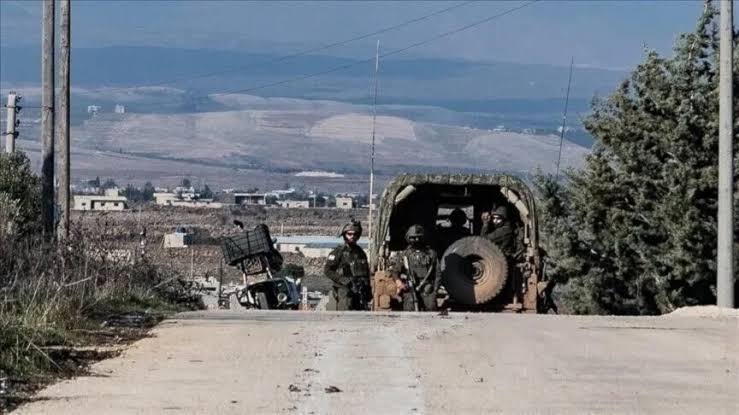
The Syrian Future Movement follows with deep concern and condemnation the findings of a report by the United Nations Office for the Coordination of Humanitarian Affairs (OCHA)—citing the Office of the United Nations High Commissioner for Human Rights—released on November 23, 2026. The report documents approximately 280 incidents of armed incursions by the Israeli occupation into southern Syria during the month of September 2026 alone—the highest monthly figure recorded since the beginning of 2026.
The Syrian Future Movement asserts that these figures, originating from a credible UN institution, serve as international testimony that the events unfolding in southern Syria are not merely “sporadic incursions,” but rather a systematic escalation aimed at imposing a new reality by force. This constitutes an attempt to alter the legal and demographic status of the region, in blatant defiance of the 1974 Disengagement Agreement and relevant international resolutions.
The Syrian Future Movement highlights the specific details provided in the OCHA report, which reveal the scale of the humanitarian and security catastrophe in the south:
First: Targeted Geography—Israeli military activity has concentrated in Quneitra Governorate and the western part of Daraa, extending into areas of the western Damascus countryside, including the town of Beit Jinn. This indicates that the targeting is no longer confined to a specific zone but is expanding horizontally to encompass vast areas of southern Syria.
Second: Nature of the Violations—The documented activities include incursions into villages and agricultural lands, the searching of homes, the establishment of temporary checkpoints, and acts of detention, alongside artillery shelling, gunfire, and the construction and reinforcement of military positions. The Syrian Future Movement considers this range of violations to be indicative of a premeditated intent to establish permanent military control, rather than merely conducting temporary operations.
Third: Impact on Civilians – The report notes that the continuation of these operations and the imposition of movement restrictions have hindered the population’s access to markets, healthcare facilities, and schools, while heightening concerns regarding the safety of civilians in border areas.
The Syrian Future Movement emphasizes that these restrictions go beyond limiting movement; they threaten livelihoods, deprive children of education, and obstruct patients’ access to medical treatment—all of which constitute violations of fundamental human rights.
Fourth: Arbitrary Detentions – The report reveals that, as of October 9, at least 49 Syrians remain in Israeli custody, though the Commission notes that it has been unable to independently verify the total number of detainees. The Syrian Future Movement asserts that this figure—while seemingly limited—reflects only documented cases; the actual number could be significantly higher, necessitating an independent international investigation to uncover the fate of all those detained.
Fifth: Agricultural and Environmental Damage – The report documents extensive damage to agricultural and forested lands in Quneitra. Land-clearing and soil-removal operations have affected approximately 2,000 dunums of forest land in the vicinity of Kodna and Jubata al-Khashab, in addition to approximately 200 dunums of olive groves in Turanja. The Syrian Future Movement asserts that the targeting of agricultural land and fruit-bearing trees is not a military operation, but rather a form of collective punishment intended to starve farmers and compel them to abandon their land—an act that constitutes a war crime under international humanitarian law.
In this context, the Syrian Future Movement reaffirms its consistent position—as documented on its official website—calling for an end to Israeli violations in southern Syria:
In its statement titled “Arab League Condemnation of Israeli Incursions,” dated November 19, 2026, the Syrian Future Movement welcomed the statement issued by the Arab League, which condemned the Israeli incursions into the Quneitra and Daraa governorates “in the strongest possible terms.”
The Syrian Future Movement views this Arab stance, alongside the OCHA report, as a source of mounting international pressure on the occupying power; however, it remains insufficient unless accompanied by binding enforcement mechanisms.
Furthermore, in its statement titled “Quneitra Is Not Alone,” dated October 21, 2026, the Syrian Future Movement expressed its appreciation for a unified national statement issued by Syrian civil society organizations and activists, while noting the “dangerous expansion of activities linked to the ‘Sofa 53’ project.”
The Syrian Future Movement points out that these engineering projects—which include the construction of earthen berms and military sites—are designed to permanently alter the landscape of the region and are part of a broader scheme to establish control over southern Syria.
The Syrian Future Movement emphasizes that the continuation of these violations, in the absence of any genuine international deterrence, reveals the international community’s failure to uphold international law and emboldens the occupying power to persist in its actions.
The Syrian Future Movement asserts that the international community’s silence regarding the events unfolding in Quneitra, Daraa, and the Damascus countryside amounts to complicity in the crime. Every day that passes without serious action is a day in which land is razed, olive trees are uprooted, and the lives of civilians are placed under threat.
Acting upon its national responsibility, the Syrian Future Movement puts forward the following recommendations:
First: Transforming the OCHA report into a binding UN resolution—The Syrian Future Movement calls on the UN Security Council to convene an emergency session to address the OCHA report and to issue a resolution under Chapter VII. This resolution should mandate that Israel cease all incursions and assaults in southern Syria, withdraw immediately from the areas it has entered, and relinquish control over agricultural lands and civilian sites.
Second: Establishing an independent international commission of inquiry—The Syrian Future Movement advocates for the formation of an independent international commission of inquiry, composed of experts in international humanitarian law and human rights. This commission would investigate all Israeli violations in southern Syria, determine individual accountability, and submit its findings to the UN Human Rights Council and the International Criminal Court.
Third: Compensating those affected and supporting farmers—The Syrian Future Movement calls upon the transitional government and international organizations to provide fair compensation to farmers whose lands have been damaged, to bolster the resilience of the local population against attempts at forced displacement, to deliver humanitarian aid to those affected, and to rehabilitate the damaged lands.
Fourth: Strengthening the state’s presence in the The South – The Syrian Future Movement calls for strengthening the presence of state institutions in Quneitra, Daraa, and the Damascus countryside, providing essential services to the population, ensuring the return of displaced persons, and preventing any security or service-related vacuum that the occupation might exploit.
Fifth: Documenting violations at the national level in parallel with international mechanisms – The Syrian Future Movement demands the creation of a documented national database of Israeli violations in the south, in cooperation with human rights organizations. This aims to ensure that evidence is preserved and made available to international forums, consistent with the movement’s previous statements.
The Syrian Future Movement reiterates its condemnation of the Israeli escalation in southern Syria and expresses its full solidarity with the people of Quneitra, Daraa, and the Damascus countryside, who confront the occupation’s machinery on a daily basis.
The Syrian Future Movement points out that the OCHA report serves as international testimony that the occupation continues to violate Syria’s sovereignty and territorial integrity. The international community is now, more than ever, called upon to move beyond mere statements toward the adoption of binding resolutions.
The Syrian Future Movement asserts that national sovereignty is not a subject for bargaining or negotiation. The cessation of these aggressions must be an immediate and unconditional obligation, not merely a clause within a security deal.
For its part, the Syrian Future Movement will continue to support all efforts that bolster the resilience of southern Syria, critique any international shortcomings, and monitor developments on the ground—all in pursuit of a new Syria that regains its full territory and in which every inch of its soil is safeguarded.