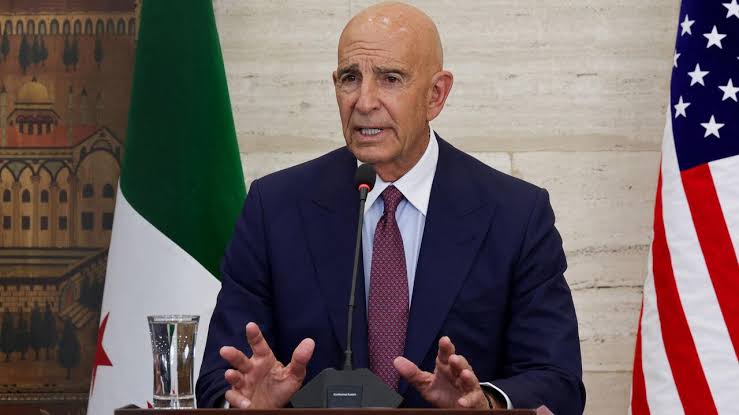
The Syrian Future Movement is following with great interest the information shared by activist Lubna Merhi on Tuesday, November 3, 2026, regarding a meeting that took place on Saturday, October 31, 2026, between the U.S. Special Envoy for Syria, Tom Barrack, and several figures from the Syrian coast. The meeting reportedly addressed issues concerning prisoners and abductees, inflammatory sectarian rhetoric, the rights of retired personnel from the army and the Ministry of Interior, and a proposal to establish an “Office for Civil Peace” with executive authority.
The Syrian Future Movement notes that this information has not been released in any official statement—neither from the U.S. nor the Syrian side—nor has it been corroborated by any other party. It is presented here as circulating information that requires clarification, rather than as established fact.
The Syrian Future Movement believes that this ambiguity, in itself, necessitates an official clarification from the transitional government regarding the nature of the meeting, the parties involved, and its agenda. Any discussion concerning internal sovereign matters and human rights should not be left to the realm of leaks and speculation.
The Syrian Future Movement acknowledges that the U.S. Envoy, by virtue of his mandate, possesses the legitimacy to engage with various stakeholders—including the Syrian government, factions, and local figures—with the aim of bridging perspectives, providing guarantees, and preventing escalation in sensitive areas.
The Syrian Future Movement considers that such a tactical role may be necessary during a fragile transitional phase, characterized by a profound lack of trust among the parties, where each side may require an external guarantor that the other party cannot provide. However, the Syrian Future Movement draws a clear distinction between the legitimacy of maintaining contact and the legitimacy of making decisions; while Barak may possess the former, he lacks the latter regarding matters of national sovereignty.
The Syrian Future Movement notes that the issues raised—prisoners and abductees, sectarian rhetoric, the rights of retirees, and the establishment of an office for civil peace—are fundamentally internal sovereign and human rights matters. These must remain under the purview of the Syrian state rather than being managed from the outside, regardless of how sound the underlying idea or how noble the objective may be.
The Syrian Future Movement holds the transitional government fully responsible for addressing these issues. It urges the government to take the initiative—rather than merely reacting—and to embrace these demands as a national responsibility, rather than as a response to external meetings.
The Syrian Future Movement questions why the government did not, months ago, take the initiative to address the issue of prisoners and abductees, hold those responsible for sectarian rhetoric accountable, and establish an office for civil peace—thereby preventing any external mediator from finding a pretext to discuss matters that fall squarely within the state’s own jurisdiction.
Furthermore, the Syrian Future Movement reaffirms its consistent position—as stated on its official website on August 13, 2025, in a post titled “Publication by the Ministry of Justice of a Summary of the Investigative Committee’s Report on Events in the Syrian Coastal Region”—that “justice is not achieved through statements, but through concrete actions and a clear political will to hold everyone involved accountable, regardless of their status or position.” The Syrian Future Movement also recalls its statement titled “Uncovering a Network Seeking to Incite Rebellion in the Syrian Coastal Region,” issued on December 6, 2025, in which it called for the “formation of a high-level national committee to address the grievances of the coastal population, comprising trusted national figures from all regions and social components.”
The Syrian Future Movement maintains that these demands—which it has advocated for over a year—would have served as a viable national alternative to any external management of this issue.
The Syrian Future Movement warns against any meeting shifting from a mediation effort to the external management of social issues, as this would lead to serious negative consequences:
First: The creation of a parallel authority. If local figures become accustomed to presenting their demands to a foreign envoy rather than to their own state institutions, it weakens the state’s internal legitimacy and fosters a culture of reliance on external actors, rather than building a genuine relationship of citizenship with the state.
Second: The politicization of rights-based issues. Matters concerning prisoners, abductees, retirees, and civil peace are humanitarian and national concerns; they must not be turned into bargaining chips in regional or international conflicts, nor should they be linked to external agendas—regardless of how those agendas might be justified.
Third: The weakening of the government in the eyes of its own people. Acting as a mediator to resolve state-related issues—rather than supporting the state in fulfilling its own duties—creates the impression that the government is either incapable or unwilling to act, thereby undermining public trust. The Syrian Future Movement asserts that the correct national stance is neither to reject a meeting simply because it involves an American party, nor to accept it merely because the party acts as a mediator. Rather, the position should be clear: we welcome any international effort that contributes to providing guarantees and preventing escalation, yet we reject any such effort becoming a substitute for the state in managing the affairs of its own citizens.
Acting upon its national responsibility, the Syrian Future Movement recommends the following:
First: The transitional government must issue an urgent, official clarification regarding the nature of the meeting, the parties involved, and its agenda. It must also declare its principled position on any external meetings that address matters of national sovereignty; remaining silent on such reports only encourages their recurrence and erodes public trust.
Second: The government must immediately take ownership of the issues raised—treating them as matters of sovereign responsibility—by: establishing a comprehensive file on prisoners and abductees; holding accountable anyone found to be spreading sectarian rhetoric, regardless of their affiliation; resolving the entitlements of retirees; and creating an “Office for Civil Peace” via an official decree with clear executive authority. This would ensure that these critical issues do not remain contingent upon external mediation.
Third: The American envoy must remain within the scope of a mediator’s role. He should not overstep by moving from facilitating dialogue among political, military, and international actors to managing local social affairs. Instead, he should direct his efforts toward pressuring the Syrian government to implement necessary reforms; it is pressure exerted upon the state—not sympathetic meetings—that brings about sustainable change. Fourth: Washington must translate its words into actions. If it is serious about supporting stability in Syria, it should exert genuine pressure on the Syrian government to implement these reforms—rather than merely holding meetings with local figures, which could be interpreted as reinforcing external tutelage or establishing relationships with entities intended to serve as alternatives to state institutions.
Local figures who participated in the meeting must remain focused on advocating for rights from within the country, rather than becoming a front for external administration. The strength of national demands lies in their domestic legitimacy and their connection to state institutions—not in their ties to a foreign envoy, however well-intentioned that envoy may be.
The Syrian Future Movement values any effort that contributes to addressing human rights issues in the Syrian coastal region, and it views international mediation as an opportunity to secure guarantees and prevent escalation. Nevertheless, it emphasizes that a mediator remains a mediator, and a state remains a state.
The Syrian Future Movement asserts that building a new Syria cannot be achieved through the existence of parallel authorities managing citizens’ affairs from abroad. Instead, it requires a strong and just state—one capable of protecting its citizens, securing justice for victims, and holding those responsible to account, without the need for any form of external tutelage.
The Syrian Future Movement affirms that national sovereignty is a daily practice, manifested in the state’s capacity to manage its own affairs and in its rejection of any external party acting as a substitute in matters concerning its citizens.
For its part, the Syrian Future Movement will continue to support all initiatives that strengthen Syria’s sovereignty and civil peace. It will remain critical of any actions that weaken the state and will closely monitor developments on the ground—all in pursuit of a new Syria where the affairs of its citizens are managed through its own national institutions, rather than through external mediation.Fifth: